
The BCBA exam is one of the most rigorous credentialing exams in the behavioral health field. The first-attempt pass rate has hovered between 50 and 65 percent for years. That number does not reflect a lack of intelligence among candidates. It reflects a lack of strategy.
Most people who fail the BCBA exam are experienced clinicians. They have spent years working with clients, supervising RBTs, and applying behavioral principles in real settings. What they often lack is a structured, exam-specific preparation plan that reflects how the BACB actually writes and scores the test.
This guide fixes that. It is written for candidates who are serious about passing on their first attempt, and for those making a second or third try who want to understand what went wrong the first time. You will find the exam format, a 12-week domain-by-domain study plan, the most effective study tools, five free sample practice questions, and an honest comparison of the study methods that work versus the ones that feel productive but are not.
Everything here is aligned to the BACB 6th Edition Task List, which governs all BCBA examinations from 2022 onward.
Start preparing with the right tools today:
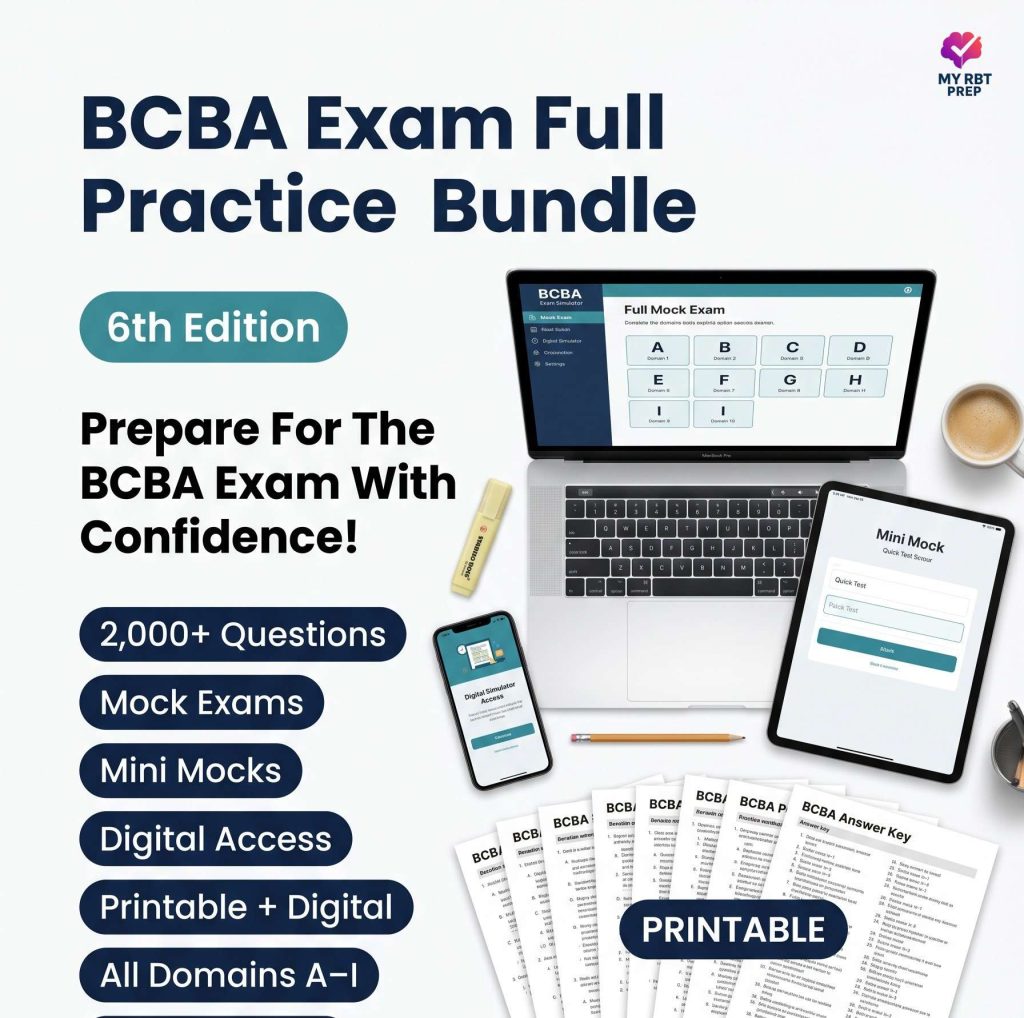
- BCBA Practice Exam — Full-length 185-question mock exams, 6th Edition aligned, with detailed rationales
- BCBA Flashcard Deck — 556 cards covering definitions, scenarios, and ethics across all domains
- ABA Exam Toolkit — The complete prep bundle for candidates who want everything in one place
What Is the BCBA Exam?
The BCBA, or Board Certified Behavior Analyst, is the advanced practitioner credential issued by the Behavior Analyst Certification Board. It is the standard credential for professionals who design, oversee, and take clinical responsibility for applied behavior analysis programs. Earning it requires completing a graduate-level coursework sequence, accumulating supervised fieldwork hours, and passing a standardized national examination.
Board-certified behavior analysts work in a wide range of settings. Autism treatment clinics and home ABA therapy programs represent the largest employment sector, but BCBAs also work in schools, residential treatment facilities, hospitals, correctional settings, and corporate organizational behavior management contexts. The credential is recognized by insurance payers in all 50 US states and is increasingly recognized internationally.
The BCBA exam is administered by Pearson VUE, the same testing provider used by dozens of healthcare credentialing bodies. You sit for the exam at a Pearson VUE testing center, under proctored conditions, on a computer. The exam is criterion-referenced, meaning your score is compared against a fixed standard rather than against other candidates. You pass or fail based on your own performance.
The exam is not a test of how long you have been in the field. It is a test of your ability to reason through clinical and ethical scenarios using the principles of applied behavior analysis at a professional practice level. That distinction matters enormously for how you prepare.
[hurrytimer id=”2295″]

BCBA Exam Format and Structure (2026)
Before you study a single task list item, you need to understand exactly what you are walking into. Candidates who know the format in detail make better use of their preparation time and feel more confident on exam day.
| Exam Component | Details |
|---|---|
| Total Questions | 185 scored multiple-choice questions |
| Answer Format | Four options (A, B, C, D) — one correct answer per question |
| Time Limit | 4 hours (approximately 1 minute 18 seconds per question) |
| Content Framework | BACB BCBA Task List, 6th Edition (effective 2022) |
| Passing Score | Scaled score of 400 out of 500 (criterion-referenced standard) |
| Testing Provider | Pearson VUE testing centers (nationwide) |
| Retake Limit | Up to 8 attempts per exam cycle (waiting periods apply after failures) |
| Score Report | Immediate pass/fail result; detailed domain scores mailed within a few weeks |
BCBA Task List Domains and Question Distribution
The exam draws questions from across the 6th Edition Task List, which is organized into content domains. The BACB does not publish exact question counts per domain, but candidate reporting and educator experience point to an approximate distribution. Your study time should roughly follow these weights.
| Domain | Content Area | Approx. Weight | Est. Questions |
|---|---|---|---|
| A | Foundations | ~10% | ~18-19 |
| B | Concepts and Principles | ~12% | ~22 |
| C | Measurement | ~14% | ~26 |
| D | Experimental Design | ~10% | ~18-19 |
| E | Ethics | ~10% | ~18-19 |
| F | Behavior Assessment | ~15% | ~28 |
| G | Behavior-Change Procedures | ~14% | ~26 |
| H | Personnel Supervision and Management | ~8% | ~15 |
| I / J | Implementation, Systems Support, and Dissemination | ~7% | ~13 |
Notice that measurement, behavior assessment, and behavior-change procedures together account for roughly 43 percent of the exam. Most candidates underinvest in these three areas. The data says otherwise. If you are short on time, prioritize C, F, and G.
Why Most Candidates Fail the BCBA Exam
This section is worth reading carefully before you look at any study plan. Understanding the specific failure patterns of BCBA candidates is, in many ways, more valuable than any content review. Most failures are not about knowledge gaps. They are about preparation strategy gaps.
Failure Reason 1: Studying Content, Not Questions
Reading Cooper, Heron, and Heward is not exam preparation. Watching lecture videos is not exam preparation. Both activities are useful for building a foundational understanding of ABA, but neither one trains the cognitive skill the exam actually measures, which is applied clinical reasoning under time pressure.
The BCBA exam does not present clean, textbook-style prompts. It presents clinical vignettes: a client with a specific behavior pattern, a supervisor making a specific decision, an ethical conflict with a specific set of stakeholders. Your job is to identify the most appropriate clinical response. That skill is only developed by practicing on actual exam-format questions, not by highlighting paragraphs in a textbook.
Failure Reason 2: No Full-Length Practice Under Timed Conditions
Four hours of sustained focus is physically and cognitively demanding. Candidates who sit down to their first ever 185-question session on exam day often hit a wall around question 100. Their reading comprehension degrades. They rush the final 40 questions. They second-guess answers they knew at the start of the exam.
This is a stamina problem, not a knowledge problem, and it is completely preventable. Taking at least two full-length BCBA mock exams under realistic timed conditions before exam day is not optional. It is one of the highest-value preparation activities available to you.
Failure Reason 3: Underestimating Ethics
The BACB’s Ethics Code is a technical document with a specific hierarchy of obligations, specific definitions of terms, and specific guidance for dozens of clinical and professional scenarios. Many candidates treat ethics as a common-sense domain and assume they can reason through ethics questions without dedicated study.
They cannot. Ethics questions are among the most frequently missed items on the BCBA exam. The reason is that many ethics scenarios have one option that feels right intuitively and one option that is correct according to the Ethics Code. Those are often different answers. The Code has rules about the order in which obligations are prioritized. It has specific language about multiple relationships, informed consent, supervisory responsibility, and conflicts between client and third-party interests. Study ethics like a content domain, not like a gut-check.
Failure Reason 4: Passive Study Methods
Re-reading notes, listening to podcasts, and watching review videos are passive activities. Your brain receives information, but it does not practice retrieving it. Retrieval practice, the act of forcing yourself to recall information before checking the answer, is what builds the kind of memory that holds under exam pressure.
Active recall consistently outperforms passive review in retention research. Flashcards, practice questions, and self-quizzing are all active recall methods. If your current study routine involves more reading than retrieving, you are preparing less efficiently than you could be.
Failure Reason 5: No Structured Plan
Studying “when I have time” across a large body of content leads to two predictable problems. First, you spend too long on topics you find interesting or easy and not enough time on topics that are actually weighted heavily on the exam. Second, you run out of time before exam day and rush through the domains you dreaded most. A structured, calendar-driven study plan eliminates both problems.
Failure Reason 6: Ignoring Supervision and Systems Content
Domains H, I, and J cover personnel supervision, systems support, and dissemination. Many candidates who spent years as direct clinicians before pursuing their BCBA feel confident in clinical content and underinvest in supervision and systems. These domains represent roughly 15 percent of the exam. That is 27 to 28 questions. Losing most of those questions can be the difference between a passing and failing score.
Step-by-Step BCBA Study Plan (12 Weeks)
This study plan is designed for candidates with approximately 10 to 15 hours of available study time per week. If you can study more, compress the timeline. If you have less time, extend it. The key principle is: do not compress or skip Phase 5. The final two weeks of full-length mock exams and targeted review are where preparation becomes exam readiness.
| Phase | Weeks | Domains | Daily Activities |
|---|---|---|---|
| Phase 1 | Weeks 1-2 | A: Foundations B: Concepts and Principles |
30 flashcards, 20 practice Qs, Task List review |
| Phase 2 | Weeks 3-4 | C: Measurement D: Experimental Design |
30 flashcards, 25 practice Qs, data graphing review |
| Phase 3 | Weeks 5-6 | E: Ethics Ethics Code deep dive |
Ethics scenario cards, 20 ethics practice Qs daily |
| Phase 4 | Weeks 7-8 | F: Behavior Assessment G: Behavior-Change Procedures |
35 flashcards, 30 practice Qs, FBA/BIP review |
| Phase 5 | Weeks 9-10 | H: Personnel Supervision I/J: Systems and Dissemination |
30 flashcards, 25 practice Qs, supervision case review |
| Phase 6 | Weeks 11-12 | Full exam simulation + weak-area review | 1 full mock exam per week, daily targeted review of low-scoring domains |
During Phases 1 through 5, do not wait until you feel ready to start practicing questions. Begin practice questions from day one. The goal is not to get them right on day one. The goal is to understand the format and get your brain used to clinical reasoning early. Most people who delay question practice until they have “finished studying” never feel ready, and they shortchange their practice phase.
Daily Study Session Structure (45 to 60 Minutes)
A structured daily session will outperform a longer but unfocused one every time. Here is a repeatable format that works:
- First 10 minutes: Review flashcards from the previous day (spaced repetition review)
- Next 20 minutes: Study new content for the current domain (task list item by task list item)
- Next 15 minutes: Complete 10 to 15 practice questions on today’s content
- Final 10 minutes: Review every answer you got wrong and write one sentence explaining why the correct answer is correct
That final step, writing a sentence about each wrong answer, is one of the highest-impact habits in exam preparation. It forces active processing and cements the correction in memory.
Most candidates study without a consistent daily review system.
Our BCBA Flashcard Deck is built around the spaced repetition model, with 556 cards organized by Task List domain. Definition cards build your vocabulary. Scenario cards train your clinical reasoning. Ethics cards cover the Code with precision.
Best BCBA Study Materials (2026 Honest Review)
There is no shortage of BCBA study products. Some are excellent. Some are outdated, still referencing the 5th Edition Task List that was retired in 2022. Some are well-packaged but thin on content. Here is an honest breakdown of what works, what is overrated, and what serious candidates actually use.
1. The BACB 6th Edition Task List (Free, Non-Negotiable)
Download this directly from BACB.com. It is free. It is the official content outline. Every single question on the BCBA exam maps to a specific task list item. Print it, post it on your wall, and work through it systematically. If it is not on the Task List, you do not need to study it for this exam. Everything on the Task List is testable and fair game.
Use the Task List as a study checklist. When you feel confident on a task list item, check it off. When your mock exam scores reveal weakness in a domain, return to that section of the Task List and drill it until you are confident.
2. BCBA Flashcards (High Impact, Daily Use)
Flashcards are one of the most research-supported study tools available. The mechanism is called spaced repetition: reviewing information at increasing intervals as your confidence grows. This approach produces far stronger long-term retention than re-reading or passive review.
For BCBA prep specifically, flashcards serve two distinct purposes. Definition cards build the precise behavioral vocabulary the exam requires. When a question asks you to distinguish between differential reinforcement of other behavior and differential reinforcement of alternative behavior, you need to retrieve those definitions instantly without burning 90 seconds of your time limit on one question.
Scenario cards train applied reasoning. They present a clinical situation and ask you to identify the correct behavioral principle, procedure, or ethical obligation. This is far closer to actual exam-question format than definition-only review, and it bridges the gap between knowing a term and using it correctly in context.
Our BCBA Exam Flashcard Deck includes 484 definition cards and 72 scenario-based cards. Every card is aligned to a specific Task List item. Ethics cards are included as a dedicated set. All content is updated for the 6th Edition.
3. Full-Length BCBA Mock Exams (The Most Underused Tool)
Ask any BCBA who passed on their first attempt what made the biggest difference and full-length practice exams come up again and again. They do three things no other study tool does.
First, they train stamina. Four hours of continuous concentration is hard. Candidates who have never done it before experience a significant performance decline in the final hour. Two full-length practice sessions under timed conditions condition your brain to sustain focus for the duration of the real exam.
Second, they expose you to the format. The way BCBA exam questions are written is specific. Vignettes have a particular structure. Distractors are designed to be plausible. Knowing the format going in removes a source of test-day anxiety and lets you focus entirely on content rather than figuring out what the question is asking.
Third, domain-level score breakdowns tell you exactly where to focus your remaining study time. If your mock exam shows 78 percent on Concepts and Principles but 52 percent on Experimental Design, your schedule for the following week is obvious. Without that data, you are guessing about where your time is best spent.
Our BCBA Practice Exam suite includes multiple 185-question full-length exams at graduated difficulty levels. Each question comes with a detailed rationale explaining why the correct answer is correct and why each distractor is incorrect. That explanation, not just the answer key, is where the learning happens.
4. Cooper, Heron, and Heward: Applied Behavior Analysis, 3rd Edition (Reference, Not Primary Study Tool)
The Cooper textbook is the academic gold standard for ABA content. It is also 900 pages long. Using it as a primary study tool means spending months reading before you ever practice a single exam question, and that is not an effective preparation strategy.
Use the Cooper textbook as a reference. When a flashcard or practice question rationale references a concept you do not understand deeply enough, look it up in Cooper. Read that section. Then return to practice questions. That is the appropriate role for a reference text in an exam preparation context.
5. ABA Exam Toolkit (Complete Prep Bundle)
For candidates who want a single structured resource that combines all preparation components, our ABA Exam Toolkit brings together study materials, practice exams, and flashcard systems in one place. It is designed for candidates who want a complete prep system rather than assembling resources piece by piece, and for those whose study time is limited and who need maximum efficiency from every hour they invest.
BCBA Study Resource Comparison Table
| Resource | Active Recall | Simulates Exam | Identifies Weak Areas | Best Phase |
|---|---|---|---|---|
| BCBA Flashcard Deck | Yes | Partial | Yes (by domain) | Weeks 1-12 (daily) |
| BCBA Mock Exams | Yes | Full simulation | Yes (score report) | Weeks 5-12 |
| ABA Exam Toolkit | Yes | Full simulation | Yes (complete) | Weeks 1-12 |
| Cooper Textbook | No | No | No | Reference only |
| Video Lectures | No | No | No | Intro only (Wk 1-2) |
5 Free BCBA Practice Questions (2026 Format)
The following five questions follow the actual format, difficulty, and clinical reasoning demands of the BCBA exam. Each is aligned to a specific Task List domain. Read each one carefully, choose your answer, and then click to reveal the rationale. Pay attention to the reasoning behind wrong answers, not just the correct ones.
Question 1 | Domain B: Concepts and Principles
A parent has been ignoring her child’s tantrums in response to homework requests. She reports that tantrums initially increased in frequency and intensity after she started the program, but have declined significantly over the past two weeks. What is the most accurate behavioral explanation for the initial increase?
A) Spontaneous recovery
B) Behavioral contrast
C) Extinction burst
D) Resurgence
Correct Answer: C
An extinction burst is the temporary increase in frequency, duration, or intensity of a behavior when extinction is first implemented. It does not indicate the procedure is failing. It indicates that the behavior was previously maintained by reinforcement. Spontaneous recovery refers to the reappearance of an extinguished behavior after a rest period, not an initial increase. Resurgence refers to a previously reinforced behavior returning when a more recently reinforced behavior is extinguished.
Question 2 | Domain C: Measurement
A BCBA wants to assess how long a student remains on task during independent reading periods. The behavior does not have a clear discrete onset and offset. Which measurement system is most appropriate?
A) Frequency recording
B) Partial interval recording
C) Duration recording
D) Momentary time sampling
Correct Answer: C
Duration recording captures the total amount of time a behavior occurs, which is exactly what the BCBA wants to know. Frequency recording counts occurrences but does not reflect how long each instance lasted. Partial interval recording overestimates behavior occurrence. Momentary time sampling provides a periodic snapshot but does not give a precise measure of total duration.
Question 3 | Domain E: Ethics
A BCBA is supervising an RBT who is implementing a behavior intervention plan. During a supervision session, the BCBA observes the RBT implementing a procedure incorrectly in a way that is reinforcing the target behavior. What is the BCBA’s most appropriate immediate response?
A) Document the observation and address it at the next scheduled supervision session
B) Provide immediate corrective feedback to the RBT during or directly after the session
C) Recommend the RBT for additional training through the BACB
D) Notify the client’s family immediately
Correct Answer: B
The BCBA has supervisory responsibility for the integrity of service delivery. Waiting until the next supervision session allows the incorrect implementation to continue, directly harming the client by reinforcing the target behavior. Immediate corrective feedback is the ethical and clinically appropriate response. Notifying the family without first addressing the issue directly would be premature and bypass the supervisory chain.
Question 4 | Domain D: Experimental Design
A BCBA designs a multiple baseline across behaviors design. She collects baseline data on three behaviors simultaneously but introduces the intervention to each behavior at a different point in time. What is the primary function of the staggered introduction?
A) To counterbalance order effects across behaviors
B) To demonstrate experimental control through replicated covariation
C) To reduce the number of data points needed for each behavior
D) To allow for concurrent treatment comparisons
Correct Answer: B
The staggered introduction is the design feature that provides experimental control in a multiple baseline. When a behavior only changes when the intervention is introduced, and the other behaviors remain stable during that time, it demonstrates that the intervention, not an extraneous variable, caused the change. Replicating this pattern across behaviors strengthens the causal claim. Counterbalancing order effects is associated with alternating treatment designs, not multiple baselines.
Question 5 | Domain F: Behavior Assessment
During an indirect functional behavior assessment, a teacher reports that a student’s disruptive behavior occurs most often during small group reading instruction and rarely during free play or one-on-one math tutoring. Which hypothesized function is most consistent with this pattern?
A) Access to tangibles
B) Attention from peers
C) Escape from academic demands
D) Automatic reinforcement
Correct Answer: C
The pattern shows behavior occurring in a specific instructional context (small group reading) and not during less demanding or preferred activities (free play, one-on-one tutoring). This is a classic pattern suggesting escape from academic demands, specifically demands associated with group reading instruction. Access to tangibles would present alongside preferred item availability. Automatic reinforcement would be expected across settings regardless of instructional demands.
Want 180 more questions just like these?
Our full-length BCBA mock exams include 185 questions per exam at three graduated difficulty tiers. Every question has a detailed rationale. Domain-level score reports show you exactly where to focus next.
BCBA Flashcards vs Practice Exams: What Actually Works?
Candidates often ask whether they should prioritize flashcards or practice exams. This is the wrong question. These tools do different jobs, and you need both. The real question is when to use each one and how to integrate them into a coherent study system.
What Flashcards Do
Flashcards build your knowledge base through active recall. Every time you see a card, attempt to retrieve the answer, and then check whether you were correct, you are strengthening the neural pathways associated with that information. Research on spaced repetition consistently shows that this kind of active retrieval practice produces far stronger long-term retention than passive review methods like re-reading or highlighting.
For BCBA preparation, definition flashcards are essential in the early phases of study. You cannot reason through a clinical scenario about differential reinforcement if you do not have solid command of the terminology. Scenario cards then bridge the gap between definition knowledge and applied reasoning, presenting the kind of vignette-based prompts that mirror real exam questions.
Use flashcards daily throughout your entire preparation period. In the early weeks, lean on definition cards. As you move into later phases, shift toward scenario cards. In the final two weeks, use them as a quick daily warm-up before moving into full-length practice exams.
What Practice Exams Do
Practice exams test integration. They take everything in your knowledge base and force you to apply it simultaneously under time pressure, in the same format as the real exam. A full-length BCBA practice exam is the closest thing to a dry run of exam day that you can get, and there is no substitute for it.
Beyond content practice, full-length exams do something uniquely valuable: they generate data. When you complete a timed 185-question session, you discover how your performance degrades over time, which domains you consistently struggle with, and which question formats trip you up. That data is worth more than almost any amount of additional content review, because it tells you exactly where to invest your remaining preparation time.
The Right Sequencing
| Study Phase | Primary Tool | Supporting Tool |
|---|---|---|
| Weeks 1-4 (Content Building) | Flashcards (definition focus) | Daily 10-15 practice questions |
| Weeks 5-8 (Application Building) | Flashcards (scenario focus) + practice questions | Domain-specific question sets |
| Weeks 9-12 (Exam Simulation) | Full-length mock exams (timed) | Daily flashcard review (weak domains) |
BCBA Exam Eligibility: Quick Reference
Before sitting for the BCBA exam, you must meet the BACB’s eligibility requirements. These are verified before your application is approved. Here is a quick summary of the current requirements for the standard pathway.
| Requirement | Standard |
|---|---|
| Degree | Master’s degree or higher from an accredited university |
| Coursework | Completion of a BACB-approved graduate coursework sequence (5th or 6th Edition) |
| Supervised Fieldwork | 2,000 hours of supervised fieldwork (Concentrated or Unrestricted pathway) |
| Application | Submit through BACB Gateway; approval required before scheduling with Pearson VUE |
Check the BACB website for the most current eligibility standards. Requirements are updated periodically and the information here reflects the 2026 standard to the best of current knowledge. Always verify directly with the BACB before submitting your application.
Final Tips to Pass the BCBA Exam on Your First Attempt
You have the format, the study plan, the tools, and the free practice questions. Before you close this page, here are the most important tactical tips from candidates who passed and the preparation patterns that defined their success.
Study From the Task List, Not the Textbook
The BCBA exam tests Task List content. The Task List is your syllabus. Organize every hour of study time around Task List items, not textbook chapter order. If a concept is not on the Task List, do not spend time on it. If a concept is on the Task List, know it cold before exam day.
Spend More Time on Wrong Answers Than Right Ones
When you review a practice exam, spend at least twice as long on every question you got wrong as on every question you got right. Wrong answers reveal gaps in your knowledge or reasoning. Right answers confirm what you already know. The information you are missing is more valuable than the information you already have.
Treat Ethics as a Testable Domain, Not a Common-Sense Check
Many candidates go into ethics questions confident, get the results back, and find ethics was their weakest domain. The Ethics Code has a specific hierarchy of obligations and specific language for specific situations. Read it as a technical document. Know the sections. Know what the Code says, not just what you think the right thing to do is.
Take Two Full-Length Timed Mock Exams Before Exam Day
One full exam tells you where you are. Two tell you whether you are improving and where the remaining gaps are. By the time you sit down for the real exam, 185 questions in four hours should feel familiar. You should feel like you have done this before, because you have.
Build Consistent Daily Study, Not Weekend Marathons
Thirty to forty-five minutes of focused daily study consistently outperforms three-hour weekend sessions for memory consolidation. The brain needs sleep to consolidate what it has learned. Daily study gives the brain repeated encoding opportunities across multiple sleep cycles. Cramming gives it one.
Do Not Change Your Answers Unless You Have a Specific Reason
Research on test-taking consistently shows that first instincts tend to be more accurate than second-guessed answers. Change an answer only if you have a specific, identifiable reason to believe the new answer is correct, not because you feel uncertain. Feeling uncertain is normal. Acting on vague discomfort changes correct answers to wrong ones far more often than it fixes mistakes.
Your BCBA Exam Preparation Starts Right Now
The path from where you are to BCBA credentialed is clear. You know what the exam covers. You know how it is structured. You know why candidates fail and how to avoid every single one of those failure patterns. You have a 12-week study plan ready to follow. You have free practice questions to gauge your starting point.
What you do with that information in the next 24 hours determines a lot. Candidates who begin structured preparation immediately after deciding to sit for the exam consistently outperform those who wait until they feel more ready. Readiness is built through preparation, not found through waiting.
Start with flashcards to build your foundation. Add practice questions from day one. Move into full-length mock exams in weeks 5 through 6. Take two complete timed exams in your final two weeks. Review your wrong answers. Go in prepared.
BCBA Practice Exams
185 questions per exam. Three difficulty tiers. Detailed rationales. BACB 6th Edition aligned. Domain-level score reports.
BCBA Flashcard Deck
556 cards. Definition cards. Scenario cards. Ethics cards. All Task List domains covered. Built for spaced repetition.
ABA Exam Toolkit
Complete prep bundle. Everything a serious BCBA candidate needs in one organized, efficient package.
Frequently Asked Questions About the BCBA Exam
How hard is the BCBA exam?
The BCBA exam is genuinely challenging. The first-attempt pass rate has historically ranged between 50 and 65 percent depending on the year and exam cycle. Questions are scenario-based and demand applied clinical reasoning, not just recall of definitions. Candidates who use structured study plans and full-length practice exams under timed conditions consistently achieve higher pass rates than those who rely on reading alone.
How many questions are on the BCBA exam?
The BCBA exam contains 185 scored multiple-choice questions. You have four hours to complete the exam. Each question presents four answer choices with one correct answer.
What Task List does the 2026 BCBA exam follow?
The 2026 BCBA exam follows the BACB’s 6th Edition Task List, which became effective in January 2022. If you are using study materials that reference the 5th Edition Task List, you are using outdated resources. Make sure every resource you use explicitly states 6th Edition alignment.
How long should I study for the BCBA exam?
Most candidates need 10 to 16 weeks of structured preparation, investing 10 to 15 hours per week. Candidates who completed their graduate coursework recently may need slightly less time. Candidates who have been working clinically for years and have not engaged with the academic literature recently often need more. A 12-week plan with consistent daily study is a reliable starting point for most candidates.
Is there a free BCBA practice exam available?
Free individual BCBA practice questions are available from various sources, including the five samples on this page. Full-length BCBA mock exams that accurately simulate the 185-question format, include domain-level scoring, and provide detailed rationales for each answer are part of paid preparation products. The free questions on this page give you a precise sense of the format, difficulty, and clinical reasoning demands of the actual exam.
What is the difference between the BCBA and the RBT?
The RBT (Registered Behavior Technician) is an entry-level credential for practitioners who implement behavior intervention plans under the supervision of a BCBA. The BCBA is an advanced credential for professionals who design, supervise, and take clinical responsibility for ABA programs. BCBAs complete graduate-level coursework and extensive supervised fieldwork before sitting for the BCBA exam. RBTs complete a 40-hour training program and work under direct BCBA supervision.
What happens if I fail the BCBA exam?
You are permitted up to 8 attempts per exam cycle. After a failed attempt, you must wait before you can reschedule. The BACB provides a score report that includes domain-level performance data, which tells you exactly which content areas to prioritize before your next attempt. Use that report to build a targeted re-study plan rather than reviewing all content equally.
Should I use flashcards or practice exams to study for the BCBA?
Both tools serve different and complementary purposes. Flashcards build your knowledge base through active recall and spaced repetition. Practice exams test your ability to apply that knowledge in the format and under the time constraints of the actual exam. The most effective candidates use flashcards consistently throughout their preparation and add full-length practice exams starting around weeks 5 to 6. Neither tool alone is sufficient. Both together are highly effective.