
Preparing for the RBT exam and want to check how well you understand skill-building procedures? This Behavior Acquisition Quiz includes 19 realistic, exam-style questions based on the BACB RBT Task List 3.0 (2026).
Skill acquisition is at the heart of ABA therapy. As an RBT, you’re expected to follow your supervisor’s teaching procedures correctly, use prompts consistently, fade them at the right pace, and reinforce the learner’s progress with accuracy. This quiz lets you practice those skills and identify areas to review before exam day.
Quiz Complete!
Short free quizzes only scratch the surface. Passing the actual 85-question Pearson test requires building your pacing and stamina with full practice.
- Only 6 sample questions
- No timed exam simulator
- No detailed rationales
- Cannot test full pacing
- Multiple Full Mocks (85Q)
- 1,000+ realistic scenario questions
- Step-by-step rationales
- Full app access + printable PDFs
You've completed 5 questions. You have 1 final sample question before the free preview ends.
- 🎯Multiple Full-Length Timed Mocks — exactly like the real Pearson VUE exam
- 📋1,000+ Practice Questions — covering all 2026 BACB Task List 3.0 tasks
- 🧠Detailed Rationales — learn why right answers work and avoid traps
- 📱Exam Simulator App Access — practice anytime on your phone or laptop
You've completed your 6 free sample questions. The real test is 85 questions long with tricky scenarios. Get full practice now so nothing surprises you on test day.
- Multiple Full-Length Timed Mocks — practice with real 85-question exams timed like Pearson VUE
- 1,000+ Scenario Questions — master real clinical situations across all 6 BACB domains
- Crystal-Clear Explanations — understand exactly why each answer is right and how to avoid trick choices
- Full Simulator App + Printable PDFs — practice on your phone in bed or print worksheets
- Complete Exam Prep Materials — build your pacing, endurance, and exam readiness on your schedule
Most candidates who fail admit they only practiced short free quizzes. Give yourself the best chance to pass on your very first try.
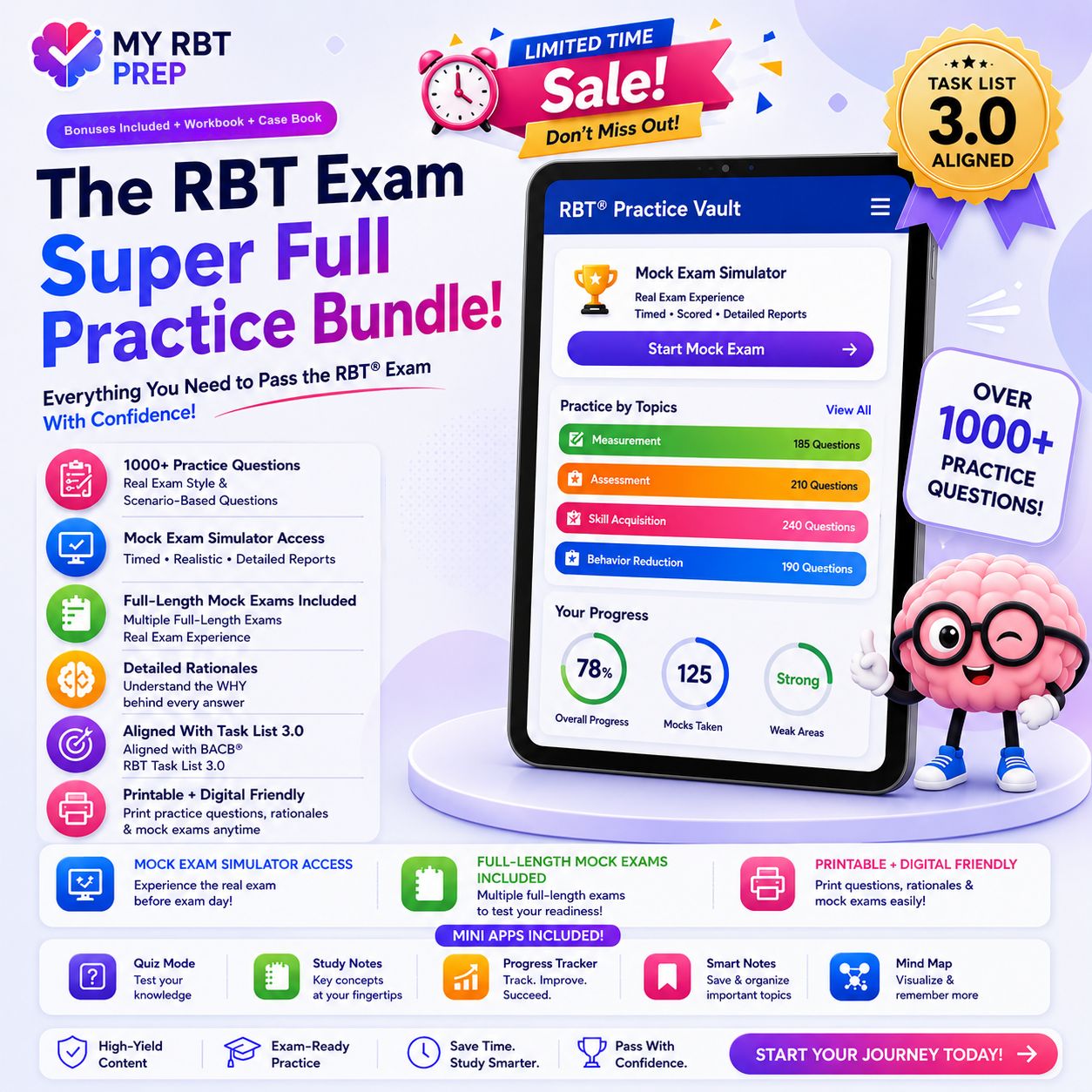
Pass Your RBT® Exam on the First Attempt
Practice with 1,000+ realistic scenario questions, multiple full-length timed mock exams, and detailed rationales formatted exactly like the real Pearson VUE test.
It helps you evaluate your understanding of prompting, reinforcement, chaining, shaping, discrimination training, and generalization, all of which play a major role in teaching new skills and completing the RBT mock exam.
What You’ll Strengthen With This Quiz
-
Correctly identifying types of prompts
(verbal, gestural, model, partial physical, full physical) -
Knowing when to use prompt fading techniques
(most-to-least, least-to-most, time delay) -
Understanding reinforcement schedules
(FR, VR, FI, VI, differential reinforcement) -
Applying chaining procedures
(forward, backward, total-task) -
Recognizing when shaping is appropriate
-
Supporting generalization and maintenance of new skills
 Active Recall Study System
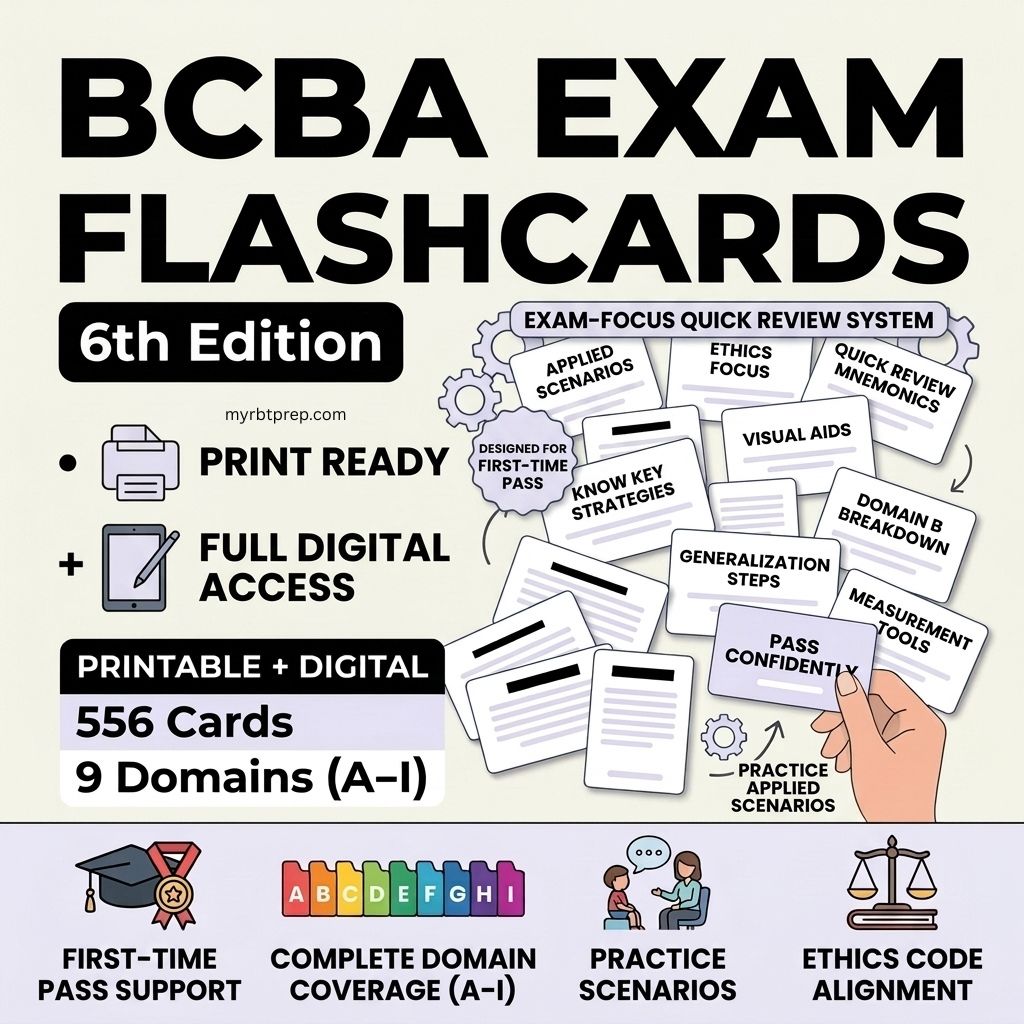
RBT® Exam Flashcards & Study App (3rd Edition)
Master essential ABA terminology and clinical discrimination across all 6 BACB task list areas with 500+ printable and digital flashcards, real exam cues, and full mobile app access.
Get Flashcards & App Access → ⚡ Master Key Terms & Definitions Fast -
Following teaching plans exactly as written by the BCBA
-
Making objective decisions during acquisition sessions
Why This Quiz Improves Your RBT Exam Prep
-
Uses realistic ABA teaching scenarios
-
Highlights common mistakes RBT candidates make during skill acquisition
-
Reinforces essential Task List 3.0 vocabulary
-
Helps you choose the right teaching strategy in each situation
-
Strengthens your understanding of reinforcement and prompting
-
Improves your ability to follow detailed teaching plans
How Acquisition Procedures Shape Learning?
Skill acquisition procedures are the backbone of ABA therapy. They help learners build communication, academic, self-help, and daily living skills. Your job as an RBT is to implement these procedures the same way your BCBA writes them. This includes delivering the right prompt at the right moment, reinforcing quickly, recording data accurately, and responding calmly when errors occur. Practicing scenarios like the ones in this quiz helps you develop that precision.
Preparing for the RBT Exam Through Consistent Practice?
RBT candidates often find acquisition questions challenging because they require understanding when and how to apply the correct procedure. Scenario-based practice gives you a realistic way to strengthen your decision-making, increase accuracy, and build confidence for the exam. Completing this quiz regularly can help you master prompting, reinforcement, and chaining three areas that appear often on the RBT test.
Core Study Guide: Skill Acquisition Procedures (Task List 3.0)
Skill acquisition represents the largest section of everyday clinical work for Registered Behavior Technicians. Under the BACB Task List 3.0, RBTs must understand every phase of a skill acquisition plan, from stimulus control transfer and discrete trial teaching to task analyses and prompt fading.
1. DTT vs. Naturalistic Teaching Strategies (NET)
ABA relies on complementary teaching formats to foster rapid learning and natural communication:
- Discrete Trial Training (DTT): Highly structured, teacher-directed trials delivered in rapid succession with clear Antecedent (SD) -> Behavior -> Consequence cycles. Excellent for teaching initial discriminations, matching, and early vocalizations.
- Naturalistic Teaching (NET): Child-led learning embedded in real-world contexts, games, or social routines. Capitalizes on current Motivating Operations (MOs) to teach requesting (manding) and functional social interaction.
2. Chaining, Prompting, and Generalization
Complex multi-step behaviors (like handwashing or toothbrushing) are broken down into measurable steps using a Task Analysis. Chaining methods include:
- Forward Chaining: Teaching and reinforcing step 1 first while the RBT completes remaining steps.
- Backward Chaining: The RBT completes all initial steps, requiring the learner to complete only the final step to access natural reinforcement.
- Total Task Chaining: Prompting and providing guidance across every step during each session.
To avoid prompt dependency, RBTs fade prompts along the hierarchy (Full Physical -> Partial Physical -> Model -> Gestural -> Verbal -> Independent) using systematic time delay or least-to-most prompting. Once mastered, skills must be tested across different people, settings, and stimuli to guarantee generalization.
3. Stimulus Control Transfer & Reinforcer Schedules
Transfer of stimulus control occurs when behavior shifts from being prompted by a therapist to responding independently to natural environmental cues (e.g., fading a verbal prompt so the learner answers only to the sight of an object). RBTs also implement continuous schedules of reinforcement (FR1) to establish new behaviors, transitioning to intermittent schedules (VR, VI) to build endurance and resistance to extinction.

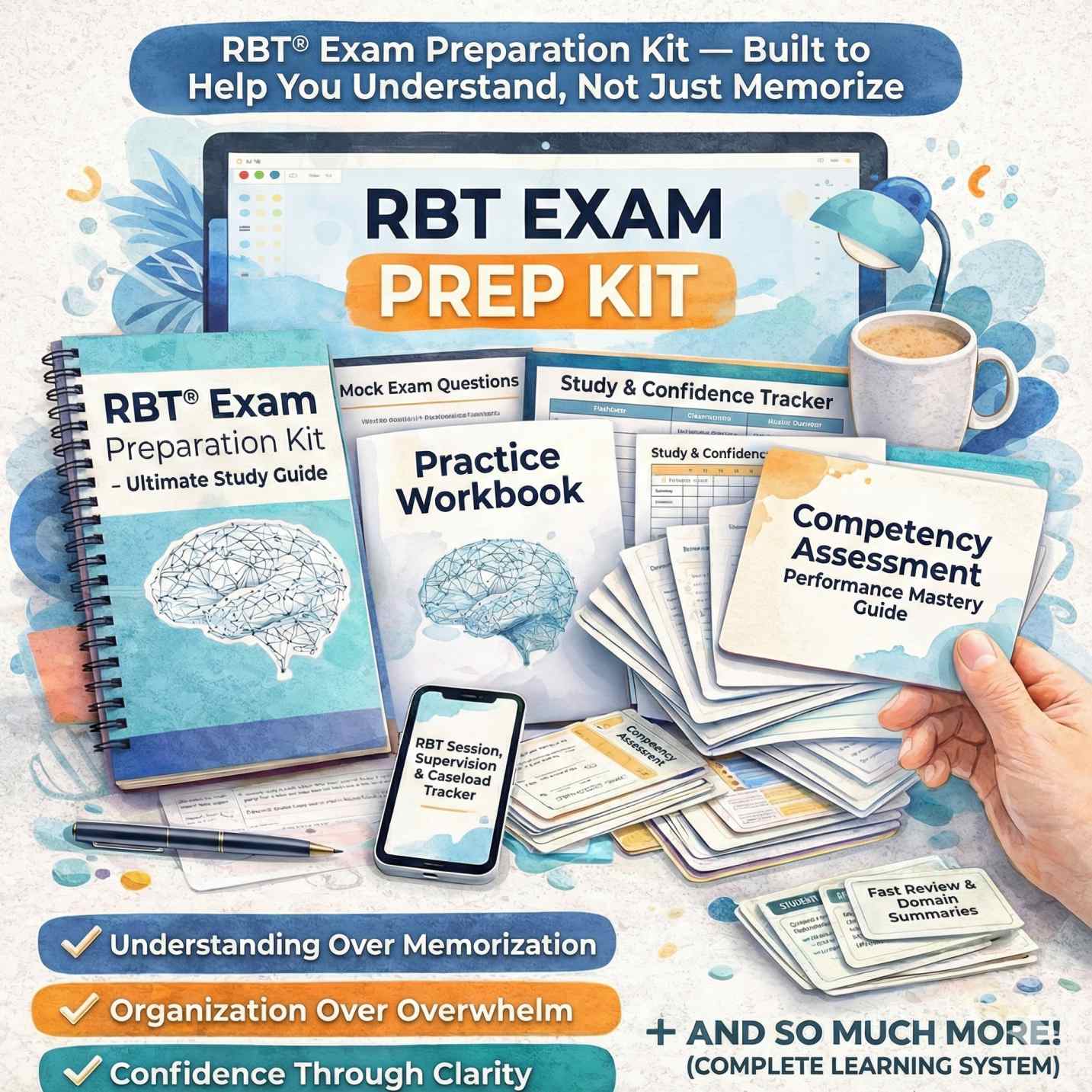
Everything You Need to Pass Your RBT® Exam
Study with our complete, all-in-one preparation package covering every task on the BACB Task List 3.0:
- 1,000+ Practice Questions & Timed Simulator
- 3rd Edition Task List Study Guide & Workbook
- Active Recall Flashcards System + Mobile App
- 20-Task Competency Assessment Mastery Guide