
This practice exam is designed as the fifth full-length test to help you prepare for the upcoming test day. Created specifically for RBT certification, this practice test consists of 75 questions that closely resemble those encountered at the official Pearson VUE test center.
The questions in this practice test cover key subjects relevant to the RBT examination, such as decreasing behaviors, acquiring skills, gathering data, and maintaining professional conduct. It is essential to thoroughly understand these areas to succeed in the exam and obtain the RBT certification. Through regular practice with this assessment, you will not only enhance your grasp of the content but also become familiar with the phrasing of questions in the actual exam.
Take the time to review each question carefully, especially those you answered incorrectly. Reflect on what went wrong, read the explanations, and consider why the correct answer is more suitable. By approaching each question with a learning mindset, you will not only practice but also improve your understanding of the material.
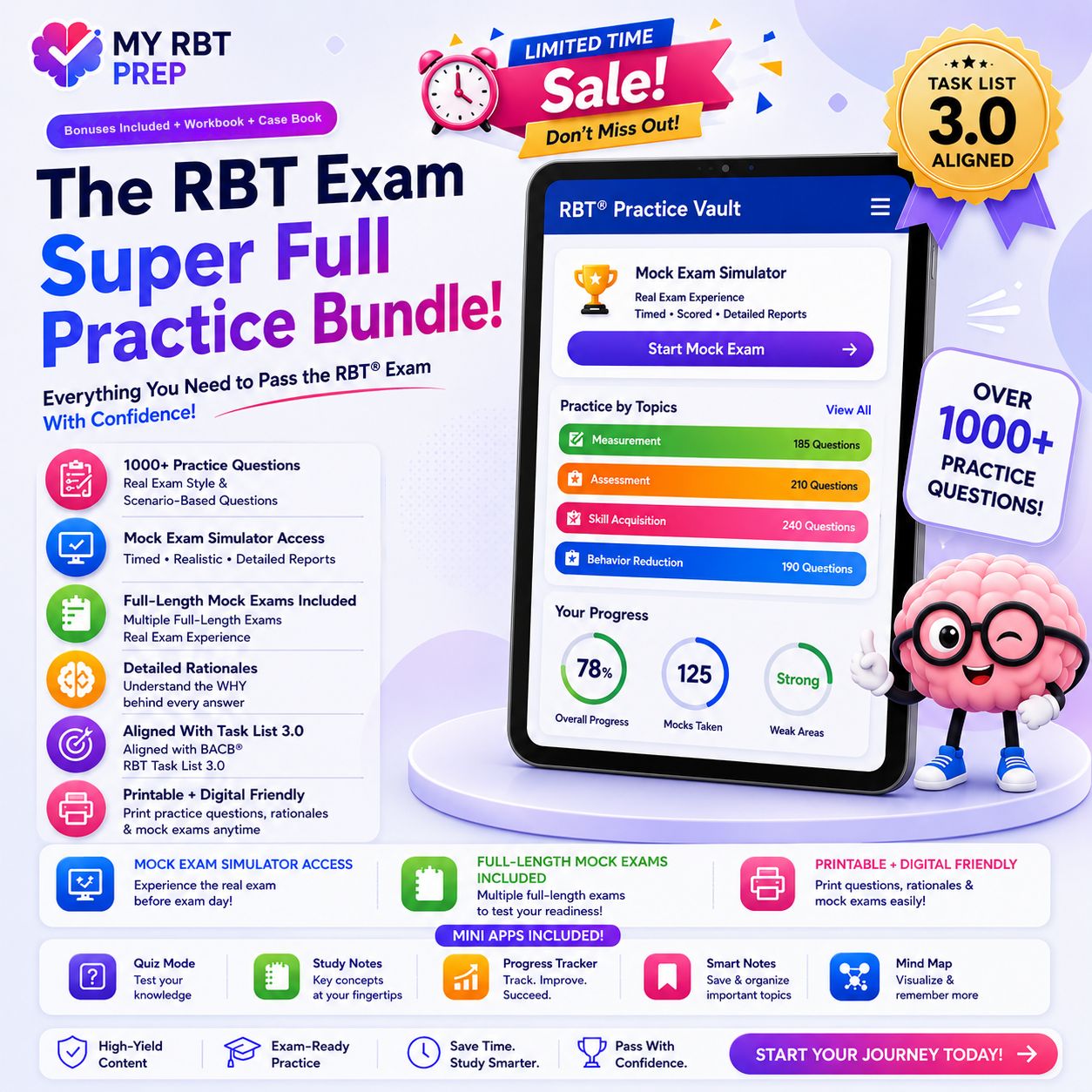
Pass Your RBT® Exam on the First Attempt
Practice with 1,000+ realistic scenario questions, multiple full-length timed mock exams, and detailed rationales formatted exactly like the real Pearson VUE test.
Engaging in this practice exam can significantly boost your self-assurance. Many individuals experience apprehension before the RBT assessment due to uncertainties about the exam. By simulating a test environment, you can increase your comfort level with the types of questions and the overall setup of the exam. This approach can help alleviate nerves, enabling you to remain composed and focused during the assessment.
Taking this additional practice test can further boost your confidence and familiarity with the exam format. The more you expose yourself to the questions and structure of the test, the more at ease you will feel during the actual exam. Understanding what to expect and managing your time effectively will empower you to perform better on test day.
When you feel ready, go ahead and take the test. It is free, realistic, and one of the most effective ways to prepare for your RBT certification. Each question you tackle brings you one step closer to achieving your goal. Good luck – you’ve got this!”
RBT Practise Exam Test 5
Quiz Complete!
Short free quizzes only scratch the surface. Passing the actual 85-question Pearson test requires building your pacing and stamina with full practice.
- Only 6 sample questions
- No timed exam simulator
- No detailed rationales
- Cannot test full pacing
- Multiple Full Mocks (85Q)
- 1,000+ realistic scenario questions
- Step-by-step rationales
- Full app access + printable PDFs
You've completed 5 questions. You have 1 final sample question before the free preview ends.
- 🎯Multiple Full-Length Timed Mocks — exactly like the real Pearson VUE exam
- 📋1,000+ Practice Questions — covering all 2026 BACB Task List 3.0 tasks
- 🧠Detailed Rationales — learn why right answers work and avoid traps
- 📱Exam Simulator App Access — practice anytime on your phone or laptop
You've completed your 6 free sample questions. The real test is 85 questions long with tricky scenarios. Get full practice now so nothing surprises you on test day.
- Multiple Full-Length Timed Mocks — practice with real 85-question exams timed like Pearson VUE
- 1,000+ Scenario Questions — master real clinical situations across all 6 BACB domains
- Crystal-Clear Explanations — understand exactly why each answer is right and how to avoid trick choices
- Full Simulator App + Printable PDFs — practice on your phone in bed or print worksheets
- Complete Exam Prep Materials — build your pacing, endurance, and exam readiness on your schedule
Most candidates who fail admit they only practiced short free quizzes. Give yourself the best chance to pass on your very first try.
By completing this practice assessment, you will gain valuable insight into the exam format and have the opportunity to hone your skills in a test-like environment and complete RBT practice test.
Here’s a revised, more engaging, and humanized version of your tips and tricks for RBTs (Registered Behavior Technicians) preparing for their certification exam or practice, with a deeper dive into FAQs and practical strategies to make the content more actionable and relatable:
RBT Exam: Practical Tips, Tricks, and FAQs for Success
Becoming a Registered Behavior Technician (RBT) is a rewarding step in your career, but the exam and day-to-day responsibilities can feel overwhelming. These tips, tricks, and frequently asked questions will help you navigate the RBT role with confidence, whether you’re studying for the exam or applying your skills on the job. Let’s break it down in a way that feels approachable, professional, and actionable.
1. Stick to Your Role Like Glue
What to Know: As an RBT, your job is to implement behavior plans, not create them. Designing interventions or making treatment decisions is the BCBA’s (Board Certified Behavior Analyst) territory.
Pro Tip: If an exam question hints at you taking charge without BCBA approval, it’s a trap! Always lean toward consulting your supervisor.
Example: A parent asks you to tweak their child’s behavior plan. Your move? Politely say, “Let’s discuss this with the BCBA to ensure we’re on the right track.”
FAQ: What if I think the plan isn’t working? Don’t change it yourself. Document your observations (data is your friend!) and share them with your BCBA for guidance.

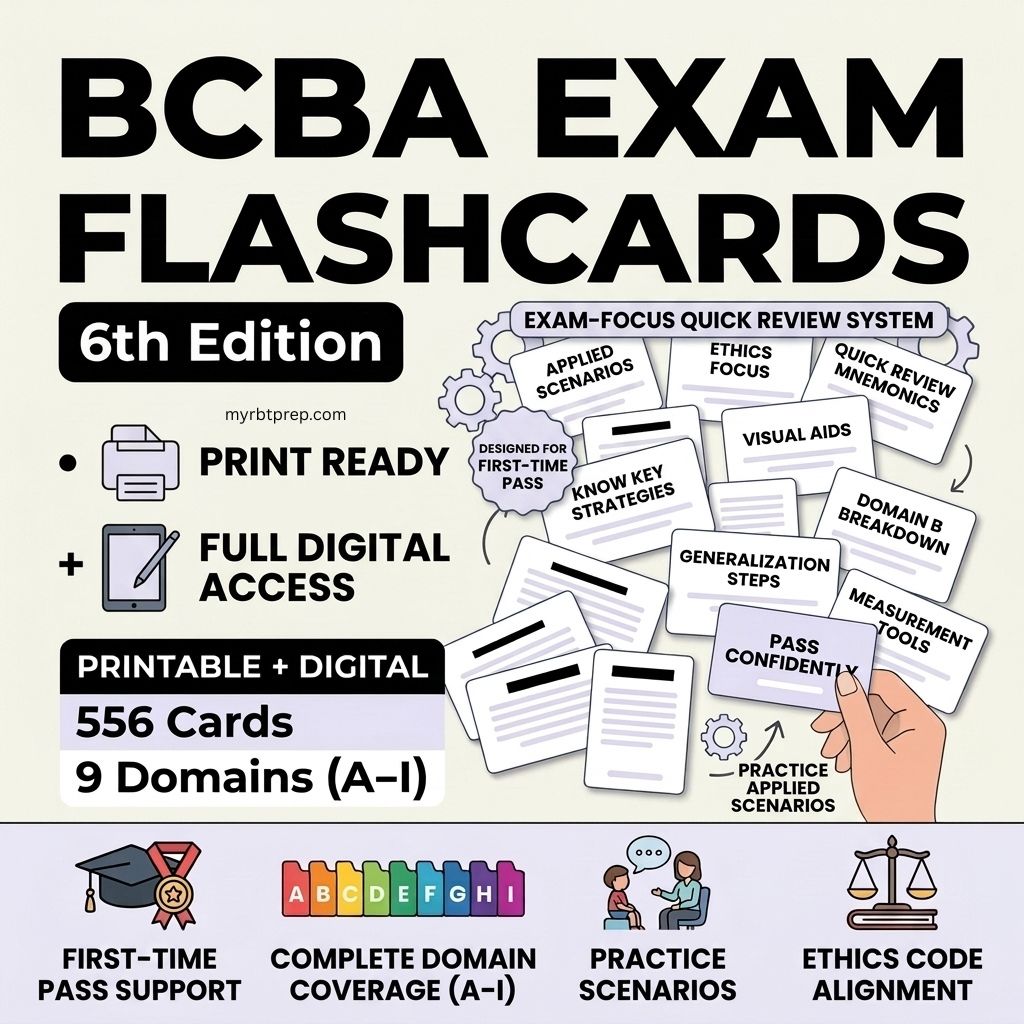
RBT® Exam Flashcards & Study App (3rd Edition)
Master essential ABA terminology and clinical discrimination across all 6 BACB task list areas with 500+ printable and digital flashcards, real exam cues, and full mobile app access.
2. Supervision Is Non-Negotiable
What to Know: RBTs need supervision for at least 5% of their direct service hours each month. This isn’t just a checkbox—it’s your lifeline for growth and ethical practice.
Pro Tip: Exam questions love to test this. If an option suggests skipping supervision or “figuring it out” on your own, it’s wrong.
Real-World Trick: Schedule supervision sessions in advance and come prepared with questions or data to make the most of them.
FAQ: What if my BCBA cancels supervision? Reschedule ASAP and document the attempt. Never let supervision slide—it’s a requirement for your certification.
3. Boundaries Are Your Best Friend
What to Know: Professional boundaries keep your work ethical and effective. Accepting gifts, attending a client’s birthday party, or connecting on social media? Big no-nos.
Pro Tip: On the exam, the safest answer is always the one that keeps things professional. If it feels too personal, it’s probably a violation.
Example: A client’s family offers you concert tickets as a thank-you. Smile, thank them, and say, “I really appreciate the gesture, but I can’t accept gifts to maintain professionalism.”
FAQ: Can I be friends with a client’s family after services end? Nope. This risks a dual relationship, which can blur lines and compromise ethics. Always keep it professional, even after services conclude.
4. Embrace Feedback Like a Pro
What to Know: Feedback from your BCBA isn’t criticism—it’s a tool to help you grow. RBTs are expected to apply feedback and ask clarifying questions when needed.
Pro Tip: Exam answers that show openness to feedback (e.g., “I’ll discuss this with my supervisor and adjust my approach”) are usually correct. Defensive or dismissive responses? Red flags.
Real-World Trick: After feedback, jot down one or two actionable steps to implement it. For example, if your BCBA suggests improving your data collection, practice using their recommended method in your next session.
FAQ: What if I disagree with the feedback? Share your perspective respectfully during supervision, but always follow the BCBA’s guidance unless it violates ethics.
5. When in Doubt, Pass It Up
What to Know: Parents or caregivers might ask for advice or changes to a plan. Your role? Redirect them to the BCBA. You’re not authorized to give advice or modify plans.
Pro Tip: Exam questions often test this by offering tempting options like “suggest a new strategy.” Always pick the answer that involves the BCBA.
Example: A parent says, “This plan isn’t working; what should we do?” Your response: “I’ll share your concerns with the BCBA, and we’ll work together to address them.”
FAQ: What if a parent insists I make a change? Stay firm but kind. Explain that all changes must go through the BCBA to ensure consistency and effectiveness.
6. Avoid Dual Relationships at All Costs
What to Know: A dual relationship happens when you mix personal and professional roles—like babysitting for a client, following them on social media, or attending their family events. These are ethical violations.
Pro Tip: If an exam question describes a scenario that feels “too friendly,” it’s likely wrong. Choose the option that keeps your role strictly professional.
Real-World Trick: Set clear boundaries early. For example, if a client’s family invites you to a personal event, say, “I’m honored, but I need to keep our relationship professional.”
FAQ: What if I already knew the family before they became clients? Disclose this to your BCBA immediately. They’ll guide you on how to manage or avoid conflicts of interest.
7. Keep Confidentiality Locked Tight
What to Know: Client information is private. Only share it with authorized team members (like your BCBA) and never discuss clients in public, with friends, or on social media.
Pro Tip: Exam questions might include sneaky options like “discuss the case with a coworker over coffee.” If it’s not with the treatment team, it’s wrong.
Example: A friend asks how your work is going. Instead of sharing client details, say, “It’s rewarding, but I keep client info private to respect their privacy.”
FAQ: Can I share success stories anonymously? Even anonymous posts can risk violating confidentiality. When in doubt, don’t share without BCBA approval.
8. Spot the Red and Green Flags
What to Know: Exam questions often use specific language to signal right or wrong answers. Memorizing these can save you time and stress.
Red Flags (Wrong Answers):
- “Offer personal advice”
- “Change the plan without approval”
- “Skip supervision”
- “Accept a gift”
- “Work without training”
- “Ignore a concern”
Green Flags (Right Answers): - “Consult the BCBA”
- “Follow the behavior plan”
- “Maintain professional boundaries”
- “Document and report”
- “Apply feedback”
Pro Tip: Practice spotting these flags in sample questions. If an option feels unprofessional, trust your gut—it’s probably wrong.
FAQ: How do I know if an answer is ethical? Ask yourself: Does this align with the RBT Ethics Code? If it prioritizes client safety, confidentiality, and professionalism, it’s likely correct.
9. Study Smarter, Not Harder
What to Know: The RBT exam tests your understanding of ethics, boundaries, and practical application, not just rote memorization.
Pro Tip: Don’t just skim practice questions. After each one, analyze why the correct answer is right and why the others are wrong. This builds critical thinking for the exam and real-world scenarios.
Real-World Trick: Create flashcards for tricky concepts (e.g., “What’s a dual relationship?”) or use apps like Quizlet. Review them during downtime, like on your commute.
FAQ: How many practice questions should I do? Aim for 100–200 quality questions from reputable sources (like the BACB’s RBT Task List). Focus on understanding, not just quantity.
10. Think Like an RBT
What to Know: The exam and your job are about making ethical, logical decisions under pressure. Picture yourself in the scenario and ask, “What would a professional RBT do?”
Pro Tip: If you’re stuck on a question, eliminate answers with red flags (like skipping supervision or giving advice). The correct answer usually feels calm, professional, and client-focused.
Example: A question asks what to do if a client’s behavior escalates. The best answer? “Follow the behavior plan and consult the BCBA if needed.”
FAQ: What if I panic during the exam? Take a deep breath and read each question slowly. Break it down: What’s the scenario? What’s the ethical choice? Trust your preparation.
Bonus: Your Study Game Plan
- Mix It Up: Use a variety of study tools—flashcards, practice exams, and videos—to keep things fresh.
- Simulate the Real Thing: Take timed practice tests to build stamina for the 85-question exam (90 minutes).
- Join a Study Group: Discussing scenarios with peers can help you spot nuances in ethical questions.
- Stay Positive: You’re learning skills that will make a real difference in clients’ lives. Keep that purpose in mind!
Final Thoughts
The RBT exam and role are about more than passing a test—they’re about preparing you to support clients ethically and effectively. By mastering these tips and tricks, you’ll not only ace the exam but also shine as a professional RBT. If you hit a roadblock, remember: consult your BCBA, stay professional, and keep learning. You’ve got this!

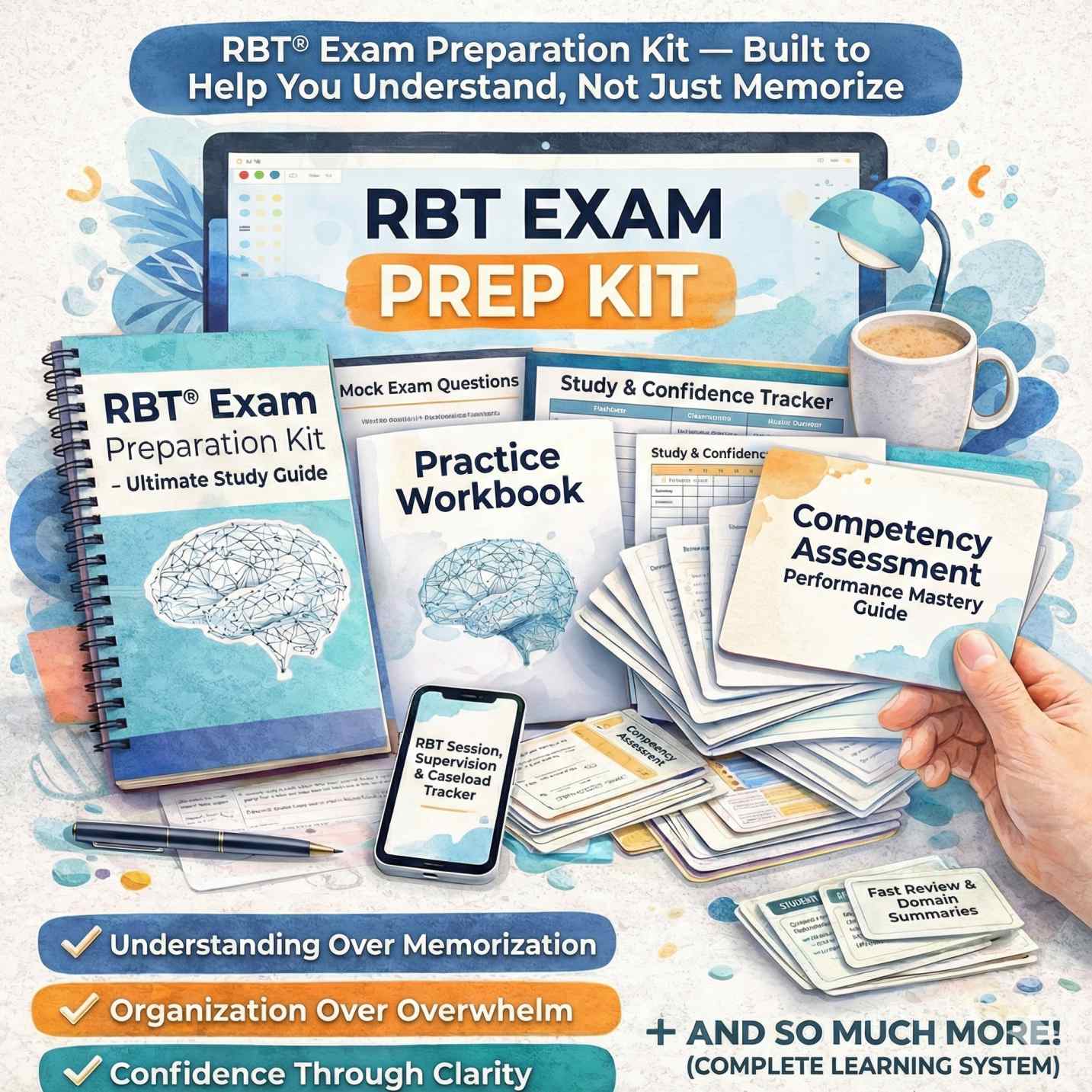
Everything You Need to Pass Your RBT® Exam
Study with our complete, all-in-one preparation package covering every task on the BACB Task List 3.0:
- 1,000+ Practice Questions & Timed Simulator
- 3rd Edition Task List Study Guide & Workbook
- Active Recall Flashcards System + Mobile App
- 20-Task Competency Assessment Mastery Guide