
Preparing for the RBT exam and want to check how well you understand behavior assessment procedures? This Behavior Assessment Quiz includes 8 scenario-based questions based on the BACB RBT Task List 3.0 (2026).
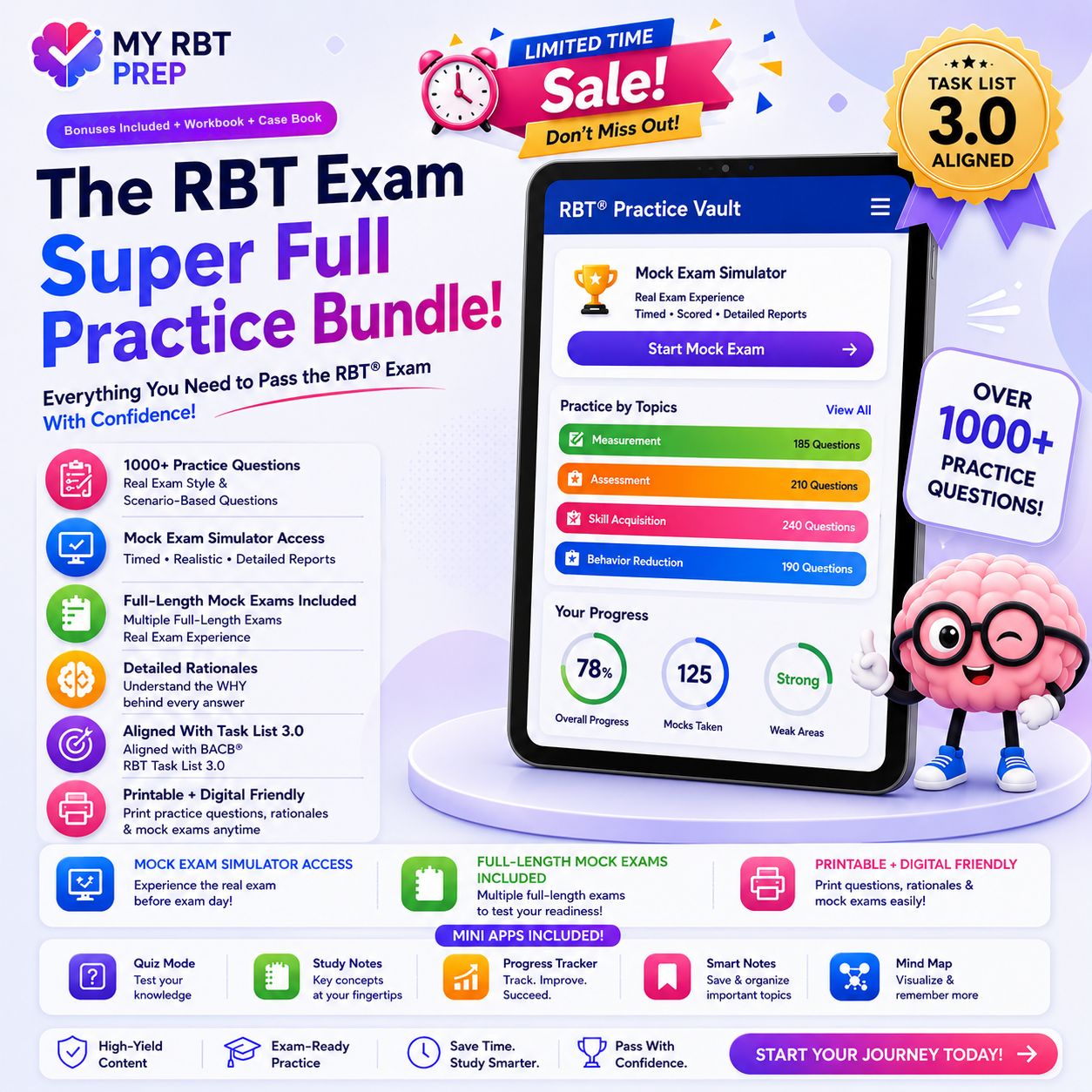
Pass Your RBT® Exam on the First Attempt
Practice with 1,000+ realistic scenario questions, multiple full-length timed mock exams, and detailed rationales formatted exactly like the real Pearson VUE test.
Accurate assessment is the first step in any ABA program. As an RBT, you must know how to gather information correctly, observe behavior without bias, and record data in a way your supervisor can use. This quiz gives you a simple way to test those skills and strengthen the areas you rely on during real ABA sessions.
RBT Behavior Assessment Quiz
Quiz Complete!
The Actual Exam Tests Tough Decisions, Not Just Definitions
You are halfway through your 10-question diagnostic sample. The official exam presents 85 tricky clinical scenarios asking 'What should the RBT do FIRST?' Finish your 10 questions to see your diagnostic readiness, or explore the full simulator suite below.
- 1,000+ Exam-Style Scenarios: Master tricky 'FIRST vs BEST' exam traps
- Timed 85-Question Mock Simulators: Match exact exam interface, timer & scoring
- Step-by-Step Rationales: Know exactly why the correct answer is right every time
- 100% Pass Guarantee: Instant download + lifetime online access on phone & laptop
It helps you evaluate your understanding of preference assessments, ABC data collection, functional assessment basics, and your role when assisting a BCBA and practice RBT Mock Exams.
What will You Improve With This Quiz?
-
Identifying the correct preference assessment method
(single-stimulus, paired-choice, multiple-stimulus with/without replacement) -
Understanding the steps of ABC recording
(Antecedent, Behavior, Consequence) -
Recognizing your role in functional assessments under BCBA supervision
 Active Recall Study System
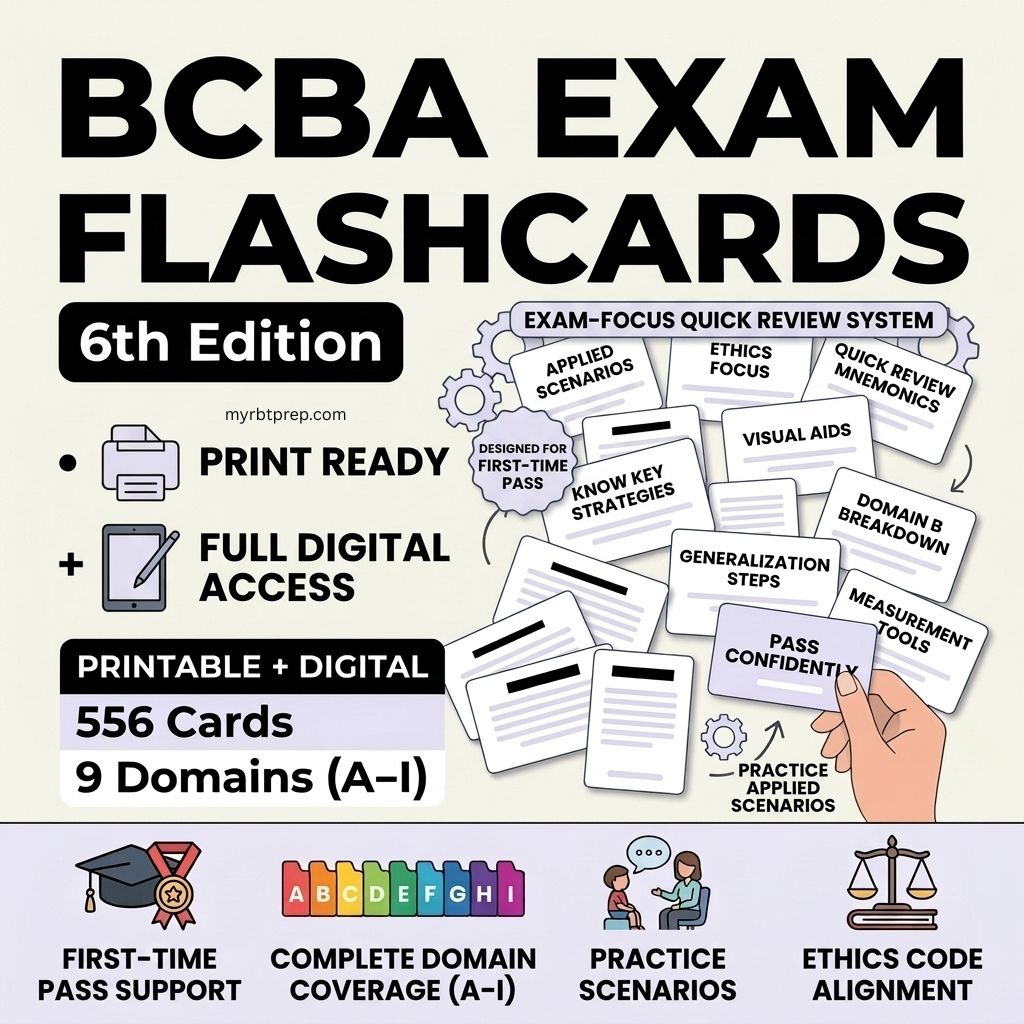
RBT® Exam Flashcards & Study App (3rd Edition)
Master essential ABA terminology and clinical discrimination across all 6 BACB task list areas with 500+ printable and digital flashcards, real exam cues, and full mobile app access.
Get Flashcards & App Access → ⚡ Master Key Terms & Definitions Fast -
Knowing what information to collect before a session
-
Recording behaviors objectively instead of adding opinion
-
Improving observation accuracy during real client sessions
-
Applying Task List 3.0 terms to natural ABA examples
Key Assessment Areas Covered
This table gives a clear overview of what the quiz focuses on and why it matters for RBT exam success.
| Behavior Assessment Area | What You’ll Practice | Why It Matters |
|---|---|---|
| Preference Assessments | Identifying high-value items, choosing the right assessment format | Strong reinforcers improve teaching and reduce problem behavior. |
| ABC Data Collection | Recording antecedent, behavior, and consequence | Helps supervisors find patterns and identify functions of behavior. |
| Indirect Assessments | Interviews, checklists, rating scales | Allows RBTs to gather background information ethically and accurately. |
| Functional Assessment Support | Assisting the BCBA during FA procedures | RBTs must know what to observe and how to record it without interfering. |
| Observation Skills | Objective note-taking, avoiding assumptions | Required for ethical, reliable assessment data. |
Why This Quiz Strengthens Your RBT Exam Prep>
-
Uses real ABA scenarios instead of memorization
-
Highlights mistakes RBT candidates often make
-
Builds familiarity with Task List 3.0 vocabulary
-
Helps you recognize the right assessment method in each situation
-
Makes ABC data collection feel natural and automatic
-
Supports better communication with your BCBA during assessments
The Role of Assessment in ABA
Behavior assessment is the foundation of every treatment plan. Before any skill is taught or any intervention is implemented, the BCBA must understand why a behavior occurs and what motivates the learner. This quiz helps you practice the observation skills needed to give your supervisor accurate, useful information. The more confident you are with preference assessments and ABC data, the better you support effective, ethical ABA services.
Boosting Your Exam Confidence Through Practice
Short quizzes like this help you build consistency, spot gaps, and improve recall. Many RBT candidates find assessment questions tricky because the options often look similar. Practicing with scenarios—rather than simple definitions—helps you answer questions the same way you will on the real exam.
Core Study Guide: Assessment Procedures (Task List 3.0)
Under the BACB RBT Task List 3.0, Registered Behavior Technicians assist supervisors during functional assessments, stimulus preference evaluations, and curriculum assessments. While RBTs never design assessment protocols or diagnose independently, knowing how to collect objective baseline data and conduct standardized preference assessments is vital.
1. Stimulus Preference Assessments
Preference assessments help identify items, activities, or sensory stimuli that may function as effective reinforcers. Common formats tested on the RBT exam include:
- Free Operant Observation: The client is given unrestricted access to an environment with multiple items. The RBT observes and records the duration spent with each item without presenting demands or trials.
- Single Stimulus (Successive Choice): Items are presented one at a time to the client, recording reaction, approach, and duration of engagement. Ideal for individuals who struggle choosing between multiple items.
- Paired Choice (Forced Choice): Two items are presented simultaneously. Every item in the test pool is paired systematically against every other item to create a clear preference hierarchy.
- Multiple Stimulus Without Replacement (MSWO): An array of items is presented. Once an item is chosen, it is removed from subsequent trials, allowing a fast, rank-ordered preference list.
- Multiple Stimulus With Replacement (MSW): The chosen item remains in the array and is repositioned for the next trial, evaluating whether one item completely dominates preference.
2. Objective ABC Data & Behavioral Definitions
When collecting descriptive assessment data, RBTs record the three-term contingency: Antecedent (what occurs immediately prior to the behavior), Behavior (the observable response), and Consequence (what happens immediately following the response). Definitions must be observable and measurable—avoiding internal, mentalistic explanations like “frustrated” or “defiant” in favor of concrete actions like “screamed and dropped to the floor.”

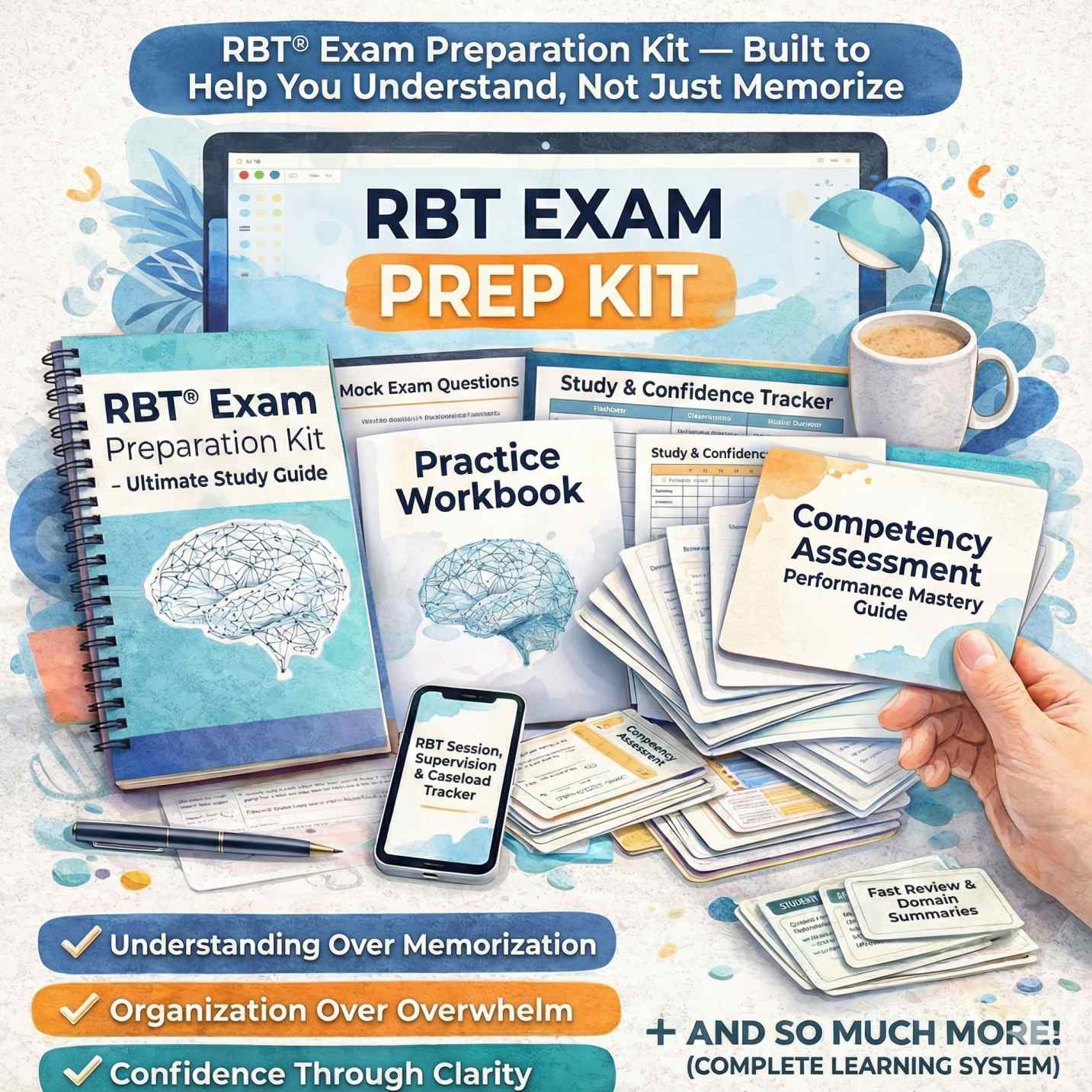
Everything You Need to Pass Your RBT® Exam
Study with our complete, all-in-one preparation package covering every task on the BACB Task List 3.0:
- 1,000+ Practice Questions & Timed Simulator
- 3rd Edition Task List Study Guide & Workbook
- Active Recall Flashcards System + Mobile App
- 20-Task Competency Assessment Mastery Guide