
Measurement is the first subject of our RBT study guide. It’s a core subject for Registered Behavior Technician preparation since 12 questions will be covered in the RBT exam. This practice test consists of 30 questions.
Measurement is the cornerstone of applied behavior analysis (ABA). It helps technicians measure accurately, monitor, and analyze behavior change. Without measurement, monitoring your client’s progress and adjusting the therapy and behavior intervention plans are not possible.
This guide emphasizes key measurement strategies for the Registered Behavior Technician (RBT) examination that address data collection techniques and skill in interpreting.
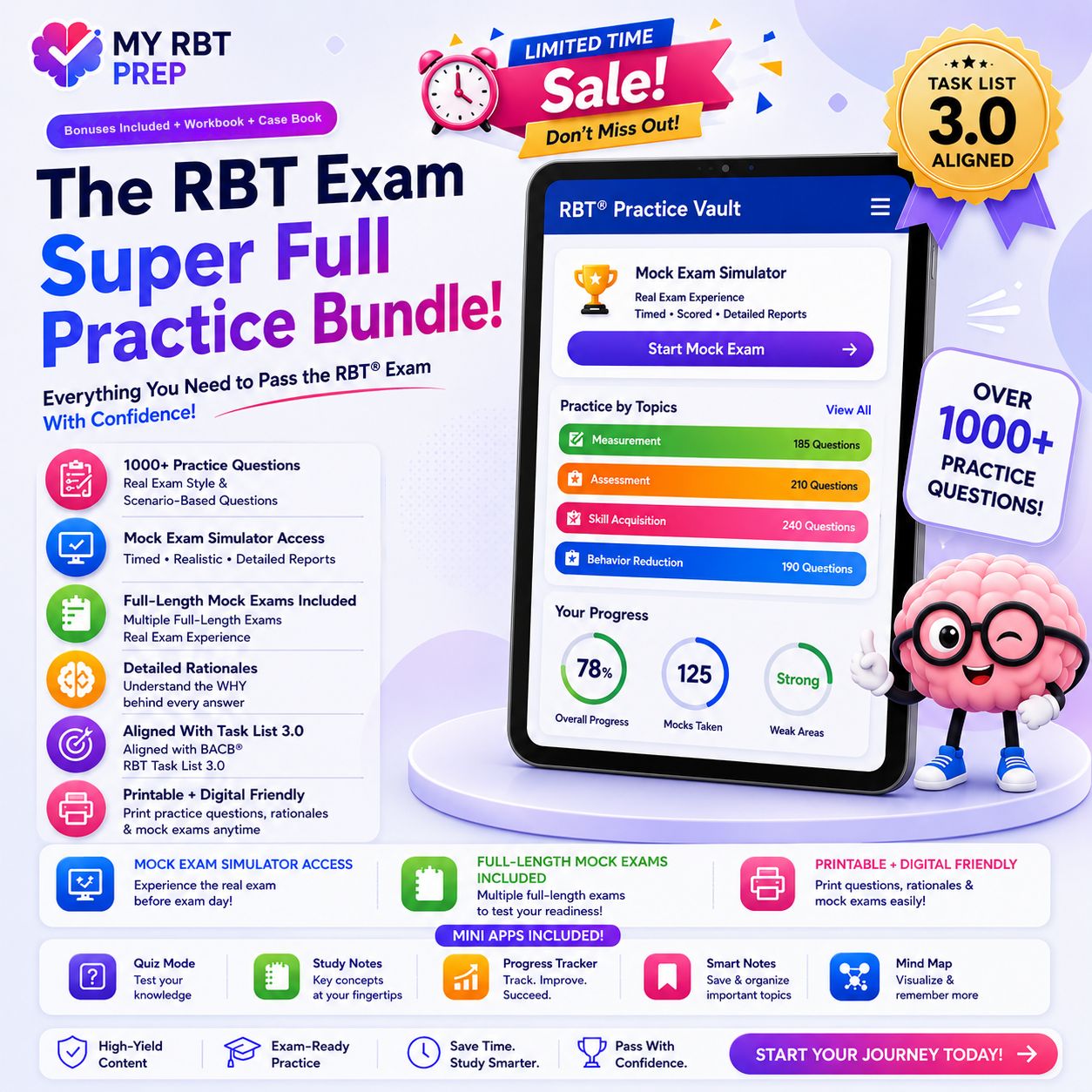
Pass Your RBT® Exam on the First Attempt
Practice with 1,000+ realistic scenario questions, multiple full-length timed mock exams, and detailed rationales formatted exactly like the real Pearson VUE test.
RBT Practice Quiz - Unit A: Measurement
Quiz Complete!
Short free quizzes only scratch the surface. Passing the actual 85-question Pearson test requires building your pacing and stamina with full practice.
- Only 6 sample questions
- No timed exam simulator
- No detailed rationales
- Cannot test full pacing
- Multiple Full Mocks (85Q)
- 1,000+ realistic scenario questions
- Step-by-step rationales
- Full app access + printable PDFs
You've completed 5 questions. You have 1 final sample question before the free preview ends.
- 🎯Multiple Full-Length Timed Mocks — exactly like the real Pearson VUE exam
- 📋1,000+ Practice Questions — covering all 2026 BACB Task List 3.0 tasks
- 🧠Detailed Rationales — learn why right answers work and avoid traps
- 📱Exam Simulator App Access — practice anytime on your phone or laptop
You've completed your 6 free sample questions. The real test is 85 questions long with tricky scenarios. Get full practice now so nothing surprises you on test day.
- Multiple Full-Length Timed Mocks — practice with real 85-question exams timed like Pearson VUE
- 1,000+ Scenario Questions — master real clinical situations across all 6 BACB domains
- Crystal-Clear Explanations — understand exactly why each answer is right and how to avoid trick choices
- Full Simulator App + Printable PDFs — practice on your phone in bed or print worksheets
- Complete Exam Prep Materials — build your pacing, endurance, and exam readiness on your schedule
Most candidates who fail admit they only practiced short free quizzes. Give yourself the best chance to pass on your very first try.
- Prepare for Data Collection
There should be data collection materials prepared by an RBT prior to each session. Data collection is an important aspect during the provision of services for clients.
We have outlined some needed materials for data collection below for a Registered Behavior Technician:
- In case your company is applying paper data collection, you will need to bring a paper data sheet and pen prior to each session.
- In case your company is collecting electronic data, you will need to bring a tablet or other electronic device prior to each session.
- You will need to have a clicker to measure how many times a target behavior is obtained.
- Practice Continuous Measurement Procedures
Registered Behavior Technicians apply various methods to monitor and document behavior in a consistent manner. It helps BCBA to examine patterns in behavior and make precise decisions about interventions.
The RBT exam may include questions on four main types of continuous measurement methods:
- Frequency: It is a continuous measurement procedure that indicates the number of times or count of a behavior or response.
- Latency: It quantifies the time between the end of SD (discriminative stimulus) and the onset of a response.
- Duration: It quantifies how long one spends on a behavior.
- Inter-response Time (IRT): It quantifies the time that passes between occurrences of a specific behavior.
- Put Discontinuous Measurement Procedures into Practice
Discontinuous measurement methods are employed to measure some cases of behavior but not all. This method is employed when there is a problem with recording all the occurrences of behavior. Discontinuous measurement techniques are primarily three in number:

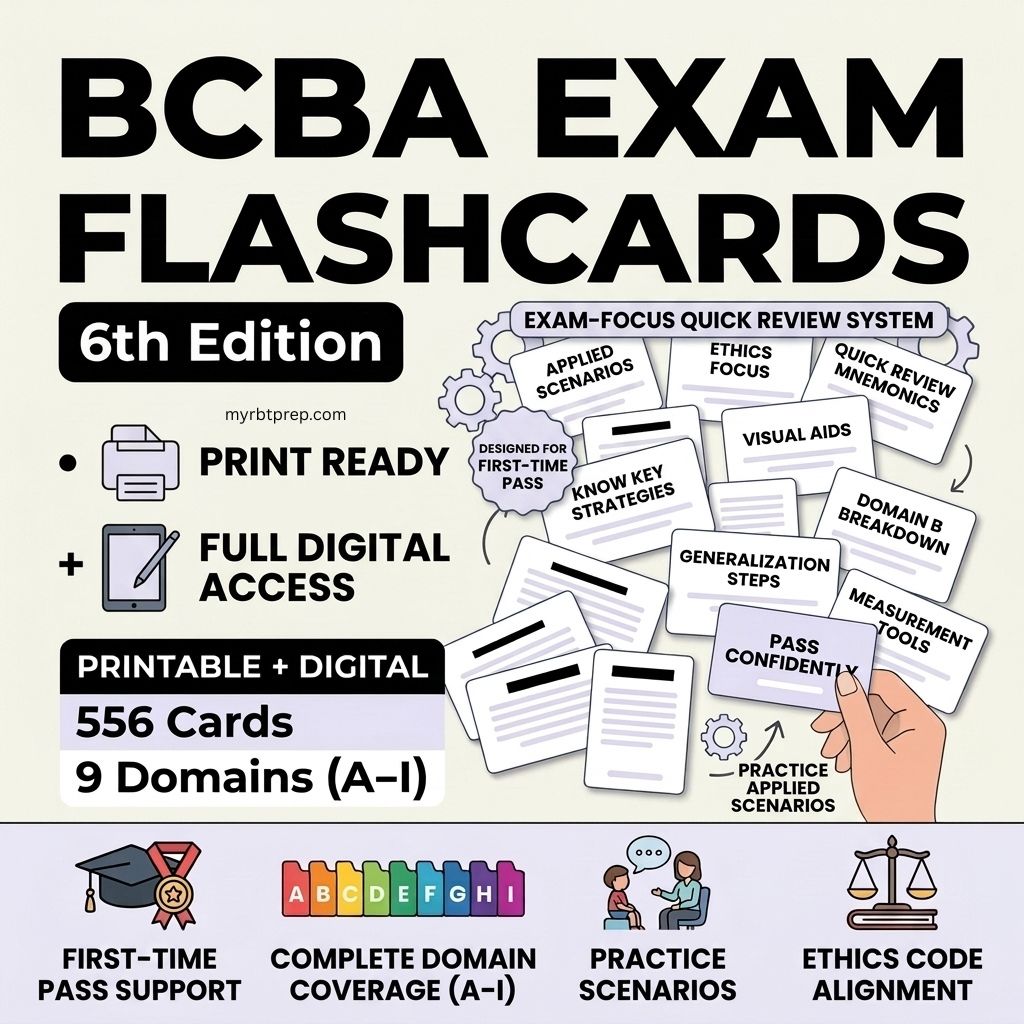
RBT® Exam Flashcards & Study App (3rd Edition)
Master essential ABA terminology and clinical discrimination across all 6 BACB task list areas with 500+ printable and digital flashcards, real exam cues, and full mobile app access.
- Whole Interval Recording: The observer records if the behavior is happening every time. This is typically employed for behaviors you would like to observe more often. However, it may fail to indicate the behavior occurring as frequently as it actually does.
- Partial Interval Recording: The behavior is recorded if the behavior occurred at any time within the interval, commonly utilized to reduce undesirable behavior. Yet it could make the behavior appear more common than it actually is.
- Momentary Time Sampling: During the procedure, the observer monitors if the behavior is occurring at specific times. The observer rapidly scans if the behavior is occurring then, such as snapping a rapid photo.
- Use Permanent-Product Recording Procedures
Permanent product recording is a data collection method in behavior analysis that focuses on measuring the result of a behavior instead of observing the behavior as it occurs For instance, clinical instruction to the client can be to prepare the bed prior to going outside, and the observer will check if the bed was prepared when the client went outside. It’s akin to measuring the end product of the operation rather than the client preparing the bed.
- Enter Data and Update Graphs
RBTs monitor behaviors and skill development, then represent the data using charts and graphs The BCBAs interpret those graphical data and base treatment on them. A registered behavior technician should be aware of displaying recorded data in graphical and chart form with a data system that is computer-based.
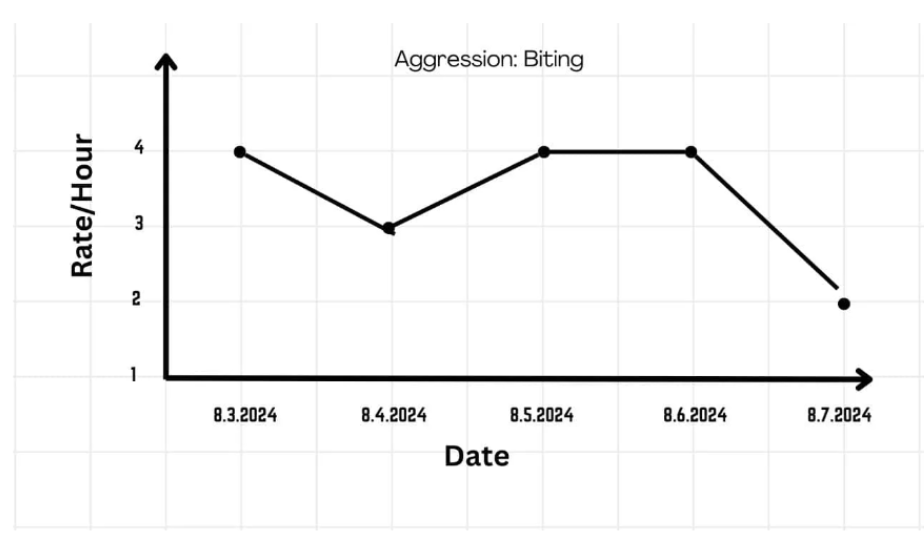
The above chart indicates that the client’s rate of biting (behavior) is plotted on the Y-axis and the date (or session number) is plotted on the X-axis. This is how an RBT should display the graphical data to BCBA.
As shown in the chart below, it can be seen that the biting rate declined after the first session (8.3.2024 to 8.4.2024), and it rose after the second session (8.4.2024 to 8.5.2024), then stable after the third session (8.5.2024 to 8.6.2024), drastically declined after the fourth session (8.6.2024 to 8.7.2024).
- Explain actions and surroundings using clear, specific, and quantifiable language that can be seen or measured:
In Applied Behavior Analysis (ABA), behaviors and environmental conditions are described using language that focuses on what can be directly seen and quantified. This is to mean you should only concentrate on actions that can be seen objectively and measured. Do not incorporate language based on your assumptions or thoughts.
For instance, rather than saying, “The child was truly nervous today,” we can say, “The child avoided eye contact, fidgeted, and answered softly.” This method guarantees precise measurement and treatment planning, honoring the rule that if a “dead man” can do it, it’s not a behavior.
Tips and tricks
✅ 1. Know Your Scope of Practice
- Tip: RBTs do not design behavior plans or make treatment decisions.
- Strategy: If a question suggests making a decision without BCBA approval, it’s probably wrong. Always choose the option that includes consulting the supervisor or BCBA.
✅ 2. Supervision Rules Are Strict
- Tip: RBTs must receive supervision for at least 5% of their direct service hours every month.
- Trick: If a question mentions avoiding, skipping, or delaying supervision, it’s incorrect.
✅ 3. When in Doubt, Set a Boundary
- Tip: Never accept gifts, attend personal events, or maintain contact with clients after services.
- Trick: The safest answer is usually the one that protects professional boundaries.
✅ 4. Feedback Is a Gift
- Tip: Supervisors give feedback regularly. You should apply it and ask questions if needed.
- Strategy: Choose answers that show openness and professionalism, not defensiveness.
✅ 5. Always Refer to the BCBA
- Tip: If a parent asks for changes or expresses concerns, never give advice or modify plans yourself.
- Trick: Pick the option that says “refer them to the BCBA” or “discuss with supervisor.”
✅ 6. Watch for Dual Relationships
- Tip: Any personal connection (e.g., babysitting, social media contact, parties) = dual relationship.
- Strategy: If it sounds too friendly or personal, it’s likely a violation.
✅ 7. Confidentiality is Key
- Tip: Share client information only with authorized team members.
- Trick: Avoid options that mention discussing clients with friends, peers, or on social media.
✅ 8. Learn from the Language
- Red Flags in Wrong Options:
- “Offer personal advice”
- “Change the plan”
- “Skip supervision”
- “Accept a gift”
- “Do it without training”
- “Keep working without reporting”
- Green Flags in Right Options:
- “Refer to BCBA”
- “Follow the behavior plan”
- “Maintain professional boundaries”
- “Communicate within guidelines”
- “Apply supervisor feedback”
✅ 9. Practice with Purpose
- Tip: Don’t just read questions—analyze why the right answer is correct and why the others are not.
- Strategy: Make flashcards for each rule or concept you get wrong during practice.
✅ 10. Stay Calm and Logical
- Tip: These questions are designed to test ethics and judgment, not just memorization.
- Strategy: Imagine you’re on the job—what would a professional RBT do in that scenario?

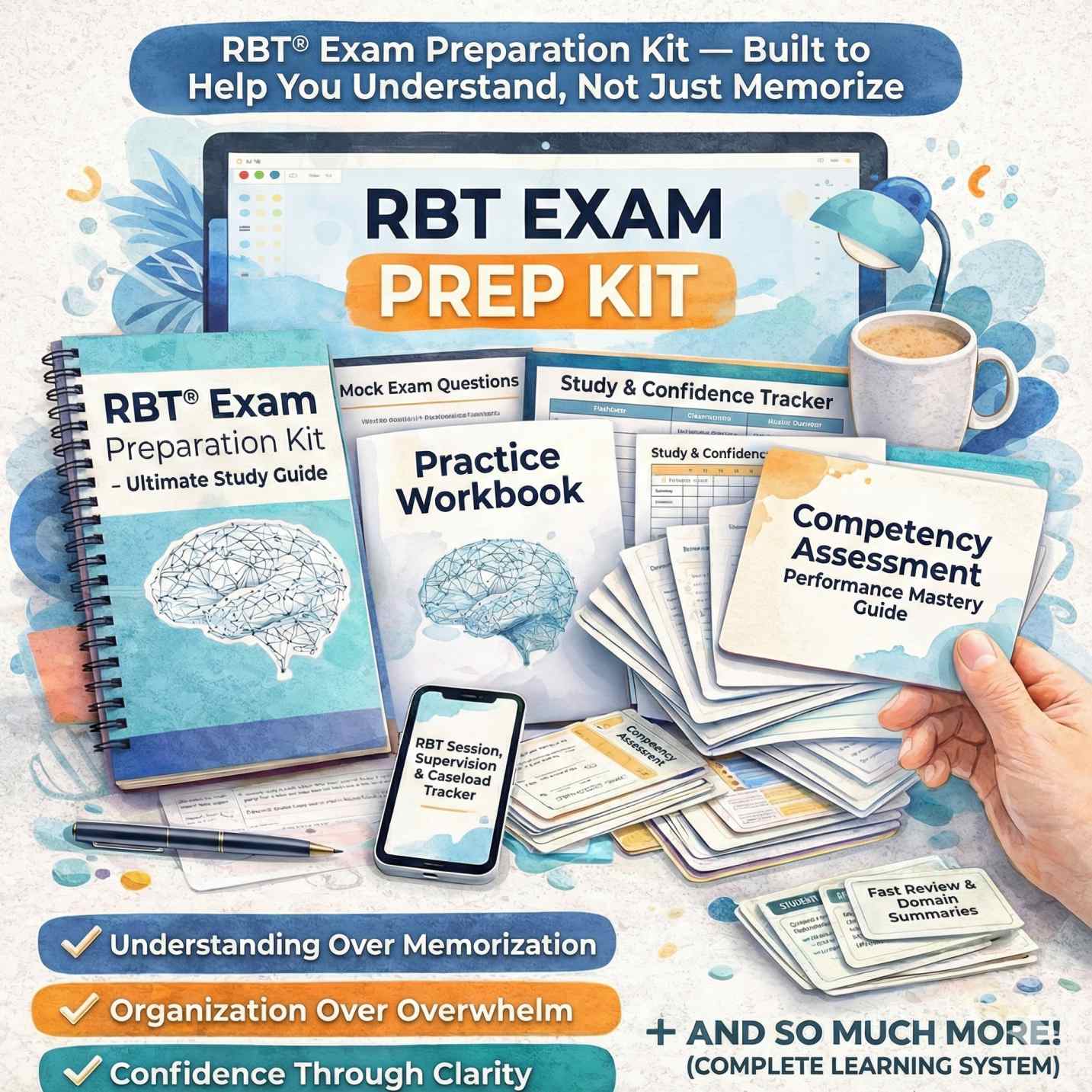
Everything You Need to Pass Your RBT® Exam
Study with our complete, all-in-one preparation package covering every task on the BACB Task List 3.0:
- 1,000+ Practice Questions & Timed Simulator
- 3rd Edition Task List Study Guide & Workbook
- Active Recall Flashcards System + Mobile App
- 20-Task Competency Assessment Mastery Guide