
The RBT Behavior Assessment Guide is an essential resource for anyone preparing to become a skilled Registered Behavior Technician. This guide provides detailed insights into conducting preference assessments, performing skill assessments, and participating in functional assessment procedures under BCBA supervision and prepare for your rbt exam with practice.
By following structured assessment protocols, RBTs can accurately collect and analyze ABC data, identify behavior functions, and develop effective behavioral interventions.
Whether evaluating early language and learning milestones with VB-MAPP, tracking daily living abilities with AFLS, or applying curriculum-based assessments, this guide ensures learners’ progress is measured objectively. It equips RBTs with the knowledge to make informed decisions and improve learner engagement consistently.
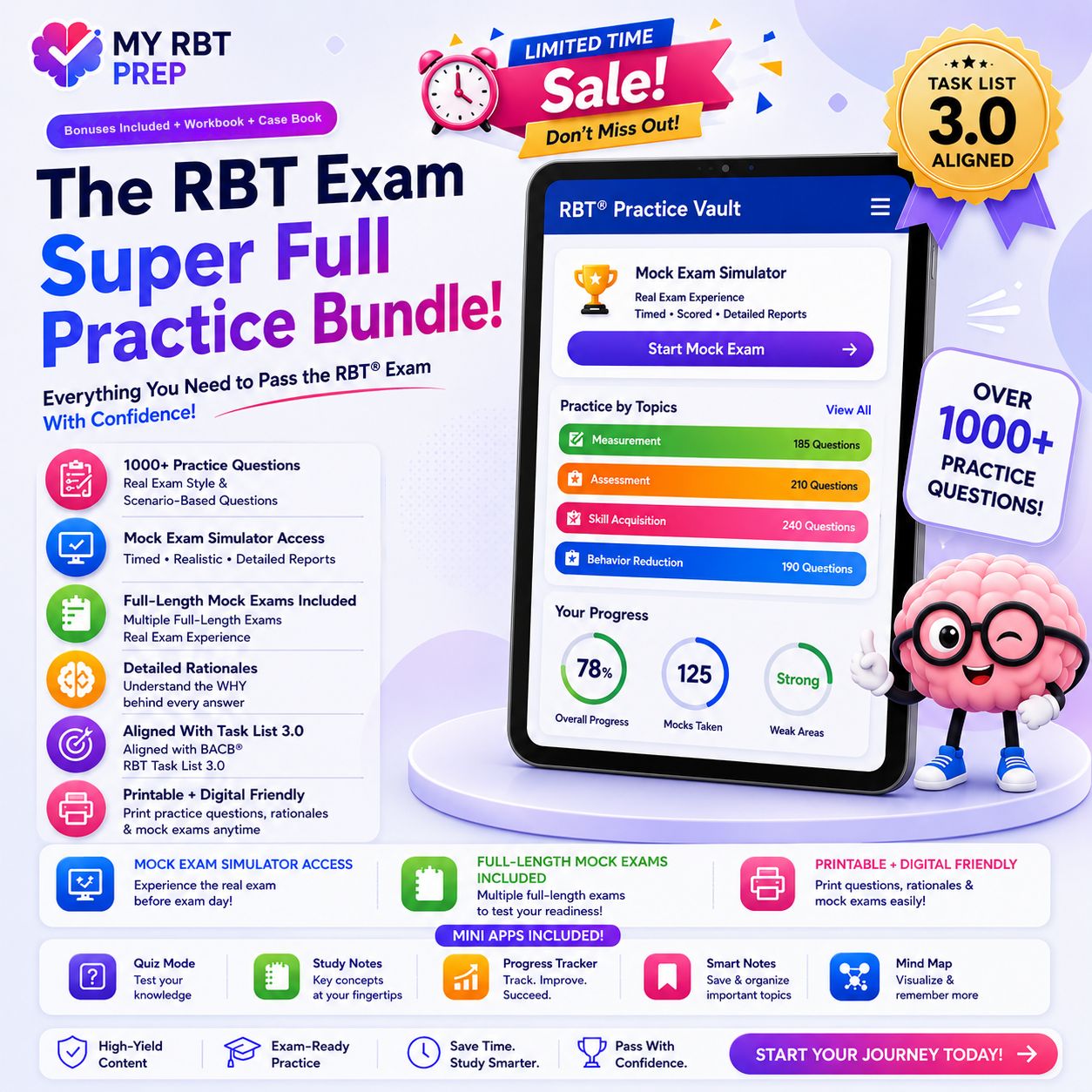
Pass Your RBT® Exam on the First Attempt
Practice with 1,000+ realistic scenario questions, multiple full-length timed mock exams, and detailed rationales formatted exactly like the real Pearson VUE test.

Functional assessment
Functional assessment is critical in determining the root causes of behavior. For instance, a child might scream during a task because they want attention or to escape a difficult instruction.
By carefully observing, recording, and analyzing behavior functions, RBTs can design behavioral interventions that increase engagement and promote learning. Data collection and scoring are essential, as every observation informs teaching and treatment strategies.
In practice, RBT Behavior Assessment also supports the application of curriculum-based assessment, helping learners achieve early language and learning milestones while targeting key teaching skills targeting in a structured way. These assessments are the backbone of creating individualized programs that work in schools, clinics, or homes.
Exam Tip: Always remember that the purpose of behavior assessment is to gather objective data first before drawing conclusions about interventions.


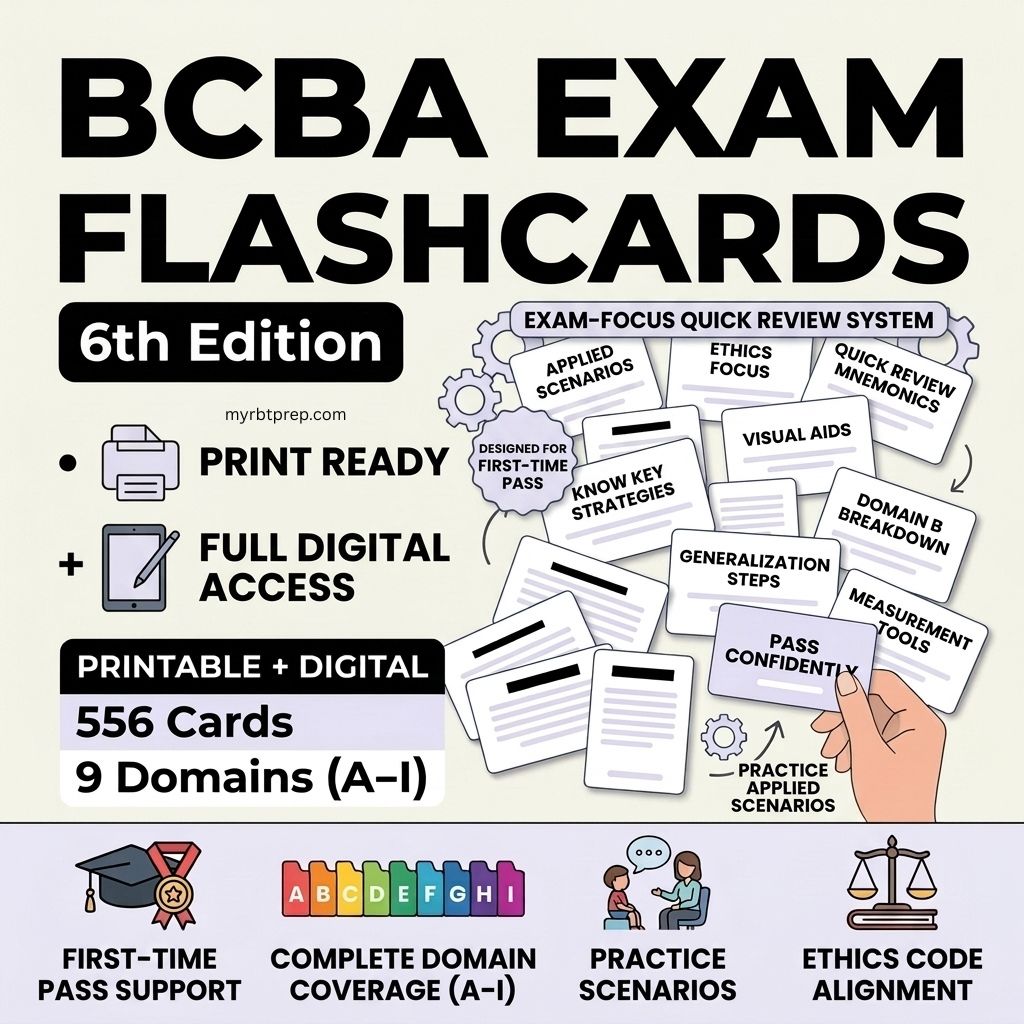
RBT® Exam Flashcards & Study App (3rd Edition)
Master essential ABA terminology and clinical discrimination across all 6 BACB task list areas with 500+ printable and digital flashcards, real exam cues, and full mobile app access.
What Will You Learn in This Guide?
This guide provides a complete roadmap for mastering RBT Behavior Assessment. You will learn to conduct preference assessments to identify motivating stimuli, perform skill assessments such as VB-MAPP, ABLLS-R, and Functional living skills (AFLS), and participate in functional assessment procedures to identify behavior triggers.
Key learning outcomes include:
- How to document learner responses during assessment effectively.
- Understanding how to apply curriculum-based assessment to teaching skills.
- Collecting and analyzing ABC data to identify behavior functions.
- Performing reinforcer assessment to determine effective motivators.
You will gain practical skills for recording and interpreting data under BCBA supervision, enabling you to support behavioral intervention in diverse settings.

Key Terms and Concepts in RBT Behavior Assessment
Several key concepts are essential for success in RBT assessments:
Preference assessment methods: Free-operant assessment, paired-stimulus assessment, and Multiple-Stimulus (MSW/MSWO) guide identification of motivating items.
Skill assessment tools: VB-MAPP, ABLLS-R, and AFLS evaluate early language and learning milestones, functional living, academic, and social skills.
Other important concepts include:
- Functional analysis (FA)
- Trial formats
- Assessment protocols
- Data collection and scoring
- Learner engagement
Exam Tip: Know all abbreviations and what each assessment tool measures. Misunderstanding terms is a common source of mistakes in the RBT exam.
B.1 Conduct Preference Assessments
Step-by-Step Process
Conducting preference assessments helps identify what motivates learners. Free-operant assessment allows learners to explore items freely while you observe. Paired-stimulus assessment presents two items per trial, rotating pairs to determine preference ranking.
MSW allows learners to choose and return items, while MSWO removes chosen items to complete ranking quickly. Following a step-by-step multiple-stimulus assessment guide ensures accuracy and reliability.
Example of MSWO ranking:
|
This table shows that the Marble Run is the strongest reinforcer. Using such structured data supports identifying reinforcers for behavior interventions and maximizes learner engagement.
Common Pitfalls to Avoid
- Prompting learners unintentionally.
- Failing to reassess when preferences shift.
- Assuming a preferred item automatically serves as a reinforcer without proper reinforcer assessment.
Exam Tips and Best Practices
- Use MSW for repeated trials to confirm strong motivators.
- Use MSWO for quick ranking in one session.
- Record selections and engagement time accurately.
- Consider environmental factors like fatigue or setting.
B.2 Participate in Assessments of Relevant Skill Strengths and Deficits
Methods for Assessing Skills
RBTs conduct skill assessments under BCBA supervision using VB-MAPP, ABLLS-R, and AFLS. These tools evaluate early language and learning milestones, academics, social skills, and functional living skills (AFLS). Structured curriculum-based assessment ensures objective results and guides effective teaching skills targeting.
Example: During a VB-MAPP expressive language probe, a learner is asked to label objects. Correct labeling indicates mastery, while errors highlight skills that need further instruction.
Common Pitfalls to Avoid
- Coaching learners during tasks.
- Mixing scoring rules from different assessment tools.
- Ignoring trial formats and protocol instructions.
Exam Tips and Best Practices
- Match assessment tools to learner goals.
- Document accurately when evaluating skill strengths and deficits.
- Apply curriculum-based assessment to teaching skills carefully for goal setting.
B.3 Participate in Components of Functional Assessment Procedures
Functional Assessment Overview
RBTs participating in functional assessment procedures collect ABC data and assist BCBAs with functional analysis (FA). Identifying behavior functions (attention, escape, access to tangibles, automatic/sensory) helps guide interventions effectively. Observing behavior patterns informs behavioral intervention and ensures learners’ needs are addressed safely.

Common Pitfalls to Avoid
- Making assumptions about behavior without recording accurate ABC data.
- Performing tasks outside RBT scope.
- Failing to follow assessment protocols during functional observation.
Exam Tips and Best Practices
- Record events objectively during FA.
- Collaborate closely with the BCBA.
- Focus on patterns between antecedent, behavior, and consequence to design interventions.
Changes in Task List 3.0 (2026)
Topics That Were Kept
B.1, B.2, and B.3 remain central to Task List 3.0 (2026). These sections emphasize preference assessments, skill assessments, and functional assessment, reflecting clinical realities and improving learner engagement.
Topics That Were Removed
No tasks were fully removed, but content was clarified for accuracy. Examples and instructions were refined to ensure RBTs clearly understand responsibilities and comply with assessment protocols.
Reasons Behind the Changes
Updates emphasize active RBT participation rather than passive assistance. Detailed examples and revised language improve understanding of how to conduct preference assessments as an RBT and implement behavioral intervention effectively.
Exam Tip: Review the changes carefully, as questions often focus on updates from previous task lists.
Practical Applications of Behavior Assessment
RBTs use preference assessments, skill assessments, and functional assessment in real-world settings like homes, schools, and clinics. Observing learner engagement helps identify motivators and informs teaching skills targeting.
Example scenario: A child avoids math tasks to escape difficulty. Conducting a reinforcer assessment using MSW or MSWO identifies motivators, and collecting ABC data guides interventions. Observation recording ensures interventions are tailored, measurable, and effective.
Tips for Successful RBT Exam Preparation
- Practice conducting preference assessments like MSW/MSWO.
- Review VB-MAPP, ABLLS-R, and AFLS thoroughly.
- Focus on accurate documenting learner responses during assessment.
- Understand functional analysis (FA) and behavior functions.
- Study trial formats and assessment protocols carefully.
Exam Tip: Time yourself while completing practice assessments and documenting data to improve speed and accuracy under exam conditions.
Next Steps After Learning Behavior Assessment
After mastering RBT Behavior Assessment, apply skills in real settings under BCBA supervision. Perform preference assessments, skill assessments, and functional assessment procedures regularly to strengthen competence.
Continuing education and practical application reinforce knowledge. Regularly review Task List 3.0 (2026), practice evaluating skill strengths and deficits, and implement curriculum-based assessment to teaching skills to stay sharp and prepared for both exams and professional work.
MSW vs MSWO Comparison Table
|
Sample ABC Data Table
|
Using Data Collection and Scoring to Improve Interventions
Accurate data collection and scoring are the backbone of effective RBT Behavior Assessment. Every observation, whether during preference assessments, skill assessments, or functional assessment, provides valuable insight into learner behavior. Consistently recording Antecedent-Behavior-Consequence (ABC) data allows RBTs and BCBAs to detect patterns, determine behavior functions (attention, escape, access to tangibles, automatic/sensory), and develop precise behavioral interventions.
Structured observation recording is essential. For instance, during a free-operant assessment, noting which items a learner engages with and for how long identifies potential reinforcers for teaching sessions. Similarly, when performing a functional analysis (FA), documenting duration, frequency, and intensity of behavior in various conditions ensures reliable data.
RBTs must follow assessment protocols closely to avoid bias. Proper trial formats and standardized scoring methods improve consistency across sessions. The collected data not only guides interventions but also helps track progress over time, informing curriculum-based assessment and teaching skills targeting. Mastering data collection and scoring equips RBTs to create evidence-based programs that maximize learner engagement and effectiveness in both clinical and educational environments.
Exam Tip: Practice scoring sample ABC data tables accurately, as this skill is often tested on the RBT exam.
Enhancing Learner Engagement During Assessments
Engagement is a critical factor in RBT Behavior Assessment because a learner who participates actively provides more accurate data. Using preference assessments such as MSW/MSWO or paired-stimulus assessment helps identify items that motivate learners, improving attention and cooperation during skill assessments or functional assessment procedures.
RBTs can enhance engagement by varying activities, keeping sessions short, and monitoring learner engagement levels continuously. For example, using highly preferred items during teaching sessions can increase compliance with tasks, while adjusting reinforcement schedules ensures sustained participation. Understanding behavior functions (attention, escape, access to tangibles, automatic/sensory) helps RBTs select appropriate strategies to maintain focus.
Practical strategies include alternating tasks to prevent boredom, using visual schedules, and recording observations systematically. Accurate documenting learner responses during assessment provides insight into what motivates each individual and informs teaching skills targeting. Tracking engagement over time helps BCBAs refine curriculum-based assessment and functional living skills (AFLS) programs for maximum effectiveness.
Exam Tip: Always observe both duration and quality of responses to determine true engagement rather than just compliance.
Comparing Assessment Tools: VB-MAPP, ABLLS-R, and AFLS
Selecting the right tool is vital for effective skill assessments. VB-MAPP, ABLLS-R, and Functional living skills (AFLS) each serve unique purposes in RBT Behavior Assessment. VB-MAPP focuses on early language and learning milestones, providing a framework for young learners’ expressive and receptive communication skills. ABLLS-R offers a broader view of academic, language, motor, and self-help skills. AFLS emphasizes functional independence and daily living competencies for older learners or those with more advanced abilities.
Each tool has specific trial formats and requires careful documenting learner responses during assessment. For example, VB-MAPP probes might ask a child to label objects independently, while ABLLS-R may evaluate multi-step instructions for accuracy. AFLS might assess real-life tasks like meal preparation or money management. RBTs must follow assessment protocols and data collection and scoring methods for reliable results.
Understanding differences between tools ensures teaching skills targeting matches learner needs. Combining results from multiple assessments allows BCBAs and RBTs to design effective behavioral intervention programs that enhance learning, skill acquisition, and independence. Mastering these tools strengthens confidence in real-world assessment scenarios and improves learner engagement consistently.
Exam Tip: Practice using sample probes for each assessment to understand scoring differences and administration requirements.
Applying Reinforcer Assessment in Real-Life Scenarios
A key part of RBT Behavior Assessment is conducting reinforcer assessment to identify what motivates learners. Reinforcers can be tangible items, activities, or social interactions. Using methods like free-operant assessment, paired-stimulus assessment, or MSW/MSWO, RBTs observe learner choices and determine what increases desired behaviors reliably.
For instance, a learner may prefer a marble run over other toys. Recording the frequency and duration of engagement helps determine whether this item is an effective reinforcer for teaching new skills. Reinforcers support compliance, attention, and learner engagement across sessions. Combining reinforcer assessment with functional assessment ensures interventions are meaningful and sustainable.
In practice, RBTs should consider factors like timing, session context, and prior exposure when selecting reinforcers. Accurate observation recording and data collection and scoring allow for objective decision-making. Effective use of reinforcers enhances behavioral intervention, improves skill acquisition, and aligns with curriculum-based assessment goals.
Exam Tip: Always confirm that a preferred item actually increases a target behavior before using it as a reinforcer during instruction.
Functional Analysis and Using ABC Data
Functional analysis (FA) study is critical for RBTs taking part in functional assessment processes. FA enable identification of antecedent to the behavior and the function of the behavior (e.g., attention, escape, automatic reinforcement). Using accurate ABC data collection, the RBT is capable of representing the relationship between antecedent, behavior, and consequence.
When running an FA the RBT may run structured trials with conditions of demand, attention, tangible access, or free play. In these trials, the trial formats and assessment protocols will assist in the observation that is relevant, environmental safety, and established ethical behaviors under the BCBA supervision. Observing and documenting consistently in each of these observations allow for consistent result interpretations and evidence-based behavioral intervention strategies.
ABC data can also reveal patterns identifying teaching skills that would target the same results, e.g, if a learner is consistently dropping tasks to escape demands the ABC type data suggests escape is the target behavior function. The RBT can work with the BCBA to reinforce a new behavior through positive reinforcement or skill building activities. FA, and ABC data are necessary to practice in RBT Behavior Assessment successfully.
Exam Tip: Particular attention to detail will be emphasized in ABC scenarios since exam questions test your level of detail if you are able to identify the three components of ABC.
Final tips
Always follow assessment protocols carefully, document ABC data accurately, practice preference and skill assessments, review Task List 3.0 (2026) regularly, and seek guidance under BCBA supervision. Consistent practice and observation improve accuracy, confidence, and learner engagement.
Faqs
How to pass the RBT competency assessment?
Focus on mastering Task List 3.0 (2026) skills, practice preference and skill assessments, and follow BCBA supervision protocols.
How do I prepare for the RBT exam?
Study key tools like VB-MAPP, ABLLS-R, AFLS, review assessment protocols, practice ABC data collection, and complete practice quizzes.
What is the best RBT study guide?
A comprehensive guide covering preference assessments, skill assessments, functional assessments, and updates from Task List 3.0 (2026).
What is the role of an RBT in behavior assessment?
RBTs assist under BCBA supervision, conduct data collection and scoring, perform preference and skill assessments, and help identify behavior functions.
What are the 7 steps of a functional behavior assessment?
Identify target behavior, gather ABC data, conduct indirect assessment, direct observation, functional analysis (FA), hypothesis development, and intervention planning.

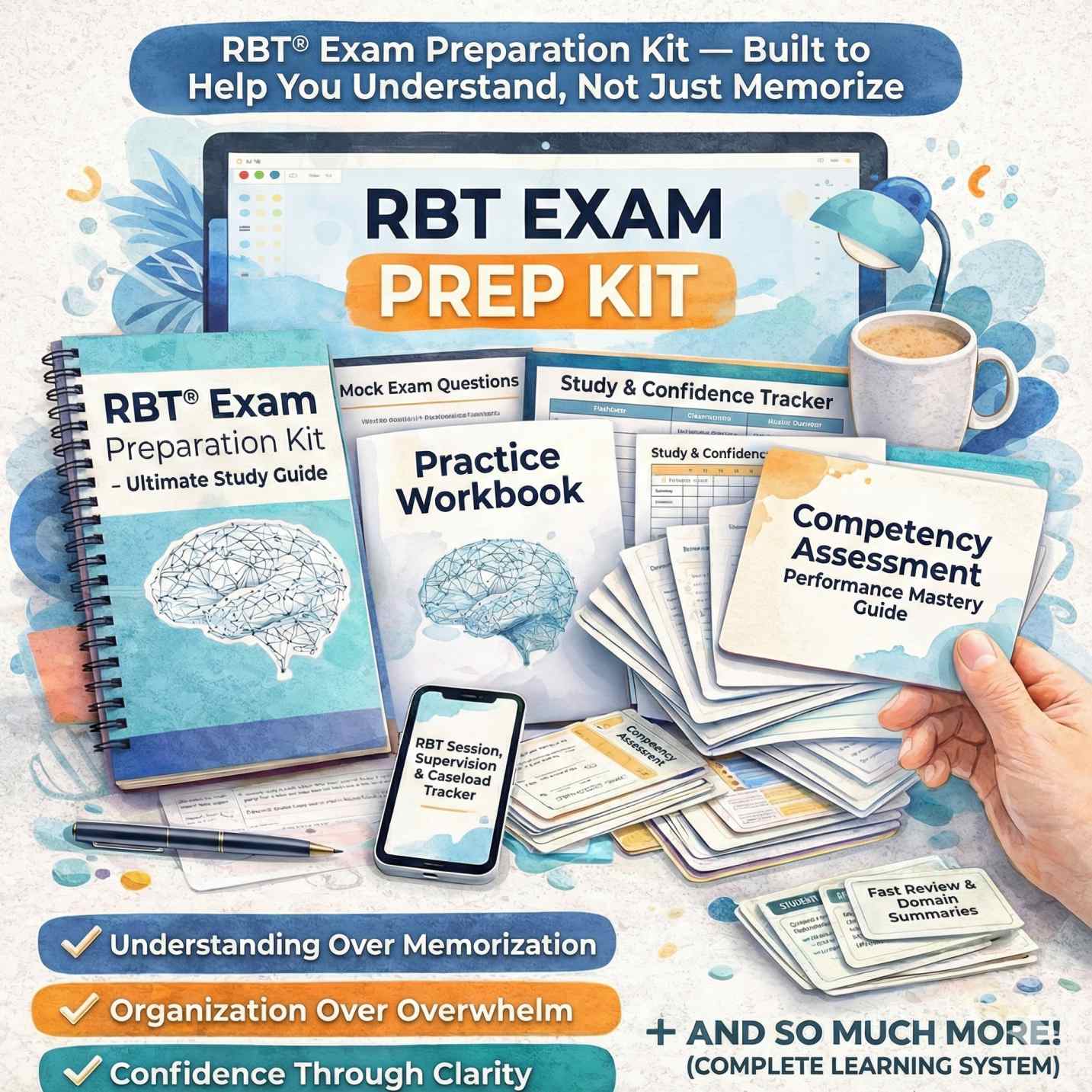
Everything You Need to Pass Your RBT® Exam
Study with our complete, all-in-one preparation package covering every task on the BACB Task List 3.0:
- 1,000+ Practice Questions & Timed Simulator
- 3rd Edition Task List Study Guide & Workbook
- Active Recall Flashcards System + Mobile App
- 20-Task Competency Assessment Mastery Guide