
The RBT Behavior Reduction Guide is an essential resource for anyone preparing to implement effective behavior interventions. This guide focuses on teaching function-based alternatives to reduce challenging behaviors safely and ethically. By using behavior support plans, RBTs can identify the underlying behavior functions such as attention, escape, tangible, or sensory needs and you can practice for rbt exam.
The guide emphasizes practical strategies, including antecedent interventions, differential reinforcement, and proper use of extinction procedures, ensuring interventions are consistent and measurable. It also covers managing side effects like extinction burst, response variation, and behavior resurgence.
With this comprehensive guide, RBTs gain the knowledge and confidence to handle behaviors effectively while prioritizing learner safety and progress.
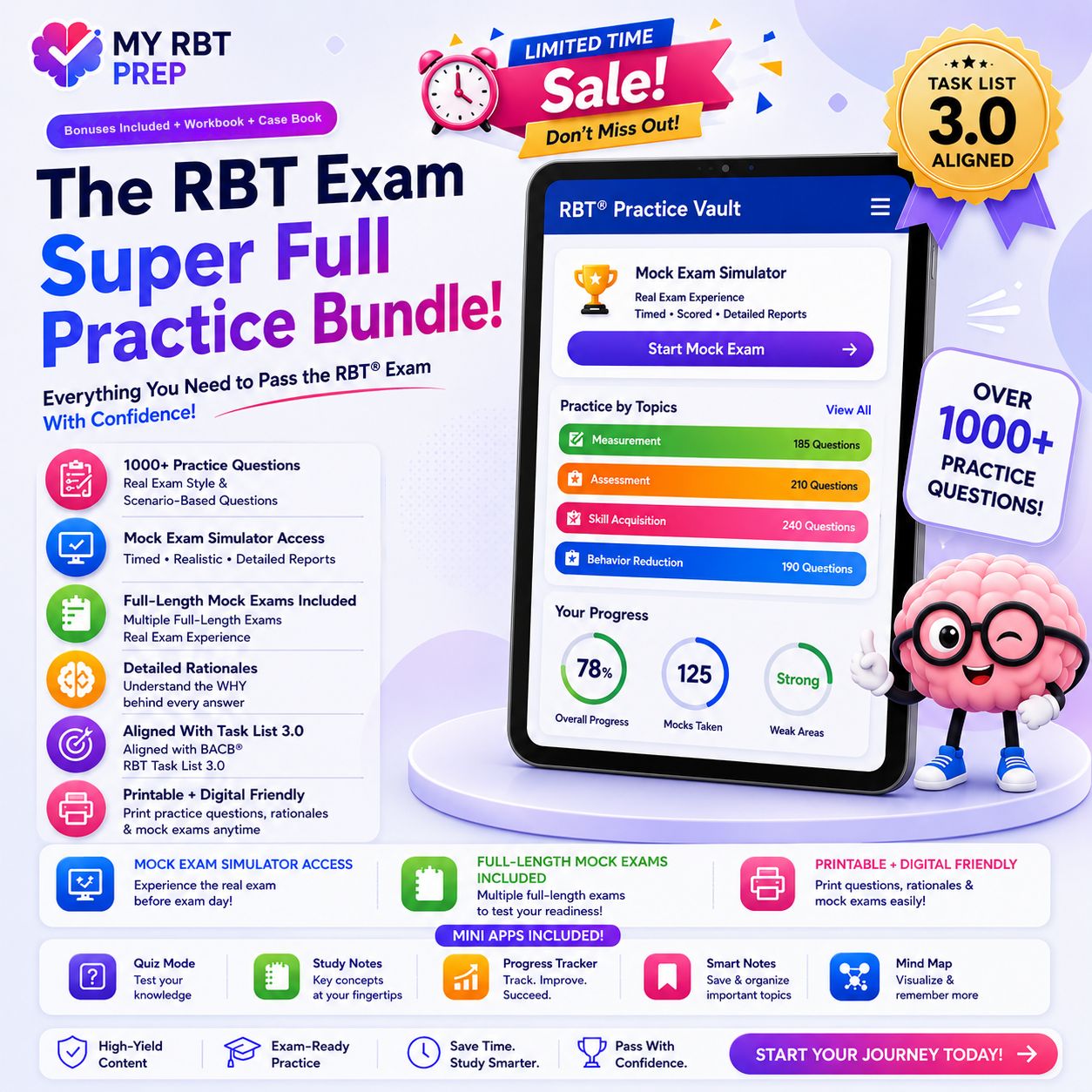
Pass Your RBT® Exam on the First Attempt
Practice with 1,000+ realistic scenario questions, multiple full-length timed mock exams, and detailed rationales formatted exactly like the real Pearson VUE test.

What Will You Learn?
The RBT Behavior Reduction Study Guide teaches you how to identify behavior functions and implement strategies that reduce problem behaviors while increasing positive skills. You will learn to apply antecedent interventions that prevent challenging behaviors, use differential reinforcement (DRA, DRI, DRO, DRL/DRH) to strengthen appropriate behaviors, and manage behaviors using extinction procedures, positive punishment, and negative punishment when necessary.
Practical skills include identifying triggers for attention-maintained behaviors, teaching Functional Communication Training (FCT) for communication-based replacement behaviors, and applying function-based alternatives for problem behavior.
You will also learn to anticipate side effects such as extinction burst, response variation, emotional responding, and behavior resurgence, preparing you for real-world scenarios. The guide emphasizes stepwise behavior intervention plans, careful reinforcer identification and scheduling, and maintaining consistent clinical behavior management for RBT, all essential for safe and effective interventions.

RBT Behavior Reduction Key Terms
Understanding key terms is essential before implementing interventions. Behavior functions (attention, escape, tangible, sensory) explain why a behavior occurs. For instance, a learner might scream for attention, throw materials to escape a task, grab items to access a preferred activity, or flap hands for sensory stimulation. Differential reinforcement (DRA, DRI, DRO, DRL/DRH) allows you to strengthen appropriate behaviors while decreasing problem behaviors.

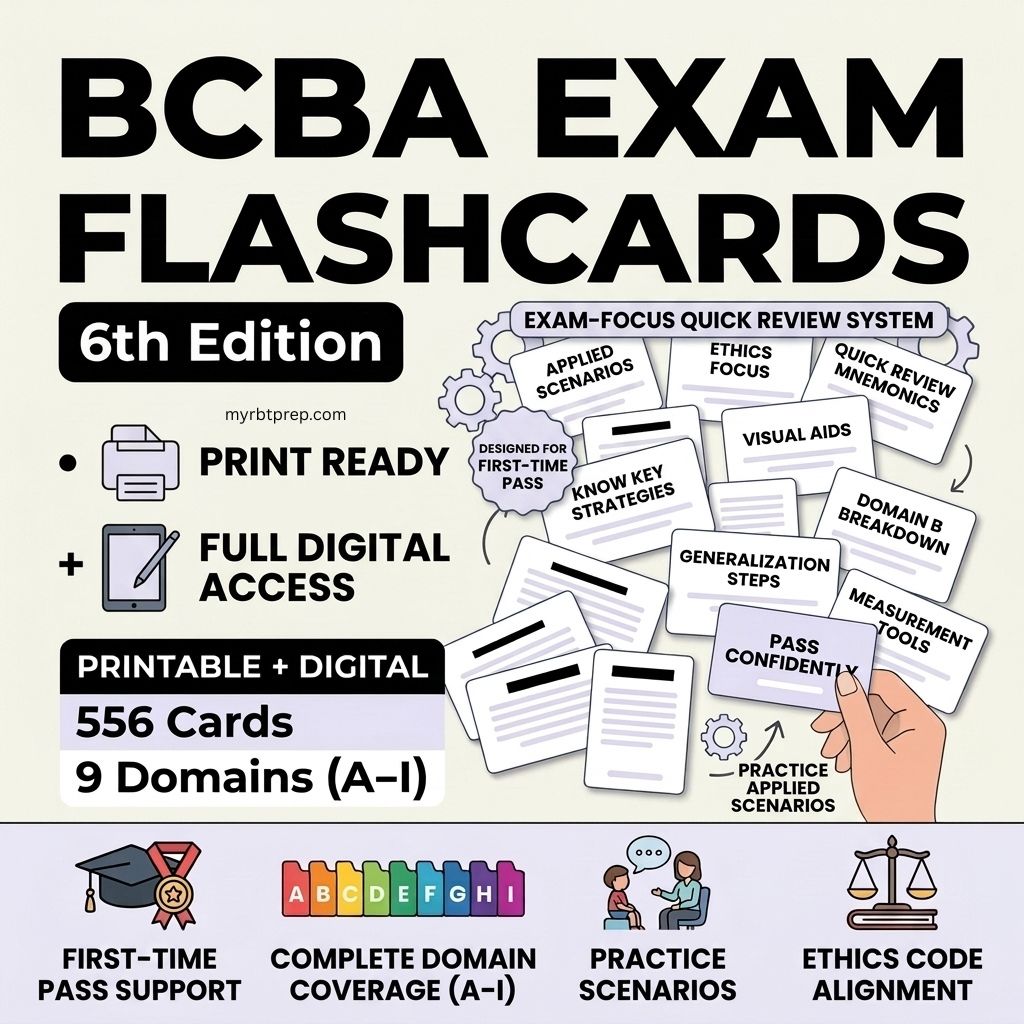
RBT® Exam Flashcards & Study App (3rd Edition)
Master essential ABA terminology and clinical discrimination across all 6 BACB task list areas with 500+ printable and digital flashcards, real exam cues, and full mobile app access.
Functional Communication Training (FCT) replaces problem behaviors with communication skills, teaching learners to request what they need instead of engaging in challenging behavior.
Time-out procedures and response cost are important forms of positive punishment and negative punishment, respectively, used only alongside teaching replacement skills. Knowledge of behavior assessment and analysis helps track behavior changes, while monitoring behavior trends ensures interventions are effective. Understanding these terms prepares you for both clinical practice and the RBT Behavior Reduction exam.
D.1 Identify Common Functions of Behavior
Every behavior serves a purpose, and correctly identifying that function is critical. Using ABC pattern analysis, you can determine whether a behavior is attention-seeking, escape-driven, tangible-focused, or automatically reinforced by sensory input. This helps in matching interventions to behavior function and developing function-based alternatives for problem behavior.
For example, a child hitting a peer may do so to gain attention or obtain a toy. By carefully observing antecedents and consequences, you can distinguish between these functions.
Once identified, you can implement antecedent interventions to reduce triggers, reinforce alternative behaviors using differential reinforcement, and prevent harm. This understanding forms the foundation for all behavior reduction strategies and ensures interventions are ethical, effective, and sustainable.
- Every behavior serves a purpose; identifying that function is essential for effective intervention.
- Use ABC pattern analysis (Antecedent-Behavior-Consequence) to determine if the behavior is attention-seeking, escape-driven, tangible-focused, or sensory/automatic.
- Matching interventions to behavior function allows for function-based alternatives and ethical behavior reduction strategies.
- Example: A child hitting a peer could be seeking attention or a toy; observing antecedents and consequences clarifies the function.
- Once identified, apply antecedent interventions, differential reinforcement, and safety strategies to reduce harm.
Exam Tips:
- Always identify the function first; topography alone can be misleading.
- Look for multiple contexts—one behavior may serve different functions in different situations.
- Focus on consequences rather than appearance.
D.2: Implement Antecedent Interventions
Antecedent interventions focus on preventing problem behaviors before they occur. Techniques like noncontingent reinforcement, high-probability request sequence, and demand fading are common.
Noncontingent reinforcement (NCR) provides the maintaining reinforcer on a time-based schedule, reducing motivation to engage in problem behaviors. For instance, if a child screams for attention every two minutes, providing attention on a timer reduces the frequency of screams.
The high-probability request sequence involves giving several easy tasks before presenting a difficult one, creating momentum for compliance. Demand fading gradually increases task difficulty, allowing learners to succeed at each step. These interventions are effective because they apply antecedent strategies effectively, make the environment predictable, and minimize frustration. Proper use ensures reducing problem behaviors ethically while supporting function-based alternatives that maintain client dignity.
- Antecedent interventions prevent problem behaviors before they occur.
- Common techniques include Noncontingent Reinforcement (NCR), High-Probability Request Sequence (High-P), and Demand Fading.
- NCR delivers the maintaining reinforcer on a time-based schedule to reduce motivation for problem behaviors.
- High-P sequences give several easy tasks before a harder one, building compliance momentum.
- Demand fading gradually increases task difficulty, allowing learners to succeed and minimize frustration.
- Proper use supports reducing problem behaviors ethically, maintaining dignity, and reinforcing function-based alternatives.
Exam Tips:
- Understand when to use each antecedent strategy: NCR = timed reinforcement; High-P = easy-easy-hard; Fading = gradual task increase.
- Anticipate triggers and reduce frustration to prevent problem behavior escalation.
- Document interventions carefully to demonstrate consistent application.
D.3: Implement Differential Reinforcement
Differential reinforcement strengthens positive behaviors by reinforcing appropriate actions while withholding reinforcement for problem behaviors.
DRA (Differential Reinforcement Alternative) teaches behaviors that serve the same function as the problem behavior. DRI (Differential Reinforcement Incompatible) reinforces behaviors that cannot occur simultaneously with the problem behavior. DRO (Differential Reinforcement Other) rewards periods without problem behaviors, and DRL/DRH adjusts the rate of acceptable behaviors.
For example, if a learner grabs a toy without asking, DRA could teach them to request politely, while DRI might reinforce keeping hands in pockets to prevent grabbing. Pairing FCT with differential reinforcement ensures learners can communicate needs instead of displaying challenging behaviors.
Using examples of differential reinforcement, stepwise behavior intervention plans, and careful reinforcer identification and scheduling helps maintain progress and ensures interventions are ethical behavior reduction practices.
- Differential reinforcement strengthens positive behaviors and reduces problem behaviors by carefully reinforcing alternatives.
- Types include DRA (alternative behavior), DRI (incompatible behavior), DRO (absence of problem behavior), and DRL/DRH (rate control).
- Example: A learner grabs a toy; DRA teaches polite requests, DRI reinforces hands-in-pocket to prevent grabbing.
- Pairing Functional Communication Training (FCT) with differential reinforcement allows learners to communicate needs instead of acting out.
- Careful reinforcer identification and scheduling, stepwise intervention plans, and ethical practices maintain progress and reduce problem behaviors.
Exam Tips:
- Know which differential reinforcement procedure fits the behavior function.
- Ensure the replacement behavior achieves the same function as the problem behavior.
- Track and adjust intervals or criteria for DRO/DRL to maintain effectiveness.
D.4: Implement Extinction Procedures
Extinction procedures reduce behaviors by removing the reinforcer maintaining them. For attention-maintained behaviors, ignoring the behavior while reinforcing appropriate alternatives is critical.
Escape-maintained behaviors require keeping demands in place with compassionate prompting. Tangible behaviors are managed by withholding items following problem behaviors while still providing access for function-based alternatives. Sensory behaviors may require introducing alternative stimuli.
Side effects such as extinction burst, response variation, and behavior resurgence often occur. Monitoring these trends ensures safe intervention.
Pairing extinction with reinforcement for appropriate behavior ensures ethical practice. By tracking progress and adjusting plans as needed, you ensure ethical behavior reduction practices while maintaining clinical behavior management for RBT.

D.5: Implement Positive and Negative Punishment Procedures
Punishment procedures decrease the likelihood of future behaviors. Positive punishment introduces a consequence like overcorrection, while negative punishment removes access to reinforcement, such as time-out procedures or response cost. These methods should always be paired with teaching function-based alternatives for problem behavior.
For instance, a child throwing materials in a game could receive a brief time-out, followed by reinforcement for handling materials appropriately.
Proper application requires understanding reinforcement and punishment in ABA, monitoring emotional responding, and responding to side effects. Using these methods ensures interventions are safe, measured, and effective while preserving client dignity and supporting reducing problem behaviors ethically.

D.6 Describe Secondary Effects of Extinction and Punishment
Extinction and punishment can trigger unintended effects such as emotional responding, response variation, or behavior resurgence. Recognizing and preparing for these effects ensures the safety of both clients and staff. Reinforcing alternative behaviors immediately reduces the likelihood of relapse. Tracking trends over time supports effective adjustments.
Anticipating side effects also strengthens behavior support plans and allows for better safety and crisis management in ABA.
Proper application of these techniques ensures interventions remain ethical behavior reduction practices, building trust while teaching new skills effectively. Observing and responding to behaviors systematically enhances clinical behavior management for RBT.
D.7 Implement Crisis/Emergency Procedures
Crisis/emergency procedures ensure immediate safety during severe behavioral events. Knowing the protocol, executing strategies correctly, and documenting observations are essential. Interventions must follow written plans precisely, avoiding untrained improvisation. This protects both the learner and staff.
For example, if a learner becomes aggressive, using trained holds or removing hazards while reinforcing calm behavior ensures safety.
Debriefing and reviewing the event ensures continual learning and improvement. Emphasizing safety and crisis management in ABA ensures all steps are consistent, ethical, and effective for long-term behavior reduction success.
|
What Changed in Task List 3.0?
Task List 3.0 emphasizes practical implementation and clarity. Core topics like D.1 Identify common functions, D.2–D.7 behavior procedures, and antecedent interventions remain. D.5 Positive/negative punishment and D.6 secondary effects are expanded to include more detail on side effects, such as emotional responding and behavior resurgence.
A previously required written behavior reduction plan was removed since behavior assessment and analysis is now integrated into all implementation tasks.
Changes emphasize applying antecedent strategies effectively and broadening differential reinforcement options. Overall, Task List 3.0 strengthens practical, ethical, and measurable behavior reduction strategies for RBTs.
Practical Tips for RBT Exam Success
Exam success relies on knowing how to identify behavior functions, apply antecedent interventions, and reinforce function-based alternatives. Practicing ABC analysis, reviewing examples of differential reinforcement, and anticipating extinction burst or behavior resurgence helps build competence.
Tracking data and monitoring behavior trends supports evidence-based decisions. Applying stepwise behavior intervention plans in real or simulated scenarios ensures readiness.
Being familiar with FCT, extinction, punishment, and crisis procedures helps RBTs pass the RBT Behavior Reduction exam confidently while reinforcing ethical and effective behavior support.
Next Steps
Success on the exam is dependent on understanding how to identify behavior functions, implement antecedent interventions, and reinforce function-based alternatives. Practicing ABC analysis, looking at examples of differential reinforcement, and anticipating an extinction burst or resurgence of behavior become valuable tools to improve your capability.
Data collection and monitoring trends allows for evidence-based decision-making. Evaluating stepwise behavior intervention plans in real or simulated situations will increase your ability to act with confidence.
Familiarity with FCT, extinction, punishment, and crisis procedures enables RBTs to confidently pass the RBT Behavior Reduction exam while acting ethically and providing effective behavior support.
Faqs
What is an essential component of a behavior reduction plan?
An essential component is identifying the function of the behavior and selecting function-based interventions to reduce problem behaviors effectively.
What are the main rules to adhere to as an RBT?
RBTs must follow written protocols, ensure learner safety, implement interventions ethically, and collect accurate data consistently.
What is the role of the RBT in implementing a behavior reduction plan?
The RBT applies antecedent strategies, reinforcement, and punishment procedures under supervision, while monitoring behavior and recording progress.
At what point should a behavior reduction be considered?
Behavior reduction should be considered when a behavior interferes with learning, safety, or social interaction.
What are the 5 stages of behavioral change?
The stages are precontemplation, contemplation, preparation, action, and maintenance, guiding systematic behavior interventions.

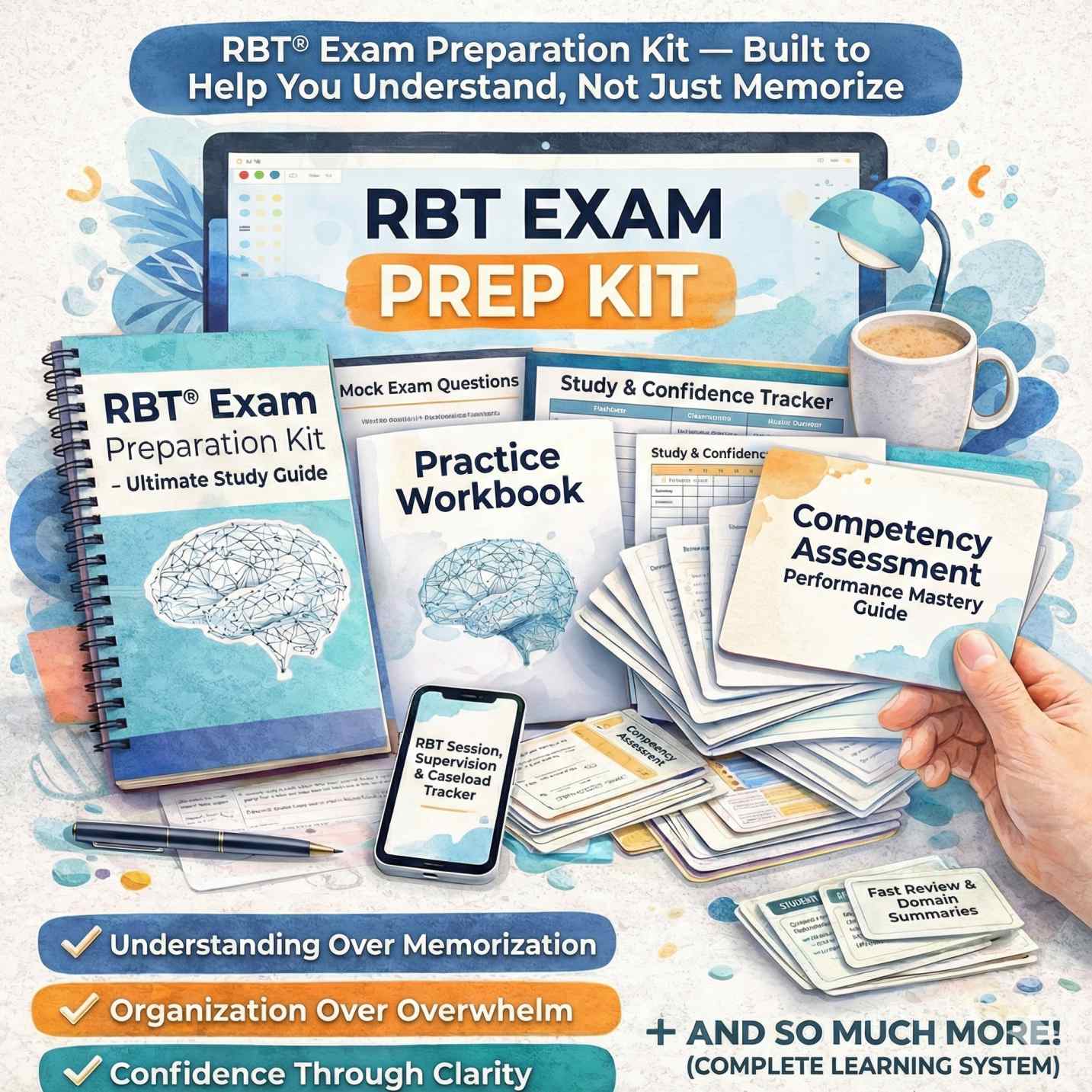
Everything You Need to Pass Your RBT® Exam
Study with our complete, all-in-one preparation package covering every task on the BACB Task List 3.0:
- 1,000+ Practice Questions & Timed Simulator
- 3rd Edition Task List Study Guide & Workbook
- Active Recall Flashcards System + Mobile App
- 20-Task Competency Assessment Mastery Guide