Applied Behavior Analysis (ABA) therapy is a science-driven approach to understanding and improving socially significant behavior. At its core, ABA therapy relies heavily on the principle of reinforcement – a fundamental mechanism that drives learning and behavior change.
For Registered Behavior Technicians (RBTs), a deep and practical understanding of reinforcement is not just theoretical knowledge; it’s the bedrock of their daily work. RBTs are directly responsible for implementing behavior-analytic services under the supervision of a Board Certified Behavior Analyst (BCBA), and the effective application of reinforcement techniques is paramount to a client’s success.
This comprehensive guide is designed to equip RBTs with the practical knowledge and real-world examples needed to master reinforcement strategies. We will explore the theoretical underpinnings, various types of reinforcement, specific RBT-focused implementation strategies, and common challenges, all with the goal of empowering RBTs to foster lasting, positive behavioral change in their clients.
Pass Your RBT® Exam on the First Attempt
Practice with 1,000+ realistic scenario questions, multiple full-length timed mock exams, and detailed rationales formatted exactly like the real Pearson VUE test.
Understanding the Fundamentals: What is Reinforcement in ABA?
In ABA, reinforcement is defined as a process by which a consequence immediately following a behavior strengthens that behavior, making it more likely to occur again in the future. This is a critical distinction from punishment, which aims to decrease the likelihood of a behavior. Reinforcement, whether positive or negative, always leads to an increase in the future frequency of the behavior it follows.
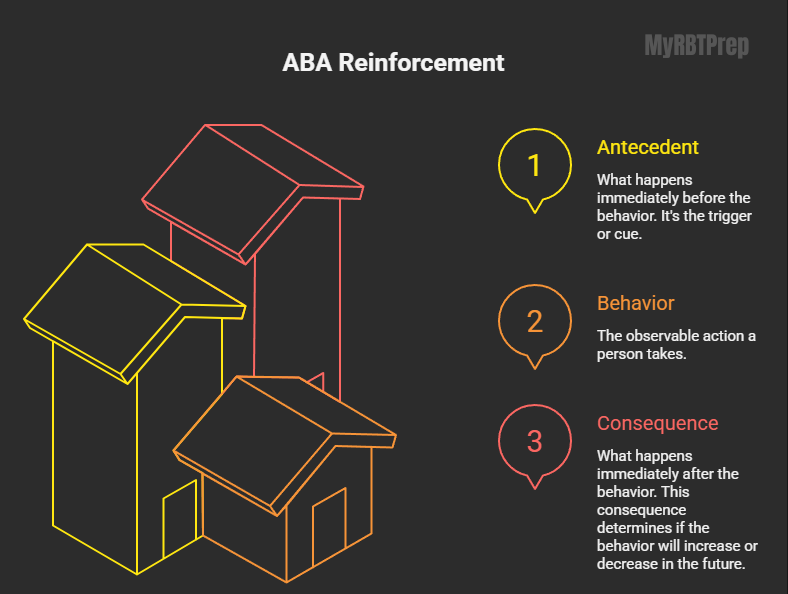
The framework for understanding and applying reinforcement is the Antecedent-Behavior-Consequence (ABC) model:
- Antecedent (A): What happens immediately before the behavior. It’s the trigger or cue.
- Behavior (B): The observable action a person takes.
- Consequence (C): What happens immediately after the behavior. This consequence determines if the behavior will increase or decrease in the future.
For an RBT, understanding the ABCs is crucial. When a client engages in a target behavior, the RBT’s response (the consequence) is what will either reinforce or extinguish that behavior.
RBT Example:
- Antecedent (A): The RBT presents a picture card of an apple and says, “What is this?”
- Behavior (B): The client correctly says, “Apple!”
- Consequence (C): The RBT immediately says, “That’s right, apple!” with enthusiasm and gives the client a high-five.
- Effect: The client is more likely to correctly label “apple” in the future.
The Two Pillars: Positive and Negative Reinforcement
The terms “positive” and “negative” in ABA do not mean “good” or “bad.” Instead, they refer to the addition or removal of a stimulus.
Positive Reinforcement: Adding to Increase
Positive reinforcement involves presenting a desirable stimulus (something the individual wants or likes) immediately after a behavior occurs, which results in an increased likelihood of that behavior happening again.

RBT® Exam Flashcards & Study App (3rd Edition)
Master essential ABA terminology and clinical discrimination across all 6 BACB task list areas with 500+ printable and digital flashcards, real exam cues, and full mobile app access.
Practical RBT Examples:
- Task Completion & Tangible Reward: A client is working on an independent puzzle task. After successfully placing three puzzle pieces without prompts (Behavior), the RBT immediately hands the client a small preferred toy car for 30 seconds (Added Stimulus). This makes it more likely the client will complete more puzzle pieces independently.
- Requesting & Access: A client points to a preferred snack (Behavior). The RBT immediately hands them the snack (Added Stimulus). The client learns that pointing leads to getting desired items.
- Following Instructions & Social Praise: During a group activity, a client follows the instruction “sit down” quickly and without resistance (Behavior). The RBT says, “Fantastic sitting, [Client’s Name]!” with a smile (Added Stimulus – praise and attention). This increases the likelihood of the client following similar instructions in the future.
- Initiating Communication: A child who typically doesn’t initiate conversation says, “Look, RBT, doggy!” while pointing to a dog outside (Behavior). The RBT immediately responds with, “Wow, you see a doggy! It’s so fluffy!” (Added Stimulus – enthusiastic attention and verbal interaction). This reinforces the initiation of spontaneous communication.
Negative Reinforcement: Removing to Increase
Negative reinforcement involves removing an aversive or unpleasant stimulus (something the individual wants to avoid or escape) immediately after a behavior occurs, which also results in an increased likelihood of that behavior happening again. It’s crucial not to confuse negative reinforcement with punishment; both positive and negative reinforcement increase behavior.
Practical RBT Examples:
- Task Aversion & Escape: A client is engaged in a non-preferred writing task. The RBT states, “Finish this sentence, then you can have a break.” The client quickly completes the sentence (Behavior). The RBT immediately says, “Great job, all done! You can take a break now” (Removed Stimulus – the non-preferred task). The client is more likely to complete non-preferred tasks quickly in the future to escape them.
- Sensory Overload & Relief: A client becomes agitated due to a loud noise in the therapy room. The RBT prompts the client to use their “quiet hands” gesture (Behavior) to indicate they want the noise stopped. When the client uses the gesture, the RBT immediately turns off the noise (Removed Stimulus). The client is more likely to use the “quiet hands” gesture in the future when experiencing aversive sounds.
- Peer Interaction & Avoidance: A child is being approached by another peer in a way they dislike (aversive antecedent). The child turns away and says, “No thank you” (Behavior). The peer walks away (Removed Stimulus – the aversive interaction). The child is more likely to use verbal refusal to avoid unwanted interactions.
Types of Reinforcers: Tailoring Motivation
Effective reinforcement hinges on identifying what motivates each individual. RBTs must understand different categories of reinforcers and use preference assessments to individualize their approach.
Primary vs. Secondary Reinforcers
- Primary (Unconditioned) Reinforcers: These are naturally reinforcing and do not require prior learning to be effective. They satisfy biological needs (e.g., food, water, warmth, comfort).
- RBT Application: Often used with learners who have limited established preferences or during initial skill acquisition when strong motivation is needed. A small piece of a client’s favorite candy after a correct response.
- Secondary (Conditioned) Reinforcers: These are stimuli that acquire reinforcing properties through association with primary reinforcers or other strong reinforcers (e.g., praise, tokens, money, toys).
- RBT Application: As clients progress, RBTs aim to transition towards secondary reinforcers because they are more practical and can be delivered more frequently in natural environments. “Great job!” or a star on a token board.
Categories of Reinforcers
RBTs commonly utilize various types of reinforcers:
- Edible Reinforcers: Highly preferred food or drinks.
- RBT Example: A client correctly identifies a color. The RBT immediately gives a small, preferred cracker.
- Tangible Reinforcers: Preferred objects or toys.
- RBT Example: After completing a short writing task, the client earns 1 minute to play with a preferred fidget toy.
- Activity Reinforcers: Access to engaging activities.
- RBT Example: A client maintains eye contact during a short interaction. The RBT allows them to choose a preferred game to play for a few minutes.
- Social Reinforcers: Praise, attention, high-fives, smiles, hugs (if appropriate and preferred).
- RBT Example: A client independently transitions between activities. The RBT gives an enthusiastic “You did it!” and a high-five.
- Token Economies: A system where clients earn tokens (e.g., stars, stickers, points) for desired behaviors, which can later be exchanged for a pre-determined “backup” reinforcer (e.g., screen time, a special toy, a preferred activity).
- RBT Example: A client earns a star on their token board for every 5 minutes they stay seated during work time. Once they earn 5 stars, the RBT allows them to choose 10 minutes of tablet time.
Implementing Reinforcement: Strategies for RBTs
Effective implementation requires careful planning and execution by the RBT.
Preference Assessments: The Foundation
Before any reinforcement plan can be effective, RBTs must identify what motivates the client. This is done through preference assessments.
- Asking: Directly asking the client what they like (if verbal).
- Observing: Watching what the client gravitates towards during free play (e.g., “free operant observation”).
- Trial-based: Presenting various items and observing the client’s choice or reaction (e.g., paired stimulus, multiple stimulus without replacement).
RBT Role: Conduct preference assessments regularly (as outlined in the behavior plan or by the BCBA) because preferences can change. Document findings to ensure the chosen reinforcers remain potent.
Contingent and Immediate Delivery
- Contingency: Reinforcement must be delivered only when the target behavior occurs. This establishes a clear “if-then” relationship: “If you do X, then you get Y.”
- Immediacy: Reinforcers should be delivered immediately (within 0-3 seconds) after the target behavior. This is crucial, especially for individuals with developmental delays, to ensure they make a clear connection between their behavior and the positive outcome.
RBT Example:
- A client is learning to follow a “touch nose” instruction.
- Correct: The RBT says “Touch nose.” The client touches their nose. Immediately, the RBT gives a high-five and says “Nice touching your nose!”
- Incorrect (Delayed): The RBT says “Touch nose.” The client touches their nose. The RBT writes data, then 10 seconds later says “Oh, good job touching your nose.” The delay makes the connection between the behavior and reinforcer less clear, potentially reinforcing an unintentional behavior that occurred during the delay.
Reinforcement Schedules: Sustaining Progress
RBTs implement different reinforcement schedules as instructed by the BCBA to acquire new skills and maintain existing ones.
- Continuous Reinforcement (CRF): Reinforcement is provided after every single instance of the target behavior.
- RBT Example: When first teaching a child to say “more” to request, the RBT provides a preferred item every time the child says “more” correctly. This helps rapidly establish the new skill.
- Intermittent Reinforcement: Reinforcement is provided only after some instances of the target behavior. This is used to maintain behaviors and make them more resistant to extinction.
- Ratio Schedules (Based on Number of Responses):
- Fixed Ratio (FR): Reinforcement after a fixed number of responses.
- RBT Example (FR-3): A client receives a token after correctly completing 3 math problems.
- Variable Ratio (VR): Reinforcement after an unpredictable, but average, number of responses.
- RBT Example (VR-4): A client receives social praise after, on average, every 4 correct responses (e.g., sometimes after 2, then 6, then 3, then 5). This schedule is very effective for maintaining high rates of behavior and is often seen in gambling.
- Interval Schedules (Based on Time):
- Fixed Interval (FI): Reinforcement for the first response after a fixed amount of time.
- RBT Example (FI-5min): A client receives access to a preferred toy if they are appropriately engaged in their task when the RBT checks after 5 minutes.
- Variable Interval (VI): Reinforcement for the first response after an unpredictable, but average, amount of time.
- RBT Example (VI-10min): An RBT reinforces a client for engaging in on-task behavior when checking at unpredictable intervals (e.g., after 7, then 12, then 9 minutes).
Fading Reinforcement and Promoting Generalization
As clients acquire new skills, RBTs, under supervision, gradually fade reinforcement by moving from continuous to intermittent schedules, reducing the magnitude of reinforcers, or shifting from tangible to more natural social reinforcers. This helps prevent dependence on artificial rewards and promotes generalization. Generalization involves the behavior occurring across different people, settings, and materials.
RBT Example: A child initially receives an edible for every correct imitation. The RBT, following the plan, moves to an FR-3 schedule, then replaces edibles with praise, and eventually encourages the child to imitate sounds in different environments (e.g., home, park) with different people (e.g., parent, sibling).
Differential Reinforcement: Precision for Problem Behavior
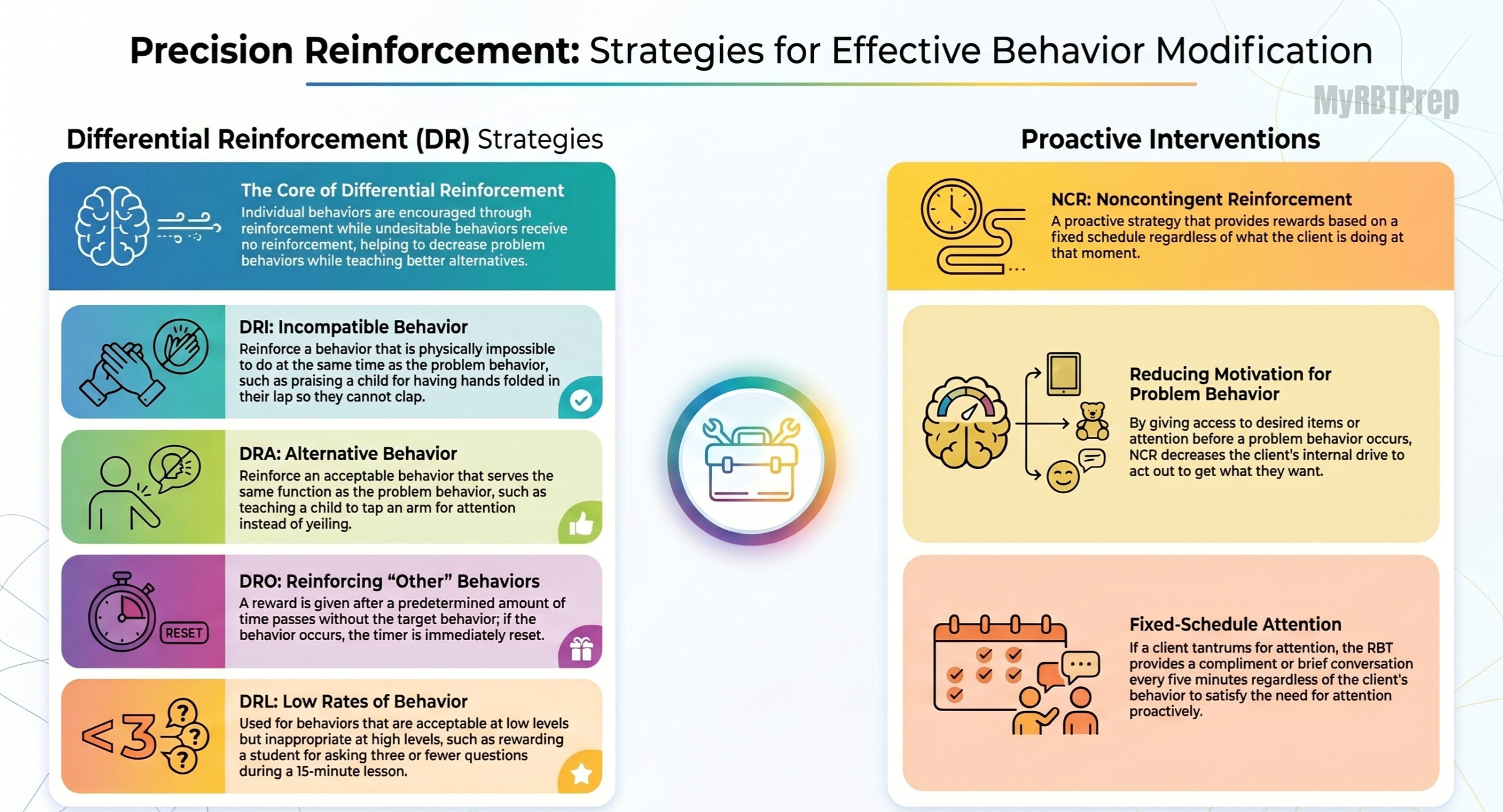
In the case of differential reinforcement (DR), individual behaviors will be encouraged through reinforcement while undesirable behaviors will not receive reinforcement. The methods of differential reinforcement have been shown to assist the RBT with decreasing problem behaviors as well as teaching better alternative behaviors.
Differential Reinforcement of Incompatible Behavior (DRI) – The RBT will reinforce a behavior that is physically impossible to simultaneously occur with the problem behavior. An example of this would be to have the RBT praise the child for keeping his/her hands folded in his/her lap while in session, as he/she can’t clap his/her hands together when his/her hands are folded.
Differential Reinforcement of Alternative Behavior (DRA) – In this case the RBT will reinforce an acceptable alternative behavior that serves the same function as the problem behavior. For example, if a child yells and throws toys in order to gain attention, The RBT would provide an acceptable way for the child to gain attention by giving him/her verbal access to the appropriate method (i.e. touching the child’s arm, saying “excuse me”) and reinforcing (providing immediate attention and praise) that behavior instead of providing attention and praise to the yelling and throwing.
Differential Reinforcement of Other Behaviors (DRO)
The RBT will reward a client after they’ve gone a predetermined amount of time without displaying a target behavior and will restart the timer if the target behavior occurs again.
For example, if a client frequently pulls hair, the RBT will set a timer for three minutes. If the client refrains from pulling hair in that three minutes, they will receive a reward such as positive reinforcement (praise) from the RBT. If the client pulls hair, the RBT will restart the timer.
Differential Reinforcement of Low Rates (DRL)
In this situation, the RBT will reward a client for the occurrence of a target behavior at a low frequency, rather than simply not at all. This can be useful for decreasing the rate of occurrence of a target behavior that is acceptable at a low level, but inappropriate at a high level.
An example of this may be if a client interrupts a lesson to ask too many questions. The RBT might give the client praise for asking three or fewer questions over a 15-minute lesson, thus providing the client with the opportunity to ask some questions while reducing the amount of questions asked during that lesson.
Noncontingent Reinforcement (NCR): Proactive Intervention
NCR involves providing rewards based on a fixed schedule regardless of the behavior being reinforced. Thus, by providing access to the items or activities the client desires prior to the occurrence of problem behaviors, NCR can decrease the motivation for a client to engage in a problem behavior.
An example of this might be if a client displays a tantrum to obtain attention. The RBT, in this instance, might provide attention to the client every five minutes (e.g., a brief conversation or compliment) regardless of whether the client engages in any problem behavior.
Troubleshooting Reinforcement Challenges for RBTs
Even with well-designed plans, RBTs may encounter challenges.
- Satiation: The client has had too much of a particular reinforcer, and it loses its effectiveness.
- RBT Solution: Rotate reinforcers frequently, offer a variety of options, conduct regular preference assessments, and potentially limit access to highly preferred items outside of therapy sessions to maintain their potency.
- Lack of Potent Reinforcer: The chosen items or activities are simply not motivating enough for the client.
- RBT Solution: Re-evaluate and conduct new preference assessments. Experiment with different categories of reinforcers (edibles, tangibles, activities, social) to find what truly motivates the individual.
- Inconsistent Delivery: Reinforcement is not being delivered reliably or immediately.
- RBT Solution: Review the behavior plan with the BCBA, practice discrete trial delivery, set reminders, and ensure all team members (including caregivers) are consistent in their application of the plan. Accurate data collection by the RBT is key to identifying inconsistency.
- Unintentional Reinforcement: An undesirable behavior is inadvertently being strengthened because it is followed by a reinforcing consequence (e.g., attention, escape, access to tangibles).
- RBT Example: A client yells during a transition (undesired behavior), and the RBT responds by saying “You need to use your inside voice!” (attention). This attention, even if corrective, might function as a reinforcer, increasing the yelling.
- RBT Solution: RBTs must be highly vigilant of the ABCs for all behaviors. If a problem behavior appears to be increasing despite intervention, analyze the immediate consequence. Communicate with the supervisor to adjust the plan, ensuring that challenging behaviors are not accidentally reinforced.
Conclusion: Empowering RBTs for Lasting Change
Reinforcement is more than just rewarding good behavior; it’s a dynamic, individualized process essential for teaching new skills, increasing adaptive behaviors, and reducing challenging ones. For Registered Behavior Technicians, mastering the principles and practical applications of reinforcement is fundamental to their role. By thoroughly understanding positive and negative reinforcement, discerning between various types of reinforcers, skillfully implementing schedules, and applying differential reinforcement strategies, RBTs become powerful agents of change.
The RBT’s commitment to continuous learning, meticulous data collection, and ethical application of these strategies ensures that clients receive high-quality, effective ABA therapy. Reinforcement procedures make up a major portion of the BACB exam — test your clinical decision-making with our interactive RBT Behavior Acquisition Quiz or practice full exam scenarios with the Free RBT Practice Test.
Frequently Asked Questions (FAQs)
Q: What is the primary difference between negative reinforcement and punishment?
A: Reinforcement increases a behavior by removing an aversion, while punishment decreases a behavior by adding or removing stimuli.
Q: What steps must an RBT take before delivering reinforcement?
A: Confirm the target behavior occurred, identify a potent preferred stimulus, and prepare for immediate, contingent delivery.
Q: Why is tailoring reinforcement to individual preferences so important?
A: Motivation is highly subjective; using personalized reinforcers ensures the consequence is powerful enough to increase the behavior.
Q: How often should an RBT switch reinforcement schedules?
A: RBTs follow BCBA instructions to shift from continuous to intermittent schedules once a skill is acquired to aid maintenance.
Q: What is the importance of collaboration with caregivers regarding reinforcement?
A: Consistency across home and clinic environments ensures the behavior change generalizes and remains durable outside of sessions.

Everything You Need to Pass Your RBT® Exam
Study with our complete, all-in-one preparation package covering every task on the BACB Task List 3.0:
- 1,000+ Practice Questions & Timed Simulator
- 3rd Edition Task List Study Guide & Workbook
- Active Recall Flashcards System + Mobile App
- 20-Task Competency Assessment Mastery Guide