Registered Behavior Technicians (RBTs) play a pivotal role in the implementation of Applied Behavior Analysis (ABA) therapy programs. Their effectiveness hinges on a profound understanding and skillful application of core, evidence-based ABA techniques.
This article outlines the fundamental strategies every RBT should master to provide high-quality, impactful support to individuals receiving ABA services. Proficiency in these techniques, coupled with rigorous data collection and analysis, empowers RBTs to foster meaningful behavioral change and skill acquisition.
Foundational Principles for RBT Interventions
Effective ABA intervention begins with an understanding of how behavior works. The “A-B-C” (Antecedent-Behavior-Consequence) model is the cornerstone for analyzing and understanding why behaviors occur. RBTs consistently collect ABC data during sessions, documenting what happened immediately before a behavior (antecedent), the behavior itself, and what happened immediately after (consequence). This data is crucial for identifying patterns, determining the function of a behavior, and making informed adjustments to treatment plans under the supervision of a Board Certified Behavior Analyst (BCBA).
The Antecedent-Behavior-Consequence (ABC) Model
The ABC model helps RBTs break down behavioral events into observable and measurable components:
- Antecedent: What occurs immediately before the target behavior. This can be a verbal instruction, a specific object, a change in the environment, or even an internal thought or feeling.
- Behavior: The individual’s observable and measurable response or lack of response to the antecedent.
- Consequence: What happens directly after the behavior. This often includes reinforcement for desired behaviors or no reaction for incorrect/inappropriate responses.
By systematically tracking ABC data, RBTs contribute to identifying the triggers and maintaining factors for both desired and challenging behaviors, thereby guiding the selection and modification of intervention strategies.
Direct Teaching and Skill Acquisition Methods
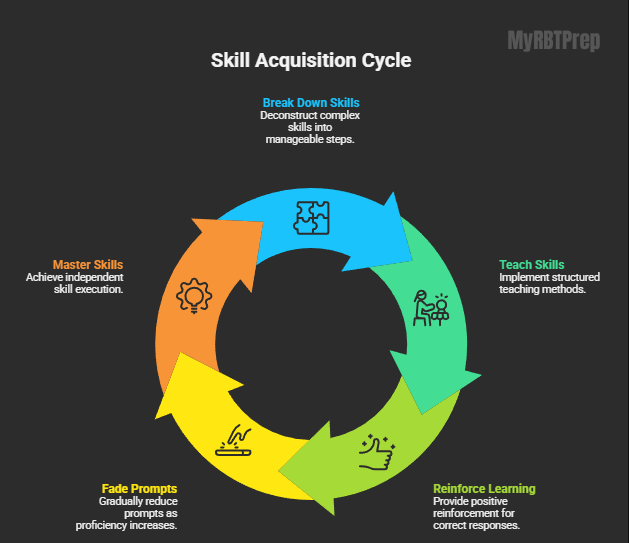
These techniques are primarily used to teach new skills or behaviors in a structured manner.
Discrete Trial Training (DTT)
Discrete Trial Training is a highly structured teaching method used to break down complex skills into smaller, manageable steps. It involves repeated, one-on-one instruction in a controlled environment.
- Definition: A teaching method characterized by a quick, distinct instruction (discriminative stimulus), a learner’s response, and an immediate consequence, followed by a brief pause.
- Implementation Steps:
- Antecedent (Instruction): The RBT provides a clear, concise instruction (e.g., “Touch car”).
- Prompt (if needed): The RBT may provide a prompt (e.g., hand-over-hand guidance) to ensure a correct response.
- Response: The learner performs the target behavior (e.g., touches the car).
- Consequence:
- Correct Response: Immediate positive reinforcement (e.g., “Great job!”).
- Incorrect Response: The RBT may use an error correction procedure (e.g., re-present the instruction with a stronger prompt).
- Inter-trial Interval: A brief pause (typically 3-5 seconds) before the next trial begins.
- Practical Example: Teaching a child to identify colors. The RBT might present two cards (red and blue) and say, “Touch red.” If the child touches red, they receive praise. If not, the RBT might guide their hand to the red card and then re-present the instruction. This is repeated multiple times to ensure mastery.
Errorless Teaching
Errorless teaching is a strategy designed to minimize or eliminate errors during the initial stages of skill acquisition, fostering confidence and reducing frustration.
- Definition: A prompting procedure where the RBT provides immediate and sufficient prompting to ensure the learner makes the correct response every time, thereby preventing errors.
- Implementation:
- The RBT delivers the instruction.
- Immediately provides a strong prompt (e.g., full physical, verbal model) to elicit the correct response.
- Reinforces the prompted correct response.
- Gradually fades prompts as the learner becomes more proficient.
- Practical Example: Teaching a child to trace letters. Initially, the RBT provides full physical guidance for tracing the entire letter. Over successive trials, the RBT reduces the physical prompt to a light touch, then a gesture, until the child can trace independently.
Task Analysis
Task analysis involves breaking down complex, multi-step skills into smaller, sequential, and more manageable components.
- Definition: The process of deconstructing a multi-step behavior or skill into its individual, discrete steps that can be taught one by one.
- Implementation:
- Identify the target skill (e.g., washing hands).
- List all the individual steps required to complete the skill in order (e.g., turn on water, wet hands, get soap, rub hands, rinse, turn off water, dry hands).
- Teach each step systematically, often using other ABA techniques like prompting and reinforcement.
- Practical Example: Teaching handwashing. The RBT would break it down into steps, perhaps starting with teaching “turn on water,” reinforcing that, then moving to “wet hands,” and so on, until the entire sequence is mastered.
Behavior Chaining
Behavior chaining is the instructional strategy used to teach skills that have been broken down through task analysis. It involves teaching the individual steps in a specific sequence to build a complete skill.
- Definition: A teaching procedure that involves linking individual behaviors (steps from a task analysis) together to form a complex, integrated skill.
- Types:
- Forward Chaining: Teach the first step, then link it to the second, and so on. Reinforcement is given upon completion of the current mastered step and all subsequent steps.
- Backward Chaining: Teach the last step first, then the second-to-last step followed by the last, and so on. Reinforcement is delivered upon completion of the last step, which provides a strong, natural reinforcer.
- Total Task Chaining: Teach every step of the chain in every session, providing prompts as needed for unmastered steps.
- Practical Example: Using backward chaining to teach dressing: The RBT would do all steps except the last one (e.g., pulling a shirt over the head). The child completes the last step and receives reinforcement. Once that’s mastered, the RBT does all steps except the last two, and the child completes those, receiving reinforcement after the final step.
Methods for Guiding and Shaping Behavior
These techniques are essential for guiding a learner towards a new behavior or modifying an existing one.
Prompting and Prompt Fading
Prompts are cues that help a learner perform a desired behavior. Prompt fading is the systematic removal of these cues to encourage independent performance.
- Definition: Prompting involves providing assistance to an individual to evoke a correct response. Prompt fading is the gradual reduction of these prompts until the behavior occurs independently.
- Types of Prompts:
- Verbal: Spoken words or sounds that guide the response (e.g., “Say ‘ball'”).
- Gestural: Pointing, nodding, or other non-verbal cues.
- Modeling: Demonstrating the desired behavior.
- Physical: Light touch, partial physical, or full physical guidance.
- Positional: Placing the correct item closer to the learner.
- Visual: Pictures, symbols, written words.
- Implementation: Start with the least intrusive prompt necessary to get a correct response. As the learner consistently responds correctly, gradually reduce the intrusiveness of the prompt.
- Practical Example: Teaching a child to point to a “cat” picture. Initially, the RBT might provide a full physical prompt (hand-over-hand) to help the child point. As the child responds correctly, the RBT fades to a partial physical prompt (touching the child’s elbow), then a gestural prompt (pointing to the picture), until the child points independently after the verbal instruction.
Shaping
Shaping is a process of gradually teaching a new behavior by reinforcing successive approximations of that behavior.
- Definition: Reinforcing behaviors that are closer and closer to the target behavior while extinguishing previous approximations that are no longer “good enough.”
- Implementation:
- Identify the target behavior.
- Identify a behavior the learner can already perform that is an approximation of the target behavior.
- Reinforce successive steps that more closely resemble the target behavior.
- Withhold reinforcement for previous approximations as new, closer approximations emerge.
- Practical Example: Teaching a child to say “water.” Initially, the RBT might reinforce any vocalization. Then, they might only reinforce sounds like “wa.” Next, they would only reinforce “wawa,” and finally, only “water.”
Modeling
Modeling involves demonstrating the desired behavior for the learner to imitate.
- Definition: A teaching strategy where an RBT or peer demonstrates a target behavior, allowing the learner to observe and then imitate the action.
- Implementation:
- The RBT performs the target behavior clearly and precisely.
- The RBT prompts the learner to imitate the behavior (e.g., “Do this,” “Your turn”).
- The RBT provides immediate reinforcement for accurate imitation.
- Practical Example: Teaching social greetings. The RBT models saying “hello” and waving. The RBT then prompts the child, “Say hello and wave!” and reinforces the child’s imitation. Video modeling can also be used for complex skills or social interactions.
Reinforcement Strategies and Motivational Considerations
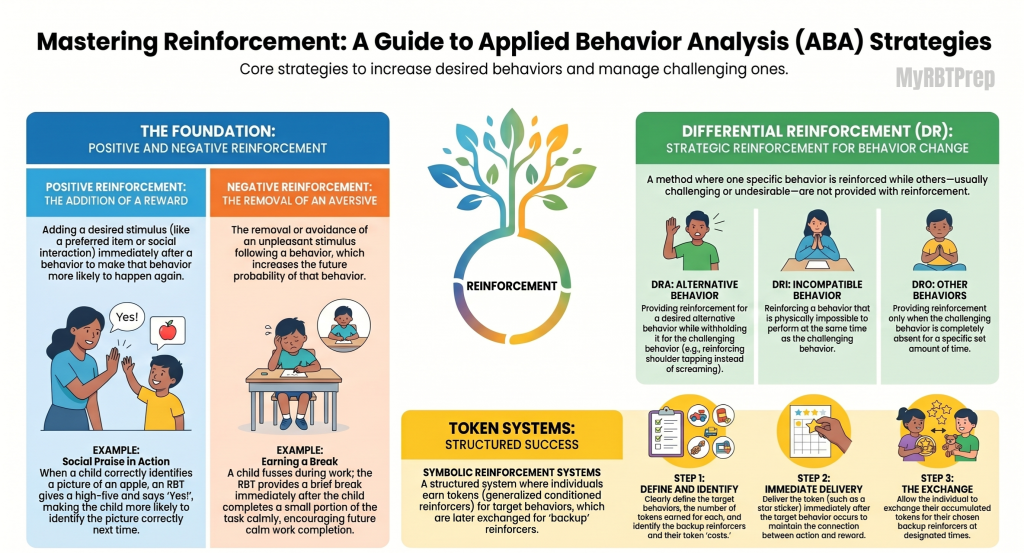
Reinforcement is a cornerstone of ABA, increasing the future probability of a behavior occurring.
Positive Reinforcement
Positive reinforcement is the addition of a desired stimulus following a behavior, which increases the likelihood of that behavior occurring again in the future.
- Definition: The delivery of a preferred item, activity, or social interaction immediately after a behavior, making that behavior more likely to happen again.
- Implementation:
- Identify effective motivators (reinforcers) for the individual.
- Deliver the chosen reinforcer immediately and consistently after the desired behavior.
- Vary reinforcers to prevent satiation and maintain motivation.
- Practical Example: A child correctly identifies a picture of an apple. The RBT immediately says, “Yes! That’s an apple!” and gives the child a high-five, which the child enjoys. This positive interaction makes the child more likely to correctly identify pictures in the future.
Negative Reinforcement
Negative reinforcement involves the removal of an aversive stimulus following a behavior, which increases the future probability of that behavior.
- Definition: The removal or avoidance of an unpleasant stimulus contingent on a behavior, leading to an increase in the future occurrence of that behavior.
- Implementation: Identify an aversive stimulus for the individual. Design an intervention where a desired behavior leads to the removal or avoidance of that stimulus.
- Practical Example: If a child fusses during an independent work activity (aversive to them), and the RBT provides a brief break (removal of the aversive activity) immediately after the child completes a small, requested portion of the work calmly, the child is more likely to calmly complete future work requests to gain that break.
Differential Reinforcement
Differential Reinforcement is when you reinforce certain behavior(s) but don’t reinforce other(s).
- Definition: A method where one behavior is reinforced, and one or more others (usually challenging or undesirable) are not. There are often multiple methods that will reinforce a desired behavior that is either an alternative to, incompatible with, or just plain different than the challenging behavior.
- Types of Differential Reinforcement (DR):
- Differential Reinforcement of Alternative Behavior (DRA) is when you provide reinforcement for the desired alternative behavior while withholding (not giving) reinforcement for the challenging behavior.
- Differential Reinforcement of Incompatible Behavior (DRI) is when you reinforce a behavior that couldn’t physically happen at the same time as the challenging behavior.
- Differential Reinforcement of Other Behaviors (DRO) is when you reinforce the absence of the challenging behavior for a set amount of time.
- Practical Example (DRA): A child screams for attention. An RBT teaches that child (through contingent reinforcement) to tap their shoulder to get the same attention (alternative behavior). When the child taps his/her shoulder, the RBT immediately provides attention. When the child screams, the RBT ignores the screaming, thus using extinction. This will help increase the child’s shoulder tapping, while decreasing the child’s screaming.
Token Systems
Token systems are a structured form of positive reinforcement where symbolic reinforcers (tokens) are earned for target behaviors and later exchanged for preferred items or activities.
- Definition: A system in which an individual earns generalized conditioned reinforcers (tokens) for displaying target behaviors, which can then be exchanged for a variety of backup reinforcers.
- Implementation:
- Clearly define target behaviors and the number of tokens earned for each.
- Identify desired backup reinforcers (e.g., toys, computer time, snacks) and their “cost” in tokens.
- Deliver tokens immediately after the target behavior.
- Allow the individual to exchange earned tokens for backup reinforcers at designated times.
- Practical Example: A child earns a star sticker (token) each time they complete a page of homework. After earning 5 star stickers, they can exchange them for 10 minutes of tablet time (backup reinforcer).
Faqs
- Top ABA Therapy Techniques Every RBT Should Know for Effective Practice
What techniques do RBTs use?
RBTs use techniques like discrete trial training (DTT), task analysis, reinforcement, and prompting to teach skills and reduce challenging behaviors.
What is the 80/20 rule in ABA?
The 80/20 rule in ABA suggests that 80% of progress comes from 20% of high-impact interventions.
What is the 6 second rule in autism?
The 6-second rule refers to pausing 6 seconds before responding to a child, giving them time to process and respond.
What are the 7 fundamentals of ABA?
The 7 fundamentals are: reinforcement, prompting, fading, shaping, chaining, generalization, and data collection.
What are the 7 pillars of mental health?
The 7 pillars include self-care, relationships, resilience, purpose, emotional regulation, mindfulness, and physical health.