What Is an Extinction Burst? (Clear Definition)
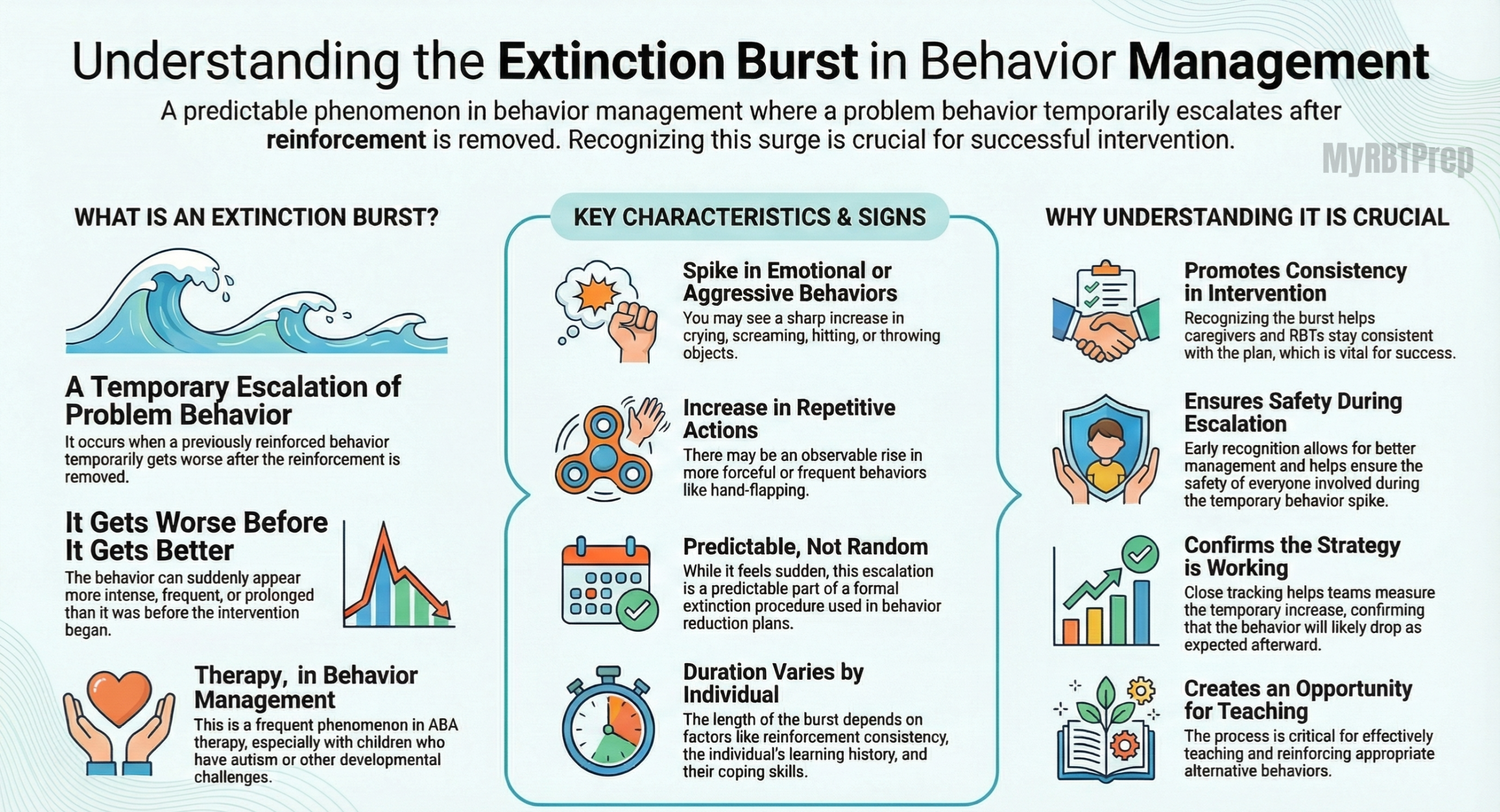
An extinction burst is a common phenomenon in behavior management, especially in ABA therapy examples involving children with autism or other developmental challenges.
It occurs when a previously reinforced problem behavior temporarily escalates after reinforcement removal, often appearing more intense, frequent, or prolonged than before.
This sudden surge can surprise both parents and caregivers, as it seems the behavior worsens before improving.
Understanding an extinction burst is crucial for anyone involved in behavior intervention, including RBTs (Registered Behavior Technicians), because it helps them remain consistent, ensure safety during behavior escalation, and effectively teach alternative behaviors. Early recognition allows for better management and long-term behavior reduction.
Why Do Extinction Bursts Occur? (Root Causes)
An extinction burst appears because the brain expects the old reinforcement, especially when a strong history of attention shaped the problem behavior.
When you start removing reinforcement, the learner tries to force the old rule back into place like someone pushing harder on a stuck door that once swung freely.
A burst also grows from emotional frustration especially when attention-seeking behaviors or escape behaviors lose their payoff.
Many autism behavior examples show this pattern. You often see louder screaming, crying or more intense tantrum patterns because familiar strategies suddenly stop working.
| Aspect | Description | Example | Key Insight |
| Root Cause | The brain expects previous reinforcement and tries to regain it | A child repeatedly screams when attention is no longer given | Strong reinforcement history triggers persistence |
| Behavior Pattern | Sudden increase in problem behavior when reinforcement stops | Louder screaming, more intense tantrums | Learner “pushes harder” like forcing a stuck door |
| Emotional Factor | Frustration due to loss of expected rewards | Crying or emotional outbursts during extinction | Emotions amplify the intensity of behavior |
| Common Setting | Attention-seeking or escape behaviors in ABA therapy | Child throws toys after ignoring a request for attention | Familiar strategies failing leads to escalation |
| Learning Insight | Extinction bursts are temporary but predictable | Initial spike in problem behavior before reduction | RBTs should anticipate and monitor carefully |
Key Characteristics of an Extinction Burst

You often notice a rise in crying and screaming behaviors or more forceful hand-flapping behavior as the burst begins. You may even see sharp spikes in tantrum behavior, hitting, or object throwing.
These actions feel sudden but they follow predictable extinction procedures used in behavior reduction strategies.
Some learners show longer bursts while others shift quickly. The nature depends on reinforcement consistency, past learning, and overall coping skills. Close tracking helps RBT (Registered Behavior Technician) teams measure whether the behavior temporarily increases or changes form before dropping as expected.
Real-Life Examples of Extinction Bursts
A common example appears when a child with autism cries for candy and the parent stops giving it. The first day becomes intense.
You see shouting, harder crying, and fast escalating behavior. When the parent continues showing strong consistency, things settle down and alternative behaviors grow.
Another everyday example appears when a teen loses access to a phone for breaking rules. At first the teen argues loudly.
After several days of parent consistency, the outbursts fade. Many ABA therapy examples mirror these patterns especially when caregiver training supports managing challenging behaviors across home routines.
| Scenario | Behavior Observed | Response | Outcome |
| Child with autism stops receiving candy | Crying, shouting, fast escalating behavior | Parent remains consistent, does not give candy | Behavior intensity decreases, alternative behaviors develop |
| Teen loses phone access for breaking rules | Arguing, loud protests | Parent enforces rules consistently | Outbursts fade over several days, teen adapts |
| ABA therapy session with caregiver training | Attention-seeking or escape behaviors | Caregiver applies extinction consistently | Problem behavior reduces, positive behaviors increase |
Difference Between Extinction Burst & Spontaneous Recovery
An extinction burst appears at the start of extinction, while spontaneous recovery appears later after behavior has already decreased.
During a burst, the learner pushes harder as a final attempt to get the old reinforcement. During recovery, the behavior briefly returns even after progress seemed stable.
Here is a simple comparison table:
|
Spontaneous recovery usually fades faster if RBTs, parents, and caregivers return immediately to the plan and keep reinforcing calm behavior and teaching alternative responses.
How Extinction Works in ABA Therapy
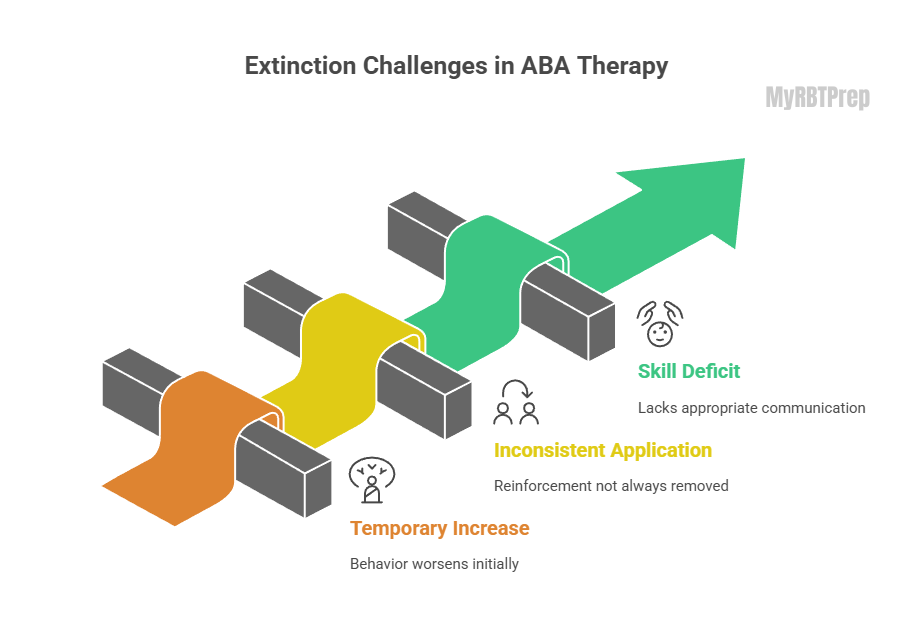
In ABA, extinction in ABA means stopping the payoff that keeps a problem behavior alive. When a learner screams for attention and adults stop responding, the behavior temporarily increases before dropping away.
You see this in sessions designed under BCBA (Board Certified Behavior Analyst) supervision.
The process succeeds when the team uses differential reinforcement (DRA, DRO, DRI) to shape appropriate communication skills.
When you remove the old payoff and reward new skills, the child learns fresh patterns that replace old actions and support long-term behavior reduction strategies.
How RBTs Can Effectively Manage Extinction Bursts
Effective RBTs respond to bursts with calm professionalism. They track frequency, intensity, duration while keeping the learner safe.
Strong teams use reinforcement consistency so the learner senses predictable structure even when old behaviors fail. This approach prevents confusion and lowers emotional strain.
Good practice also includes teaching alternative behavior so the learner sees new ways to meet communication needs.
A child yelling for help learns to tap a card instead. When RBTs reward the new skill, the old problem behavior loses power and managing unsafe behaviors becomes easier.
| Strategy | Action Taken | Example | Outcome |
| Calm Response | Maintain professionalism, avoid reacting emotionally | RBT observes a child yelling without responding with frustration | Keeps learner safe and reduces escalation |
| Track Behavior | Record frequency, intensity, and duration | Log each instance of problem behavior during session | Provides accurate ABA data collection and supports behavior graphing in ABA |
| Reinforcement Consistency | Apply consistent rules and reinforcement | Ignore old tantrum behavior while rewarding positive behavior | Learner experiences predictable structure, reduces emotional strain |
| Teach Alternative Behavior | Introduce new ways to communicate needs | Child learns to tap a card instead of yelling for attention | Old behavior loses power, learner adopts safer, functional behavior |
Common Mistakes to Avoid During Extinction
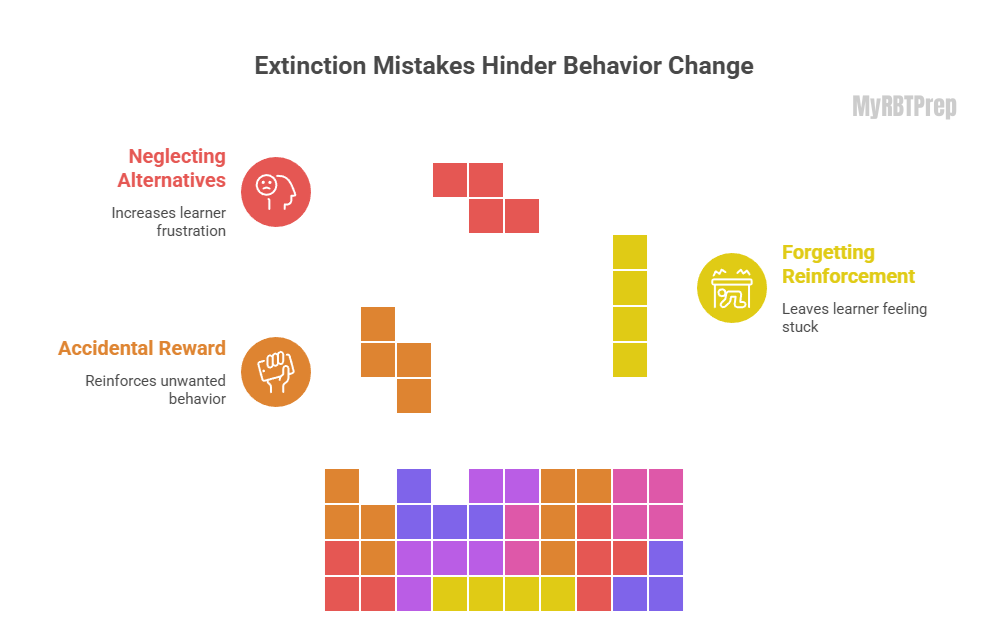
A common mistake appears when adults accidentally reward the burst. A parent might hand over the tablet when tantrum noise grows unbearable.
This teaches the child that louder screaming, crying works. That pattern creates long-term escalating behavior that becomes harder to reverse later.
Another mistake appears when teams forget differential reinforcement. Removing the payoff without teaching new skills leaves the learner stuck.
When professionals forget to strengthen alternative behaviors, frustration grows. Clear BCBA supervision prevents this by guiding teams through consistent planning and careful data review.
Parent & Caregiver Tips for Handling Extinction Bursts at Home
Parents feel overwhelmed when bursts begin but steady consistency is key. Many families use simple routines so the child knows what happens next.
When home structure stays firm, unwanted behaviors lose power because they no longer create results. Clear communication keeps emotions calmer during behavior escalation.
Caregivers also benefit from learning teaching alternative responses so they can help the child express needs with speech, gestures, or devices.
When caregivers reward new skills quickly, the household feels more peaceful. Good caregiver training helps families support the same extinction procedures used in therapy.
| Tip | Action Taken | Example | Outcome |
| Consistency | Maintain steady routines and rules | Follow the same response each time the child yells for attention | Unwanted behaviors lose power and decrease over time |
| Clear Communication | Explain what happens next in simple terms | “First homework, then TV time” | Reduces emotional strain and confusion during behavior escalation |
| Teach Alternative Responses | Help child express needs safely | Child uses gestures, speech, or communication devices instead of tantrums | Encourages functional communication and reduces problem behavior |
| Reinforce Positive Skills | Reward new, appropriate behaviors promptly | Praise child for using a card to ask for help | Household becomes calmer and child learns functional alternatives |
When to Adjust or Stop an Extinction Procedure
Sometimes an extinction plan requires adjustments especially if self-injury or aggression rises. A sharp jump in dangerous actions signals a need for support from your BCBA.
These moments call for fresh plans that keep safety during behavior escalation at the center of decision making.
Adjustments also help when progress plateaus. You might see the behavior settle at a low but stubborn level.
In those cases, teams add new reinforcement strategies, update alternative behaviors, or strengthen routines so the learner feels secure. Small changes often lead to big outcomes.
Why Behaviors Get Worse Before They Improve
A strong extinction burst often surprises families because the child suddenly uses louder crying and screaming behaviors once reinforcement removal begins. You see this pattern when a behavior carried a long reinforcement history, especially in cases of attention or escape.
The moment adults start removing reinforcement, the child tries harder to restore the old rule which leads to a sharp rise in frequency, intensity, duration. Many parents feel confused and believe they did something wrong, but this reaction simply shows that the routine is changing.
The child feels unsure and repeats every familiar strategy hoping someone will give in. These moments bring emotional pressure and often trigger tantrum behavior that feels challenging to manage.
When adults hold steady consistency, the burst gradually weakens. As the days pass, the child learns that problem behavior no longer brings the old reward.
When adults teach alternative behaviors and support appropriate communication skills, calmer actions begin to replace the old patterns.
These changes grow stronger when caregivers practice the same behavior reduction strategies across home and school. With time, the burst settles and the child adapts to new expectations with more confidence.
| Reason | Behavior Observed | Cause | Outcome |
| Reinforcement Removal | Louder crying, screaming, tantrums | Child’s long reinforcement history, attention or escape behaviors | Short-term spike in frequency, intensity, and duration |
| Attempt to Restore Old Rule | Repeating familiar strategies | Child tests adults to regain previous rewards | Emotional pressure and challenging behavior for caregivers |
| Uncertainty | Hesitation, repeated trial behaviors | Learner unsure about new routine | Confusion for both child and caregivers |
| Consistent Adult Response | Maintaining rules without giving in | Adults stay firm and predictable | Extinction burst weakens, problem behavior gradually decreases |
| Teaching Alternatives | Promoting communication skills or functional behavior | Child learns new ways to get needs met | Calmer, appropriate behaviors replace old patterns |
How RBTs Respond to Extinction Bursts During Behavior Escalation
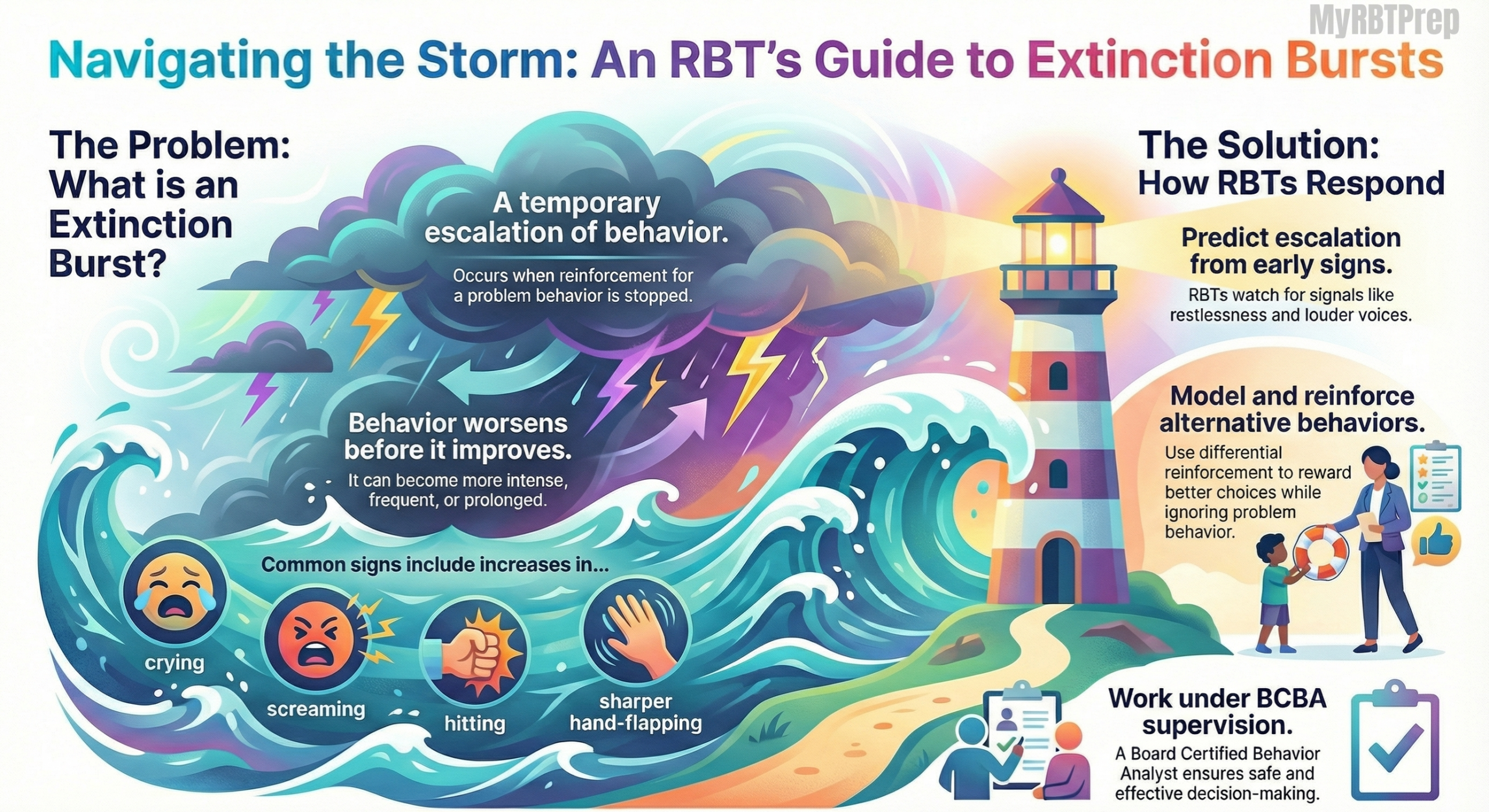
A skilled RBT (Registered Behavior Technician) understands that an extinction burst is a normal reaction when unwanted behaviors lose their payoff. You might see sharper hand-flapping behavior, restlessness, or louder voices as frustration builds.
These early signs help the RBT predict behavior escalation before it becomes bigger. When the RBT notices these signals, they shift into guidance mode, keeping the child safe and calm. They help the child understand that old problem behaviors in ABA will not work anymore.
Instead, they model clear alternative behavior and encourage simple communication that fits the child’s communication needs. Many ABA therapy examples highlight this moment of learning because the child discovers new ways to ask for help. The RBT uses differential reinforcement (DRA, DRO, DRI) to reward each small step toward better choices while ignoring behavior that once brought strong attention.
These strategies help the child feel more secure because they see predictable patterns that make sense. Throughout the process, the RBT receives guidance from a BCBA (Board Certified Behavior Analyst) who ensures safe decision-making and strong support. Together, the team helps the child build new habits that replace old reactions and create long-term success.
Helping Parents Stay Steady During Extinction Bursts at Home
Families often feel overwhelmed during an extinction burst when the child goes into intense tantrum actions or suddenly demands old rewards by screaming and crying. The home becomes stressful if/when the routine changes and the old behavior does not “work.”
These bursts of behavior occur because the child is confused and is pressing harder for control. The parents ask, “Why does it get worse when we are trying to get better?”
The answer to this reactionary behavior of the child is based on their reinforcement history, which previously taught them that these specific behaviors equated strong results with certain responses from their adult caregivers. In the ABA world, the child is learning a new pattern using extinction. The mind has to process the adjustments and this is the confidence in the parent to be consistent. When adult caregivers follow through and remain steadfast in providing and teaching alternative behavior, the child will learn a different way to initiate communication. Many families use visual reminders, calm words and predictable routines, to encourage appropriate words or conduct.
Each of these techniques reduces worry and provides ways to manage challenging behaviors on difficult days. Some bursts of behavior become intense and may have themes of self-injury or aggression; so, these families ensure to contact their team for quick intervention.
As noted, families under the guidance of a BCBA learn safety protocols for the child engaged in inappropriate behavior adjustment protocol, until parents gain trust in those methods. Over the weeks of practice, home life will be calmer, while their child’s alternatives become more consistent.
| Strategy | Action Taken | Example | Outcome |
| Stay Consistent | Follow routines and rules without giving in | Parent ignores tantrums when child screams for attention | Child learns old behaviors no longer produce results |
| Use Calm Communication | Speak softly and use predictable cues | “First homework, then TV time” | Reduces confusion and emotional strain for child and caregiver |
| Teach Alternative Behaviors | Encourage functional communication | Child taps card or gestures instead of yelling | Child adopts safer, effective ways to communicate needs |
| Visual Reminders & Predictable Routines | Use charts, schedules, or visual cues | Display daily routine chart at eye level | Supports consistency and helps child anticipate expectations |
| Seek Professional Support | Contact BCBA when behaviors escalate | Call BCBA if self-injury or aggression occurs | Ensures safety and reinforces proper extinction strategies |
Conclusion
An extinction burst looks intimidating but it simply shows that the old reinforcement rules no longer apply. When parents, caregivers, teachers, and RBTs stay calm, structured, and supportive, the behavior drops and new skills emerge. Real progress comes from teamwork and steady follow-through.
When families hold firm through removing reinforcement and keep reinforcing calm behavior, children learn healthier ways to communicate. The process takes patience but the long-term benefits create stability, confidence, and better daily routines.
Faqs
What is the extinction burst method?
It is a behavior process where a problem behavior briefly increases when the reinforcement is removed, just before the behavior starts to decrease.
What is an example of an extinction burst in real life?
A child screams louder when a parent stops giving attention to tantrums, but the behavior eventually decreases once it no longer works.
What three things happen during an extinction burst?
The behavior becomes more frequent, more intense, and longer in duration right after reinforcement is removed.
What is an example of extinction in psychology?
Ignoring a behavior that was once reinforced—such as no longer reacting to a child’s whining—until the behavior fades away.
What is an extinction burst in psychology?
It is the temporary spike in unwanted behavior that occurs when a learned behavior no longer receives reinforcement.