For aspiring Registered Behavior Technicians (RBTs), the competency assessment is one of the most important steps in the certification process. After completing the required 40-hour training program, candidates must demonstrate that they can apply Applied Behavior Analysis (ABA) principles correctly before becoming eligible for the RBT exam. Because of this requirement, many candidates feel nervous and wonder what kinds of questions they will be asked, what skills they will need to demonstrate, and how difficult the assessment will be.
The good news is that the RBT Competency Assessment is not designed to trick candidates or make certification unnecessarily difficult. Instead, it serves as a practical evaluation that helps ensure future RBTs can provide safe, ethical, and effective services under supervision. The assessment focuses on skills that behavior technicians use every day, including data collection, reinforcement procedures, prompting strategies, documentation, professionalism, and ethical conduct.
Unlike the RBT exam, which is a multiple-choice test, the competency assessment is interactive. Candidates are asked questions, participate in role-play situations, demonstrate procedures, and explain how they would handle various real-world scenarios. Assessors want to see whether candidates understand ABA concepts and can apply them correctly rather than simply memorize definitions.
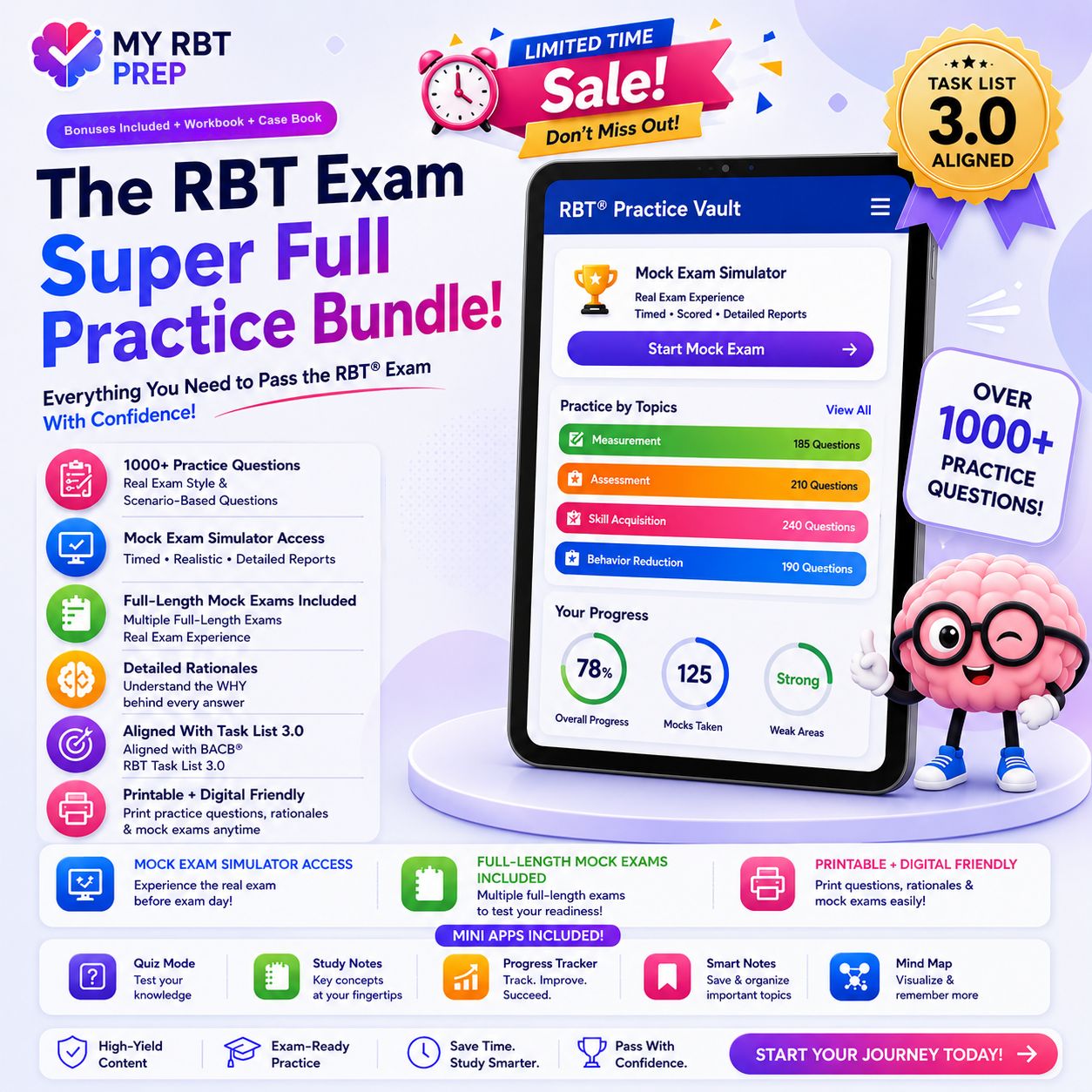
Pass Your RBT® Exam on the First Attempt
Practice with 1,000+ realistic scenario questions, multiple full-length timed mock exams, and detailed rationales formatted exactly like the real Pearson VUE test.
If you’re preparing for your assessment, understanding what to expect can dramatically reduce anxiety and improve your confidence. In this guide, we’ll explore the most common RBT competency assessment questions, explain the skills assessors evaluate, discuss common mistakes candidates make, and provide practical strategies to help you pass on your first attempt.
What Is the RBT Competency Assessment?
The RBT Competency Assessment is a required evaluation that verifies whether a candidate can competently perform tasks expected of an entry-level Registered Behavior Technician. The assessment is conducted by a qualified assessor and focuses on practical application of ABA principles rather than theoretical knowledge alone.
The assessment serves as a quality-control measure within the ABA profession. Since RBTs work directly with clients and often implement behavior intervention plans, it is important that they demonstrate competency before receiving certification. The assessment helps ensure that future technicians can accurately collect data, implement skill-acquisition programs, use reinforcement procedures correctly, maintain professional boundaries, and communicate effectively with supervisors.
Many candidates mistakenly believe that the assessment is another written examination. In reality, it is much more hands-on. Some skills are demonstrated through role-play, while others may involve direct observation in a real or simulated setting. Assessors often ask candidates to explain why they would use a particular procedure and how they would respond to specific situations.
The assessment is intended to support learning and professional development. Rather than viewing it as a barrier, candidates should see it as an opportunity to demonstrate readiness for certification and future clinical work.
Areas Commonly Evaluated During the Assessment
| Area | Evaluated? |
|---|---|
| Measurement | Yes |
| Assessment Procedures | Yes |
| Skill Acquisition | Yes |
| Behavior Reduction | Yes |
| Documentation | Yes |
| Professional Conduct | Yes |
| Ethics | Yes |
Why the Competency Assessment Is Important
The competency assessment protects both clients and practitioners. Individuals receiving ABA services often rely on consistent and accurate implementation of treatment plans. Even small mistakes in data collection, reinforcement delivery, or prompting procedures can affect treatment outcomes.
By requiring candidates to demonstrate practical competency, the BACB helps maintain high standards across the profession. The assessment ensures that newly certified RBTs possess the foundational skills necessary to work effectively under supervision.

RBT® Exam Flashcards & Study App (3rd Edition)
Master essential ABA terminology and clinical discrimination across all 6 BACB task list areas with 500+ printable and digital flashcards, real exam cues, and full mobile app access.
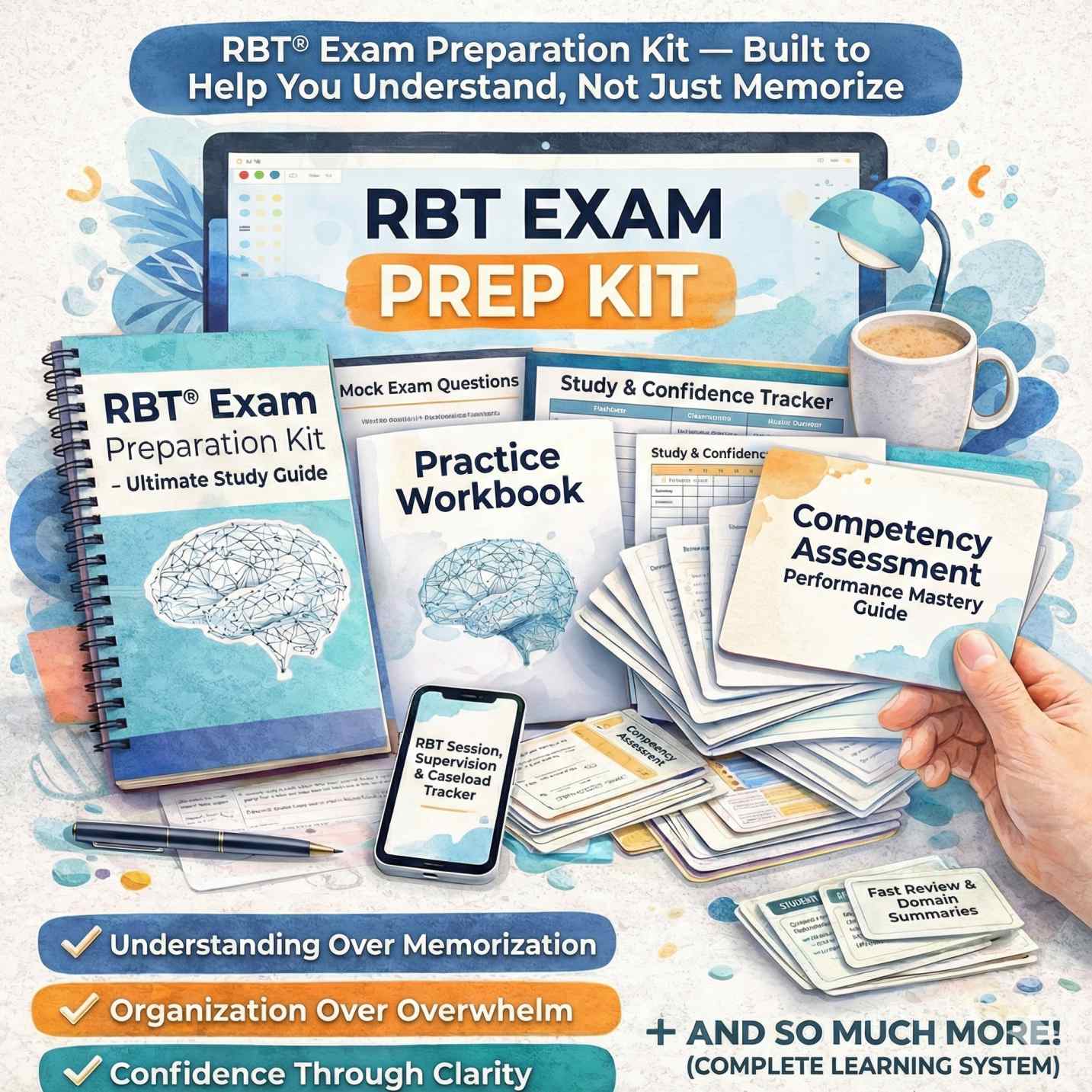
The assessment also benefits candidates themselves. Completing the evaluation helps build confidence and reinforces important concepts learned during training. Many candidates discover that practicing for the competency assessment helps prepare them for the RBT exam as well because both processes focus on understanding ABA principles and their practical applications.
Additionally, employers value the competency assessment because it creates consistency. Regardless of where a candidate completes training, the assessment provides an objective measure of readiness for professional practice.
Who Conducts the RBT Competency Assessment?
The competency assessment must be conducted by a qualified assessor who meets BACB requirements. Most commonly, assessments are completed by Board Certified Behavior Analysts (BCBAs), although other qualified professionals may also be eligible depending on current certification requirements.
Assessors are responsible for observing performance, asking questions, evaluating responses, and determining whether competency has been demonstrated. They review both technical skills and professional behavior throughout the assessment process.
Candidates should remember that assessors are not looking for perfection. Instead, they are evaluating whether the candidate possesses the knowledge and practical skills required of an entry-level RBT. Assessors often provide clarification, feedback, and opportunities for learning when appropriate.
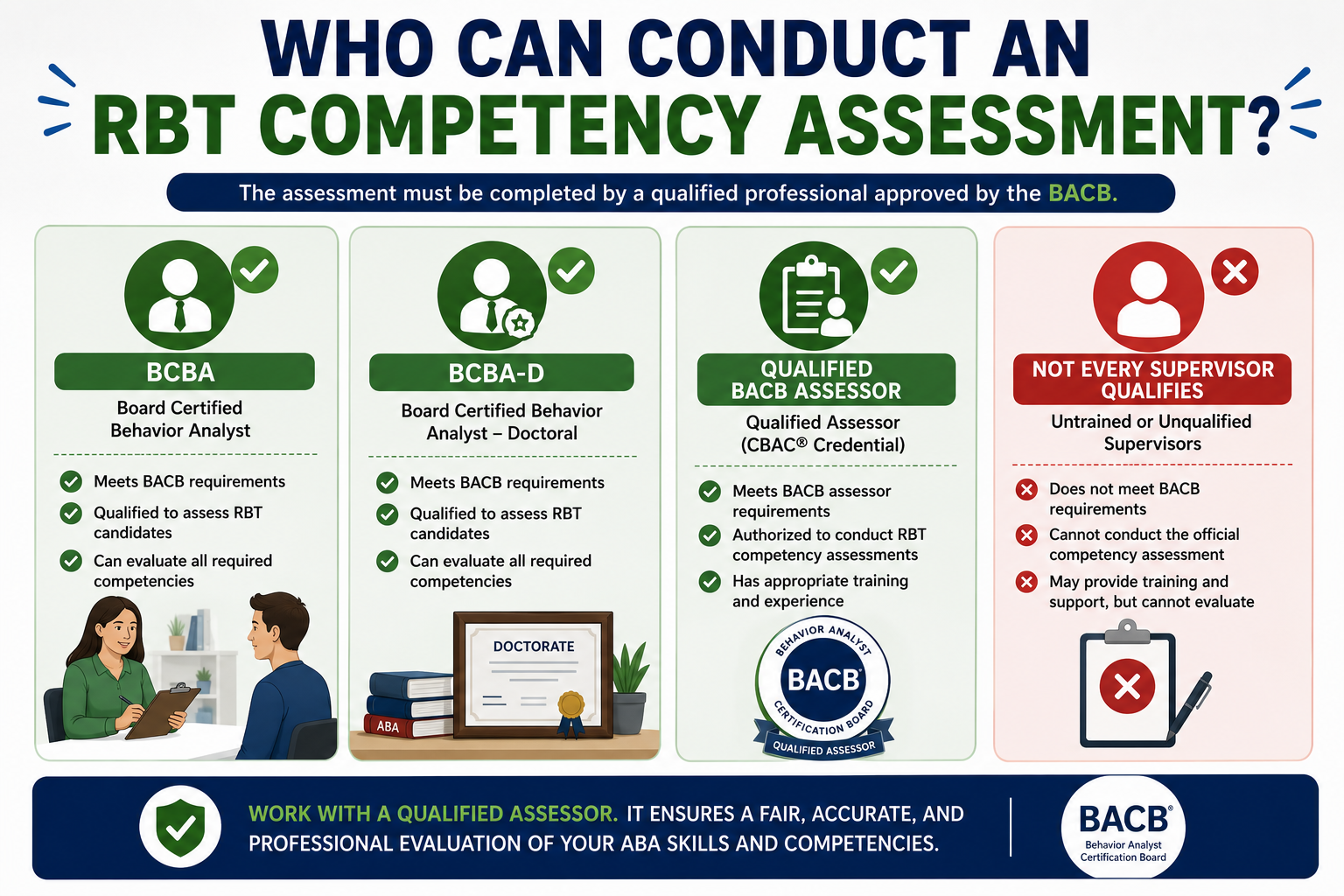
Qualified Assessors
| Professional | Can Conduct Assessment? |
|---|---|
| BCBA | Yes |
| BCBA-D | Yes |
| Qualified BACB Assessor | Yes |
| Untrained Supervisor | No |
What Types of Questions Are Asked During the Competency Assessment?
One of the most common concerns candidates have is understanding the types of questions they may encounter. While every assessment is different, most questions focus on practical ABA concepts that behavior technicians use regularly.
The goal is not simply to test memorization but to determine whether candidates understand how concepts apply in real-world situations.
Measurement Questions
Measurement is one of the most heavily assessed areas because data collection is a core responsibility of every RBT.
Example Question:
What is frequency recording?
Sample Answer:
Frequency recording measures how many times a behavior occurs during a specified period.
Example Question:
What is the difference between duration and frequency?
Sample Answer:
Frequency measures how often a behavior occurs, while duration measures how long the behavior lasts.
Example Question:
When would latency recording be appropriate?
Sample Answer:
Latency recording is used when measuring the amount of time between a specific instruction or event and the beginning of a behavior.
Example Question:
What is permanent product recording?
Sample Answer:
Permanent product recording measures behavior by examining the results it leaves behind, such as completed assignments or finished tasks.
Reinforcement Questions
Reinforcement is one of the most important concepts in ABA and frequently appears during competency assessments.
Example Question:
What is positive reinforcement?
Sample Answer:
Positive reinforcement occurs when a desirable stimulus is added following a behavior, increasing the likelihood that the behavior will occur again.
Example Question:
What is negative reinforcement?
Sample Answer:
Negative reinforcement occurs when an aversive stimulus is removed following a behavior, increasing the likelihood that the behavior will occur again.
Example Question:
How can you tell if something is truly a reinforcer?
Sample Answer:
A consequence is considered a reinforcer if it increases the future occurrence of the behavior it follows.
Prompting Questions
Prompting procedures are commonly evaluated because they are used frequently during skill acquisition programs.
Example Question:
What is a prompt?
Sample Answer:
A prompt is assistance provided to help a learner perform a desired behavior correctly.
Example Question:
Why should prompts be faded?
Sample Answer:
Prompts should be faded to promote independence and reduce prompt dependency.
Example Question:
What are some common types of prompts?
Sample Answer:
Verbal prompts, gestural prompts, model prompts, visual prompts, and physical prompts.
Behavior Reduction Questions
Candidates should also be prepared to answer questions related to behavior reduction strategies and the functions of behavior.
Example Question:
What are the four common functions of behavior?
Sample Answer:
Attention, escape, tangible access, and automatic reinforcement.
Example Question:
What is differential reinforcement?
Sample Answer:
Differential reinforcement involves reinforcing one behavior while withholding reinforcement for another behavior.
Example Question:
What is extinction?
Sample Answer:
Extinction involves withholding reinforcement that previously maintained a behavior, leading to a reduction in that behavior over time.
Documentation and Reporting Questions
Accurate documentation is an essential responsibility for RBTs.
Example Question:
Why is objective documentation important?
Sample Answer:
Objective documentation ensures accuracy and helps supervisors make informed treatment decisions.
Example Question:
What should you do if you observe a significant change in client behavior?
Sample Answer:
Document the observation and notify the supervisor according to established procedures.
Ethics Questions
Ethics and professionalism are integrated throughout the assessment process.
Example Question:
Can you share client information with friends or family?
Sample Answer:
No. Client information must remain confidential unless disclosure is authorized and professionally appropriate.
Example Question:
What should you do if a caregiver asks you to change a treatment procedure?
Sample Answer:
Refer the request to the supervising BCBA because RBTs do not independently modify treatment plans.
Example Question:
What should you do if you’re unsure how to handle a situation?
Sample Answer:
Consult your supervisor and seek guidance before taking action.
Skills You May Need to Demonstrate
The competency assessment focuses heavily on practical demonstrations. Candidates are often asked to perform tasks rather than simply discuss them.
Data Collection
You may be asked to:
- Record frequency data
- Measure duration
- Complete data sheets
- Interpret collected information
Accuracy is important because treatment decisions depend on reliable data.
Prompting Procedures
Candidates may demonstrate:
- Verbal prompts
- Gestural prompts
- Model prompts
- Physical prompts
Assessors often evaluate whether prompts are delivered appropriately and systematically faded when necessary.
Reinforcement Delivery
Candidates may be observed delivering reinforcement correctly.
This includes:
- Identifying reinforcement opportunities
- Delivering reinforcement immediately
- Maintaining consistency
Professional Communication
RBTs must communicate professionally with clients, families, supervisors, and team members.
Candidates should demonstrate respectful communication and professional conduct throughout the assessment.
Competency Demonstration Checklist
| Skill | Frequently Assessed |
|---|---|
| Data Collection | ✓ |
| Prompting | ✓ |
| Reinforcement | ✓ |
| Documentation | ✓ |
| Professional Communication | ✓ |
| Ethics | ✓ |
Common Mistakes Candidates Make
Many candidates struggle not because they lack knowledge, but because they make avoidable mistakes.
One common mistake is relying entirely on memorization. Knowing definitions is helpful, but assessors want to see practical understanding and application.
Another issue is rushing through demonstrations. Candidates sometimes focus so much on finishing quickly that they overlook important details.
Some individuals also underestimate ethics and professionalism. Because these concepts appear throughout the assessment, failing to understand professional responsibilities can negatively affect performance.
Nervousness is another common challenge. Anxiety may cause candidates to forget concepts they already know. Practicing beforehand can significantly reduce stress.
Finally, candidates often neglect data collection practice. Since measurement is a core RBT responsibility, assessors expect strong performance in this area.
Tips for Passing the Competency Assessment
Preparation is the most effective way to increase confidence and improve performance.
Start by reviewing your 40-hour training materials thoroughly using our dedicated RBT Competency Assessment Study Guide to master all 20 evaluated tasks. Complement your hands-on prep by testing your theoretical knowledge on our Free RBT Practice Test.
Practice demonstrating skills with a supervisor, coworker, or fellow trainee. Repeated practice helps identify weak areas and improves confidence.
Spend additional time reviewing:
- Reinforcement procedures
- Prompting strategies
- Data collection methods
- Behavior functions
- Documentation practices
- Ethical responsibilities
It can also be helpful to create mock assessment scenarios and practice answering common questions aloud.
Remember that assessors are evaluating competency, not perfection. Stay calm, listen carefully, and answer thoughtfully.
Quick Preparation Checklist
- Review training materials
- Practice measurement procedures
- Review reinforcement concepts
- Learn prompting strategies
- Understand behavior functions
- Practice documentation
- Review ethics
- Complete mock assessments
Frequently Asked Questions
Is the RBT Competency Assessment difficult?
Most candidates find it manageable when they understand ABA concepts and practice required skills beforehand.
Can you fail the competency assessment?
Yes. Candidates who do not demonstrate required competencies may need additional training before reassessment.
How long does the assessment take?
The length varies depending on the assessor and assessment format but typically ranges from one to several hours.
Is the competency assessment written?
No. It is primarily demonstration-based and involves practical skill evaluation.
Do you take the assessment before the RBT exam?
Yes. Candidates must successfully complete the competency assessment before becoming eligible for the RBT examination.
Final Thoughts
The RBT Competency Assessment is one of the most important steps in becoming a Registered Behavior Technician because it verifies that candidates can apply ABA principles effectively in real-world situations. While the assessment may initially seem intimidating, understanding what to expect can significantly improve your confidence and preparation.
Candidates who focus on understanding concepts, practicing skills, reviewing ethics, and strengthening data collection abilities are generally well-prepared for success. Remember that the goal is not to achieve perfection but to demonstrate competency and readiness to work under supervision.
With consistent preparation and a strong understanding of ABA fundamentals, you’ll be well-positioned to pass your competency assessment and take the next step toward becoming a certified RBT.

Everything You Need to Pass Your RBT® Exam
Study with our complete, all-in-one preparation package covering every task on the BACB Task List 3.0:
- 1,000+ Practice Questions & Timed Simulator
- 3rd Edition Task List Study Guide & Workbook
- Active Recall Flashcards System + Mobile App
- 20-Task Competency Assessment Mastery Guide