A Token economy gives you a clear and simple way to guide behavior using small rewards that build motivation over time. This approach helps you shape actions through positive reinforcement, so individuals learn that good choices bring meaningful outcomes.
In many settings you might see tokens used as points, stars, or stickers that later turn into backup reinforcers like free time or preferred activities. A well-designed system encourages consistency and supports behavior modification without stress or pressure.
When you use a token economy you create structure that feels predictable, fair, and motivating which helps children and adults build stronger functional behavior skills step by step.
Pass Your RBT® Exam on the First Attempt
Practice with 1,000+ realistic scenario questions, multiple full-length timed mock exams, and detailed rationales formatted exactly like the real Pearson VUE test.
What Is a Token Economy? (Simple Definition)
A token economy is a behavior reinforcement program where a person earns tokens for displaying specific behaviors, then exchanges those tokens for rewards. Tokens can be stickers, points, check marks, cards, or any symbolic item.
These items act as conditioned reinforcers, meaning they gain value over time because they lead to something enjoyable. This system helps you build habits through a step-by-step process where effort creates progress and progress creates rewards.
In simple terms a token economy functions like a small motivational economy in your classroom or home. You assign behavior goals and rewards, making it easy for a child or adult to know what is expected.
When they show the target behavior they earn a token, and when they earn enough tokens they get a backup reinforcer like extra playtime, snacks, or special privileges. The whole design makes learning feel achievable, especially for people who need structure or frequent reinforcement.
| Topic | Explanation |
|---|---|
| Simple Definition | A token economy is a behavior reinforcement system where a person earns tokens for showing specific behaviors and later exchanges those tokens for rewards. |
| What Tokens Can Be | Stickers, points, check marks, cards, or any symbolic item. |
| Why Tokens Work | Tokens become conditioned reinforcers — they gain value because they can be traded for something enjoyable. |
| Main Purpose | To build positive habits step-by-step by connecting effort → progress → rewards. |
| Where It Can Be Used | Classrooms, homes, therapy settings, or with children and adults. |
| How It Works | 1. Set behavior goals. 2. The person earns a token when they show the behavior. 3. Tokens are exchanged for rewards (backup reinforcers). |
| Examples of Rewards | Extra playtime, snacks, privileges, activities, or small prizes. |
| Why It Helps | Provides structure, motivation, and frequent reinforcement, making learning and behavior change feel achievable. |
How a Token Economy Works (Key Principles)

A token economy works through the psychology of reward. When you reinforce behavior immediately you help the brain link the behavior and reward together. This process follows applied behavior analysis reinforcement, where each desired action leads to a motivating outcome.

RBT® Exam Flashcards & Study App (3rd Edition)
Master essential ABA terminology and clinical discrimination across all 6 BACB task list areas with 500+ printable and digital flashcards, real exam cues, and full mobile app access.
Over time the person learns that good choices bring good consequences, and this creates long-term behavioral change.
The system also depends on consistency. You define the behaviors clearly, deliver tokens right away, and maintain predictable reinforcement schedules. Any delay or confusion weakens the connection between behavior and token.
This is why key principles like immediate reinforcement, clear criteria, and engaging reward choices matter. When you follow these principles faithfully your token economy becomes a reliable motivation system that encourages self-control and cooperation.
Types of Token Economy Systems
Different environments use token economies in different ways. In homes parents often rely on star charts, marble jars, or points that lead to screen time or treats.
These systems create a calm routine where children understand what earns rewards and what does not. A simple token chart becomes a visual reminder that keeps everyone on track without constant arguments.
Classrooms also rely heavily on token systems. Teachers may give stickers for completed assignments, points for group cooperation, or tokens for following class rules. When paired with a classroom reward system this approach helps reduce disruptions, improve engagement, and strengthen teamwork.
In ABA therapy you often see an ABA token board, where each earned token leads toward a meaningful reinforcer. These setups help learners with autism or developmental delays build foundational skills like communication, waiting, sitting, and completing tasks.
Benefits of Using a Token Economy
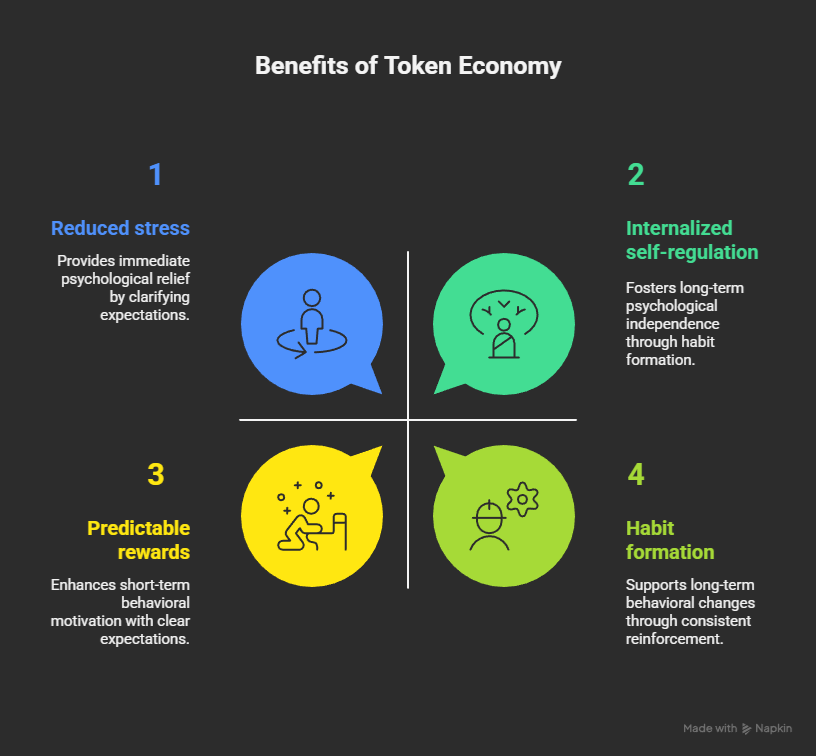
A token economy gives you an enormous advantage when you want to promote positive behavior. One benefit is predictability. The child or adult knows exactly what earns rewards so they feel secure and motivated.
This structure reduces stress, power struggles, and misunderstandings. It also encourages steady progress because every small effort gets acknowledged through the positive reinforcement method.
Another benefit is long-term skill development. As you continue using the token economy the person begins forming habits like self-regulation, patience, and cooperation. These habits become internal over time which supports independence.
Parents and teachers often notice that problematic behavior decreases because tokens shift attention toward what the person can do. In ABA therapy this approach builds essential functional behavior skills, making learning smoother and more enjoyable.
Limitations & Challenges of Token Economies
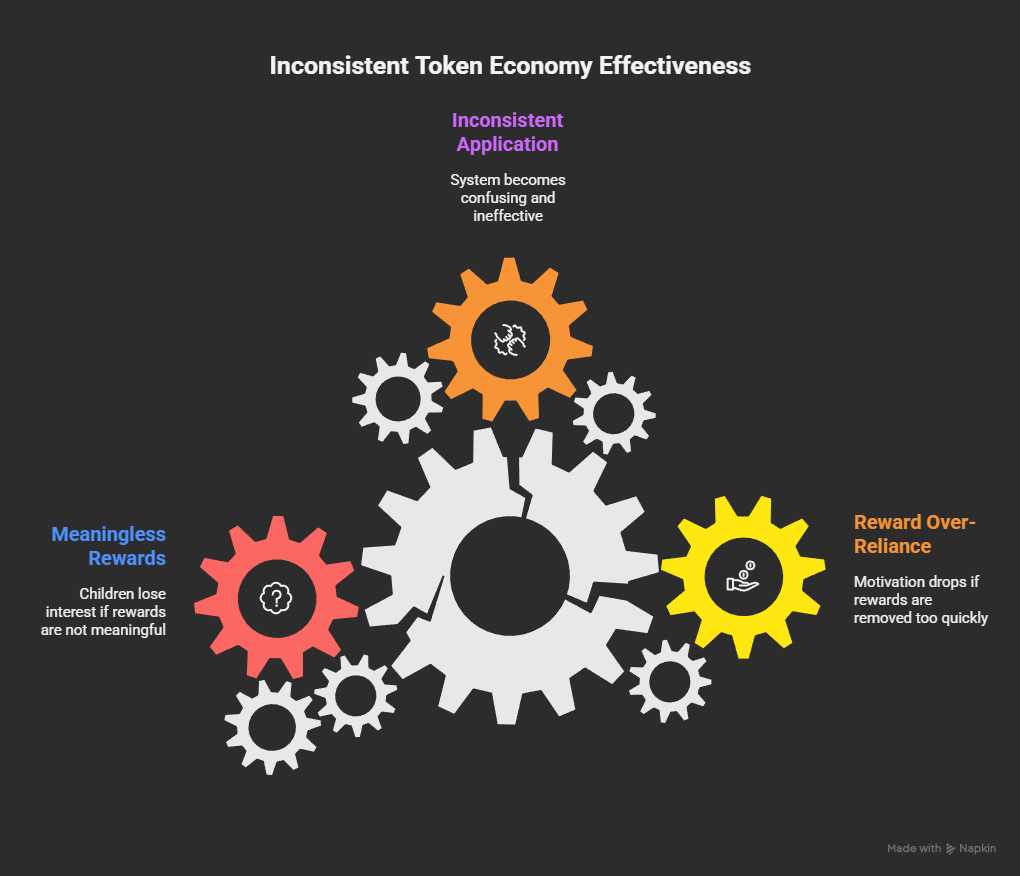
Token economies work well, but they come with challenges you should keep in mind. One issue is over-reliance on rewards. If rewards are removed too quickly motivation may drop. That is why careful planning and fading reinforcement are essential.
You need to gradually increase expectations and rely less on tokens as the person becomes more independent.
Another challenge is consistency across caregivers or teachers. If one adult gives tokens for a behavior and another does not the system becomes confusing and ineffective.
Some children also lose interest if rewards are not meaningful or if they find tokens boring. This means you must adjust the reward menu / choice board to keep it exciting. The system requires patience but when done well it delivers strong results.
Step-by-Step Guide: How to Implement a Token Economy
Implementing a token economy starts with identifying target behaviors. You need to be specific. Instead of saying “behave better,” define exactly what you want like “raise your hand before speaking” or “complete 10 minutes of homework.” Clear definitions help you track progress and avoid confusion.
Next you choose the tokens. These can be stickers, marbles, cards, or points on an app. In ABA this often involves a token board system where the learner fills in spaces until they earn a reward. After selecting tokens you set up the token exchange rate.
This tells the person how many tokens they need for each reward. If you make the rate too high motivation drops. If it is too low they earn rewards too quickly and lose interest.
Then you choose the rewards. These should be powerful backup reinforcers that genuinely motivate the person. You can use snacks, toys, screen time, praise, or special activities.
Once everything is ready you begin delivering tokens immediately each time the target behavior occurs. The key is pairing tokens with praise so the system feels encouraging. As behavior improves you gradually adjust the goals so the learner becomes more independent.
Sample Token Exchange Table
|
This table keeps the system clear and predictable so the learner always knows what to expect.
Examples of Token Economy in Real Life
In ABA therapy a common example involves teaching a child to remain seated. A child might earn one token every three minutes of calm sitting. When they fill their ABA token board they get playtime with a favorite toy.
This sitting calmly example ABA is one of the most effective early learning strategies. Over time the intervals increase until the child can sit independently.
Classrooms also use token systems effectively. A teacher may give points for completed assignments, respectful behavior, or group cooperation. When students earn enough points they can trade them for classroom privileges.
This encourages teamwork and responsibility. In homes parents use tokens for morning routines, chores, and homework. Children earn points for brushing teeth, getting dressed, or cleaning their room and trade them for screen time or special activities.
Even workplaces use token-style systems through employee rewards, recognition programs, and point-based reward systems that encourage productivity.
| Setting | Example | How Tokens Are Earned | What Tokens Can Be Exchanged For | Purpose/Benefit |
|---|---|---|---|---|
| ABA Therapy | Teaching a child to remain seated calmly | One token every ~3 minutes of calm sitting | Playtime with a favorite toy when the token board is filled | Gradually increases ability to sit independently |
| Classroom | Supporting learning and cooperation | Points for completing work, respectful behavior, or teamwork | Classroom privileges or rewards | Encourages responsibility and positive behavior |
| Home | Daily routines and chores | Tokens for brushing teeth, getting dressed, cleaning room, homework | Screen time or special activities | Builds independence and consistent habits |
| Workplace | Employee recognition and reward systems | Points or recognition for productivity or achievements | Incentives, bonuses, or perks | Boosts motivation and performance |
Token Economy vs Other Behavior Management Techniques
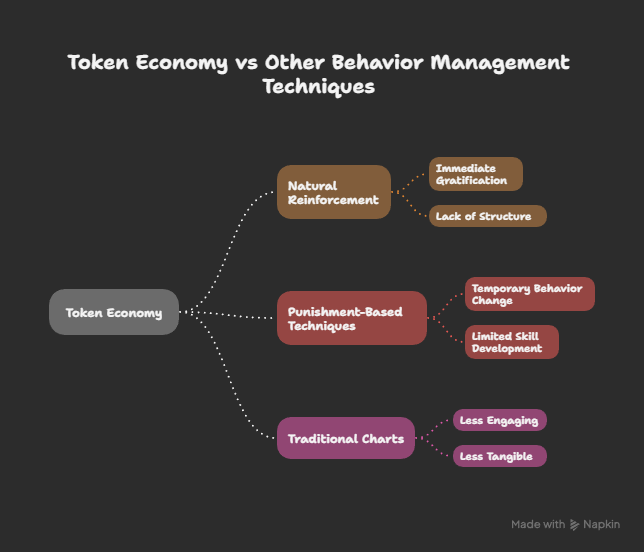
A token economy differs from simple praise or natural rewards because it adds structure and predictability. Natural reinforcement happens when an action leads directly to a pleasant result but a token system builds motivation gradually through accumulated value.
This makes it especially useful for people who need extra support or struggle with delayed gratification.
Compared to punishment-based techniques a token economy is far more effective because it focuses on what the person should do rather than what they should avoid.
Punishment may stop behavior temporarily but it rarely teaches new skills. A token system builds habits through behavior shaping, helping learners progress at a realistic pace.
It also beats traditional charts because tokens feel more tangible and engaging.
Tips for Parents & Teachers to Use Token Economy Effectively
To use a token economy successfully you need consistency and clarity. The system should feel fair and predictable. You should avoid giving out tokens randomly or skipping rewards when the child has earned them. This breaks trust and weakens motivation.
You should also choose tokens and rewards that feel exciting. If the rewards are boring the entire system loses value.
Another tip is to keep expectations realistic. A young child cannot earn 20 tokens before every reward. Start small and increase slowly.
Always give praise with the token because the combination of token plus praise strengthens the behavior faster. Review progress daily and adjust the system based on the learner’s needs. Every child or adult learns at their own pace so your token economy should grow with them.
| Topic | Key Tips / Guidance |
|---|---|
| Be Consistent & Clear | Make sure tokens and rewards are given fairly and predictably. Avoid skipping rewards once they’re earned. |
| Choose Motivating Rewards | Tokens and backup reinforcers should feel exciting and meaningful to the learner. |
| Set Realistic Expectations | Start with small token goals and slowly increase the requirement over time. |
| Pair Tokens With Praise | Always give verbal praise when delivering a token to strengthen behavior faster. |
| Review Progress Regularly | Adjust the system based on the learner’s needs and growth. |
| Individualize the System | Every learner is different, so tailor goals and rewards accordingly. |
Digital Token Economies: Using Technology to Reward Good Behavior
Digital token economies are a modern way to make earning rewards easy and fun. Instead of stickers or points on a chart, children or students can earn virtual tokens, points, or badges on apps or online platforms.
Many of these digital systems work exceedingly well in the classroom, the home, and in ABA therapy strategies because you can track behavior in real time. For example, a child might receive points for their completion of homework, following instructions, or showing self-regulation skills.
Once enough points have been acquired, they can trade those in for some type of reward, such as extra playtime, screen time, or special privileges.
Technology makes it easy to plan rewards and make adjustments to those plans. With structured behavior plans, teachers and therapists can tailor the setup to suit each child’s needs.
Progress bars, badges, or leaderboards add gamified features to this system that keep the children motivated and participate more. Data within the apps shows adults what is working and where improvements will be needed.
Digital token economies make learning and behavior reinforcement regular, exciting, and easy to manage. Merging the strength of a point-based reward system with modern technology, they help develop good habits and make the process quite enjoyable for kids and students.
| Topic | Description |
|---|---|
| What Is a Digital Token Economy? | A modern version of token systems that uses apps or online platforms to award virtual points, badges, or tokens. |
| Where It’s Used | Classrooms, homes, and ABA therapy settings. |
| How Tokens Are Earned | Completing homework, following instructions, showing self-regulation, or other positive behaviors. |
| What Tokens Buy | Rewards such as extra playtime, screen time, or special privileges. |
| Benefits of Technology | Real-time tracking, customizable behavior plans, and clear data to guide decisions. |
| Motivation Features | Progress bars, badges, and leaderboards help keep learners engaged. |
| Overall Impact | Makes reinforcement structured, fun, and easy to manage while helping build positive habits. |
Conclusion
A token economy remains one of the most powerful ABA intervention techniques because it blends structure, motivation, and positive learning experiences. You can use it at home, in school, in therapy, or even in workplaces because the rules stay simple.
Clear expectations guide behavior. Tokens symbolize progress. Rewards create motivation. When you combine these elements you build habits that last for years.
A well-designed token economy encourages confidence, cooperation, and independence while reducing stress for caregivers and teachers. With patience and consistency this system becomes a reliable partner in promoting healthy behavior and long-term growth.
Faqs
What is meant by a token economy?
A token economy is a system where individuals earn tokens for desired behaviors, which can later be exchanged for rewards.
What is a real life example of a token economy?
A child earns star stickers for completing homework and can trade them for extra playtime.
Is a token economy good or bad?
A token economy is generally good because it encourages positive behavior and skill development when used correctly.
What is an example of a token?
Examples of tokens include stickers, points, stars, or poker chips used as rewards.
What is a token in economics?
In economics, a token is a small object or coin that represents value and can be exchanged for goods or services.

Everything You Need to Pass Your RBT® Exam
Study with our complete, all-in-one preparation package covering every task on the BACB Task List 3.0:
- 1,000+ Practice Questions & Timed Simulator
- 3rd Edition Task List Study Guide & Workbook
- Active Recall Flashcards System + Mobile App
- 20-Task Competency Assessment Mastery Guide