Congratulations! Passing the Registered Behavior Technician (RBT) exam marks a significant milestone in your professional journey within Applied Behavior Analysis (ABA). This achievement signifies your dedication, competence, and readiness to provide crucial support services under the guidance of a qualified supervisor. However, receiving that “pass” notification is not the final step; it is the gateway to a dynamic and rewarding career. This comprehensive guide will walk you through the essential next steps, ongoing responsibilities, and exciting career pathways that await you as a newly certified RBT.
The Immediate Aftermath: Exam Results and Initial Status
The moment you complete the RBT exam, you’ll be eager to know your fate. The process for receiving your results and understanding your initial certification status is designed to be straightforward.
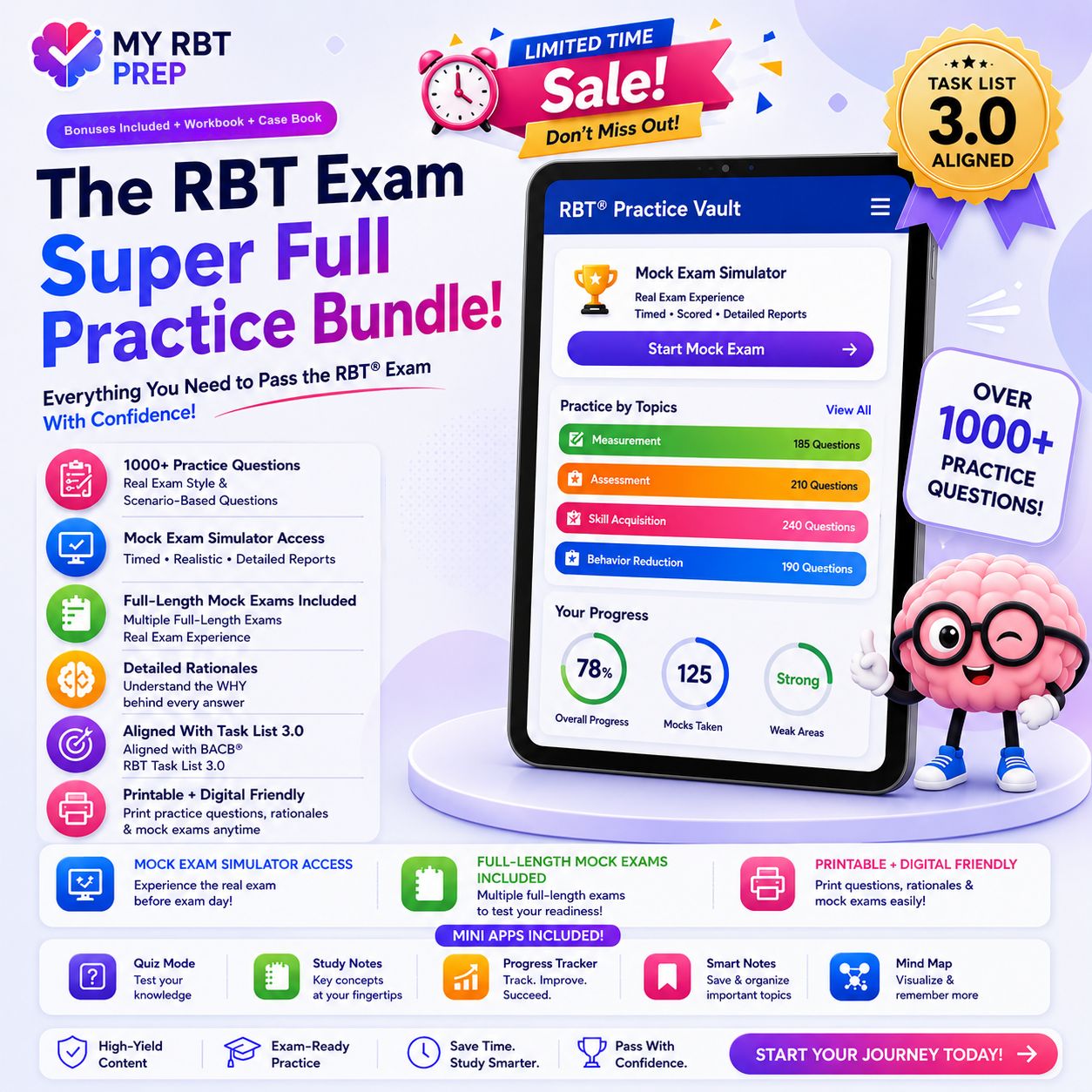
Pass Your RBT® Exam on the First Attempt
Practice with 1,000+ realistic scenario questions, multiple full-length timed mock exams, and detailed rationales formatted exactly like the real Pearson VUE test.
Receiving Your Results
Immediately upon finishing your exam at a Pearson VUE testing center, you will typically receive an on-screen pass or fail notification. This instant feedback offers immediate clarity on your performance. Following this, the Behavior Analyst Certification Board (BACB) will send you an official electronic confirmation, solidifying your certified status. These electronic documents serve as critical proof of your accomplishment, which you should save securely for future reference, including job applications and supervision records.
What if You Didn’t Pass?
It is important to remember that not passing the exam on the first attempt is a learning opportunity, not a roadblock. The BACB provides candidates with ample opportunity for retakes. You are permitted up to eight attempts within a 12-month period, commencing from the date your initial application was approved. Each retake attempt will require an additional $45 Pearson VUE examination fee. Candidates are encouraged to review the RBT Task List, identify areas for improvement, and utilize study resources to prepare more effectively for subsequent attempts.
Understanding Your Initial Certification Status
Upon successfully passing the exam, you officially earn your RBT credential. However, a crucial detail to understand is that your certification status will initially be listed as “inactive” by the BACB. This inactive status is temporary and by design. It signifies that while you are certified, you are not yet authorized to practice independently or bill for services as an RBT. The transition from inactive to active status is contingent upon securing and initiating supervision with a qualified Board Certified Behavior Analyst (BCBA) or Board Certified Assistant Behavior Analyst (BCaBA), who will then report you as their supervisee to the BACB.
Activating Your RBT Credential: The Critical Role of Supervision
Occasionally, someone observes you working as an RBT. They may give you tips, assistance, or suggestions according to what they have seen. As a result, mastering the fondamentals through key techniques is not a challenge anymore. The main purpose is to enhance your capability in providing well-reasoned and clear behavior support. Improvement takes place when the feedback is based on real situations. Observing implies acquiring better skills. Gradually each session results in greater confidence.
Education and training are two keys of success
Human service workers who help people facing challenges between neighbors in different areas are invetably going to come across these situations. The first time the person might attend many classes or learning sessions, and stay sharp for picking up new skills. It is a fact that people don’t stop learning even after getting a certificate. They simply keep going through practice as well. Magazines, networks, and skill-building courses can be the means to learning. Getting updated means that you keep coming back for more.
Keep searching first for growth ways at work

RBT® Exam Flashcards & Study App (3rd Edition)
Master essential ABA terminology and clinical discrimination across all 6 BACB task list areas with 500+ printable and digital flashcards, real exam cues, and full mobile app access.
Each step taken requires certain effort from the participants. For this reason, RBTs will have to be extremely careful to point out the ways for growing in task performance at present time. Instead of waiting, they might turn to workshops or reading articles on their own time. Scientific journals are a great source of discovering new knowledge. To be able to do growth one has to get deeply into the analysis of behavior outside the work hours. The is the key to learning and can be viewed as a regular part of the day. Those who progress are the ones who have made learning part of their lifestyle.
Documentation and Verification: Proof of Your Achievement
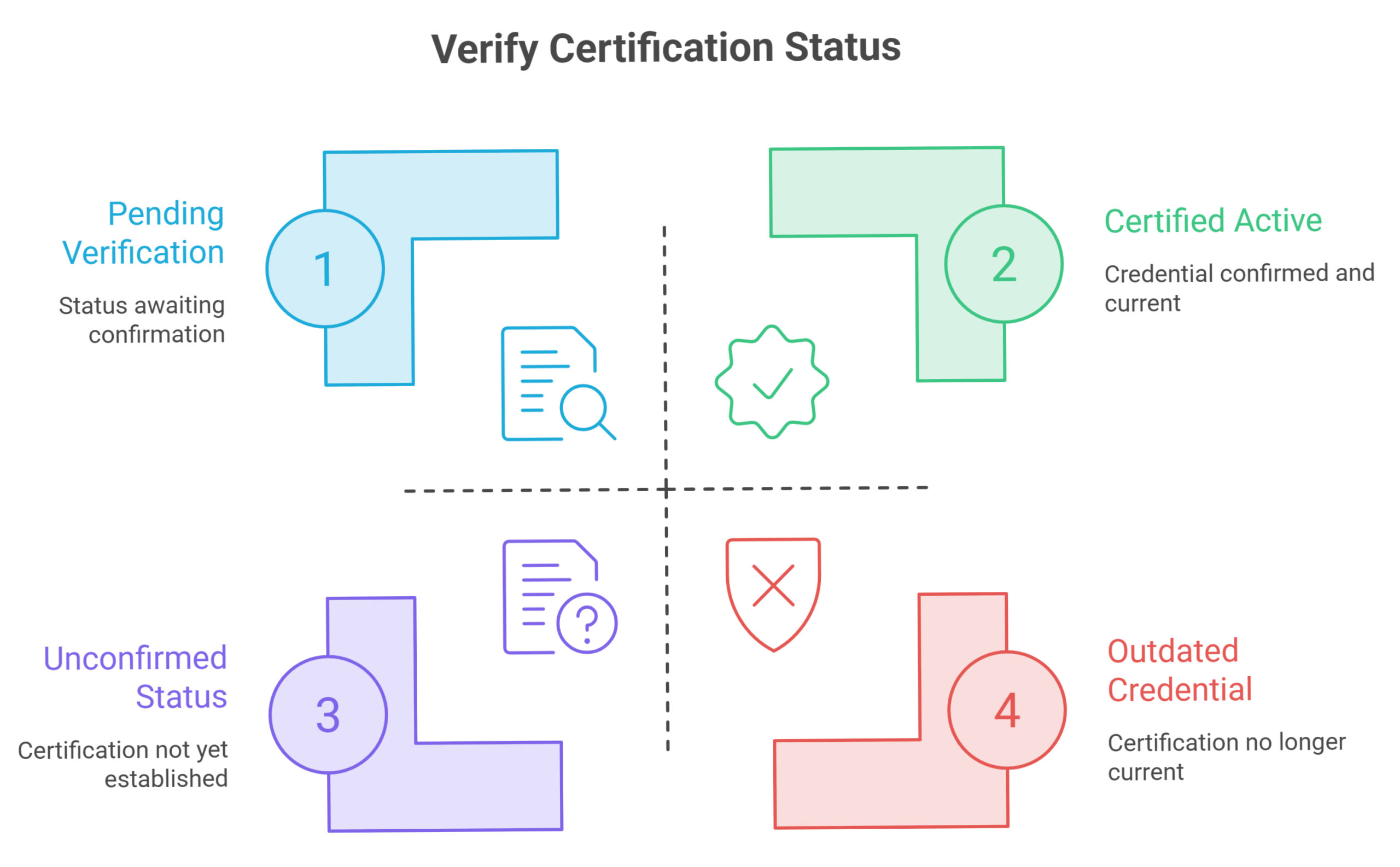
In the digital age, proof of certification primarily exists in electronic form. Understanding how to access and manage your official documentation is essential for your career.
Your Official Proof of Certification
Unlike some traditional certifications, RBTs do not receive a physical certificate. Your RBT credential is confirmed and maintained electronically via the BACB Certificant Registry. This online database serves as the official record of your certification status. While you may request a copy of your certification email or a verification letter ($25 fee per verification) through the BACB website, the primary method for employers and the public to confirm your active status is through this registry.
Importance of Electronic Documents
It is imperative to securely retain all electronic documentation related to your RBT certification, including your pass confirmation and any correspondence from the BACB. These documents will be essential when applying for positions, during onboarding processes with new employers, and for providing evidence of your certification to relevant stakeholders. Employers will frequently verify your credential directly through the BACB Registry to ensure compliance and authenticity.
Sustaining Your Certification: Ongoing Responsibilities and Maintenance
Achieving RBT certification is the beginning of a commitment to continuous professional growth and adherence to the highest ethical standards. Maintaining your certification requires active engagement in several key areas.
Adhering to Ongoing Supervision Requirements
Ongoing supervision is the most critical and continuous requirement for RBTs. It ensures that you consistently receive guidance and feedback to enhance your practice. You can track your 5% monthly supervision hours easily with our RBT Supervision & Caseload Tracker, and read our in-depth guide on RBT Supervision Requirements to avoid compliance pitfalls.
- Supervision Amount: You must receive ongoing supervision for a minimum of 5% of the hours you spend providing behavior-analytic services each calendar month. This threshold ensures adequate oversight relative to your direct service delivery time.
- Contact Structure: Supervision must include at least two face-to-face, real-time contacts per month. These contacts cannot be conducted solely via phone or email; they require direct interaction.
- Direct Observation: In at least one of the two monthly meetings, your supervisor must observe you providing services. While in-person, on-site observation is preferred for its direct insights, observation via web cameras, video-conferencing, or similar remote means is permitted, provided it complies with all applicable laws and allows for real-time interaction and feedback.
- Individual vs. Group: At least one of the two supervision sessions must be individual, meaning only you and your supervisor are present. The other session may occur in a small-group meeting, involving 2-10 RBTs with similar experiences.
- Supervisor Qualifications: Your supervisor must be a qualified BCBA or BCaBA. In some instances, a licensed professional in another behavioral health field may supervise, but only with oversight from an RBT Requirements Coordinator who is a BCBA at the same organization.
- Consequences of Non-Compliance: Failure to comply with supervision requirements can lead to serious repercussions, including the immediate termination of your certification or eligibility to recertify, and a prohibition from reapplying for six months. The BACB takes supervision compliance very seriously to protect clients and uphold professional standards.
The Biennial Renewal Process (Post-2026)
Your RBT certification is valid for one year. However, for RBTs who recertify on or after January 1, 2026, the BACB is transitioning to a biennial (two-year) recertification cycle. This means that after your next successful recertification, your certification will be valid for two years. The renewal process involves several key steps:
- Renewal Application and Fee: You will need to submit a renewal application through your BACB account and pay the associated fee, which is $50 for the biennial recertification effective in 2026.
- Recertification Competency Assessment: A critical component of renewal is completing an RBT Recertification Competency Assessment. This assessment must be administered by a qualified BACB supervisor and completed no more than 45 days prior to your certification expiration date. It ensures that you continue to demonstrate proficiency in core RBT tasks.
- Professional Development: Starting January 2026, RBTs are required to complete 12 hours of professional development every two years to maintain their certification. This ensures you stay current with the latest advancements and best practices in ABA. These professional development activities are separate from ongoing supervision and should focus on enhancing your knowledge and skills in behavior analysis. It is crucial to engage in workshops, conferences, or online courses from authorized continuing education providers.
Ethical Conduct and Compliance
Beyond formal supervision and renewal, maintaining your RBT certification requires a steadfast commitment to ethical conduct and ongoing compliance with BACB guidelines:
- Adherence to the RBT Ethics Code: You are expected to strictly follow the RBT Ethics Code for RBTs, which outlines the professional and ethical standards for behavior technicians.
- Updating Contact Information: It is your responsibility to keep your contact information current in your BACB account. This ensures you receive important updates and notifications regarding RBT certification requirements.
- Reporting Critical Events: You must promptly report any critical events or changes in your compliance status to the BACB Ethics Department, as specified in their self-reporting requirements.
- Accurate Representation: Always ensure that you accurately reflect your current certification status (active or inactive) to the public and employers.
Launching Your Career: Employment and Advancement Opportunities
With your RBT certification active, a world of opportunity in the field of ABA opens up. There is a high demand for skilled RBTs, and the role offers both immediate impact and promising pathways for long-term career growth.
The Demand for RBTs
The demand for RBTs is consistently high across various settings. You will find employment opportunities in:
- ABA Clinics: Providing direct therapy to individuals with autism and other developmental disabilities.
- Educational Institutions: Working within schools to support students with behavioral challenges.
- Healthcare Environments: Collaborating with multidisciplinary teams in hospitals or specialized care facilities.
- Home-Based Services: Delivering individualized ABA programs directly in clients’ homes.
This demand translates into a stable job market, offering meaningful work and often flexible scheduling options, which many professionals find rewarding.
Entry-Level Roles and Immediate Impact
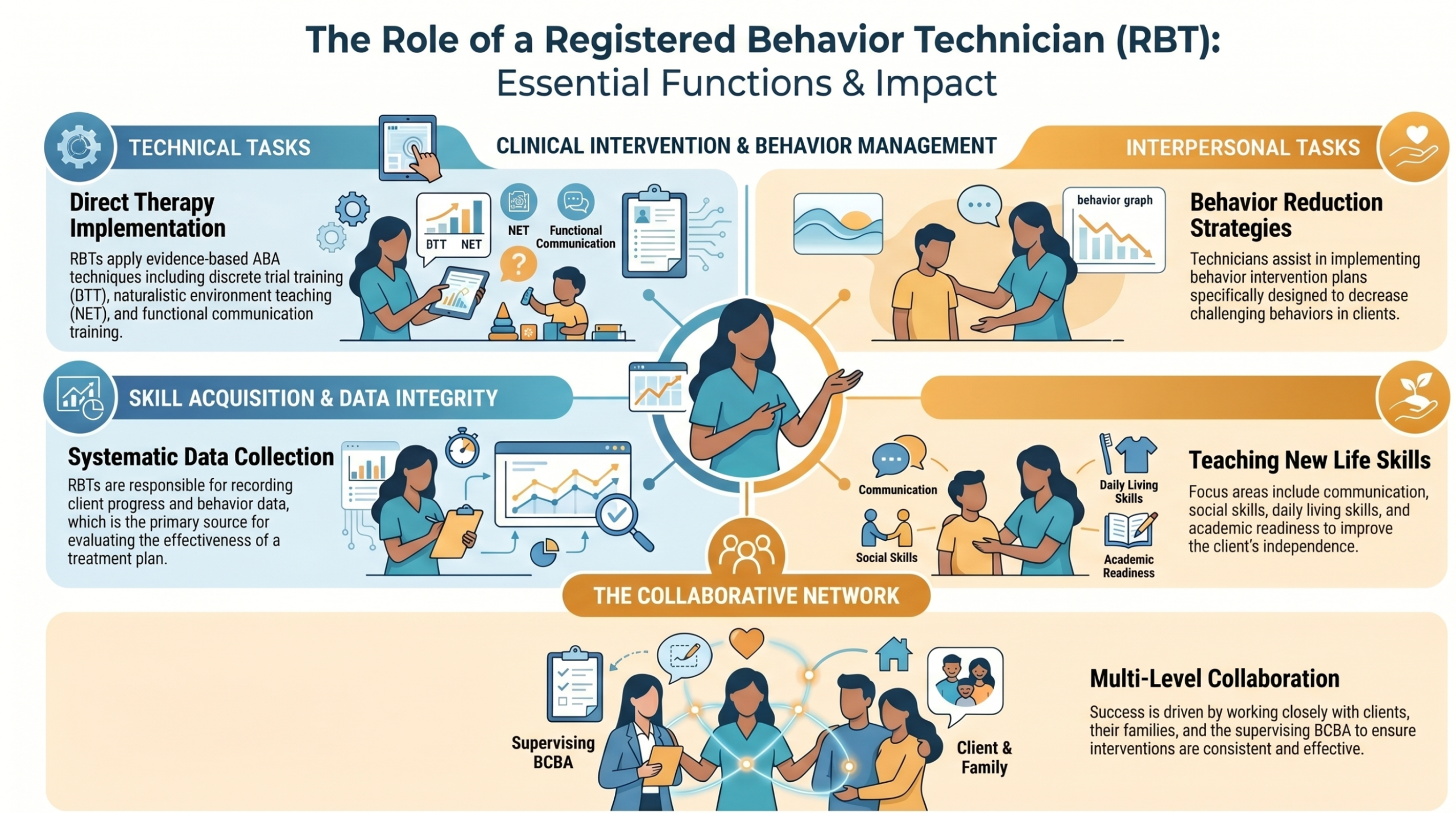
As an RBT, your daily responsibilities will revolve around implementing ABA therapy plans designed by a supervising BCBA. This involves:
- Direct Therapy: Applying evidence-based ABA techniques such as discrete trial training, naturalistic environment teaching, and functional communication training.
- Data Collection: Systematically recording client progress and behavior data, which is crucial for evaluating treatment effectiveness.
- Behavior Reduction Strategies: Assisting in the implementation of behavior intervention plans to decrease challenging behaviors.
- Skill Acquisition: Teaching new skills across various domains, including communication, social skills, daily living skills, and academic readiness.
- Collaboration: Working closely with clients, their families, and your supervising BCBA to ensure consistent and effective intervention.
Pathways for Career Growth Within ABA
The RBT role is often just the beginning of a fulfilling career in behavior analysis. Many RBTs pursue advanced certifications and leadership roles:
- Lead RBT or Senior RBT: With experience, RBTs can advance to leadership positions within an organization. These roles often involve training and mentoring newer RBTs, taking on more complex client cases, and assisting with quality assurance and program coordination.
- Board Certified Assistant Behavior Analyst (BCaBA): For those interested in taking on more responsibility, pursuing BCaBA certification is a natural next step. This requires further specialized training, supervised fieldwork, and passing the BCaBA exam. BCaBAs can conduct assessments and design intervention plans under the supervision of a BCBA.
- Board Certified Behavior Analyst (BCBA): The most common advanced pathway is to become a BCBA. This typically requires a master’s degree in applied behavior analysis or a related field, extensive supervised fieldwork, and passing the BCBA exam. BCBAs have the broadest scope of practice, including conducting comprehensive assessments, designing individualized treatment plans, and supervising other behavior technicians (including RBTs and BCaBAs). This path offers significant increases in responsibility, autonomy, and earning potential.
- Specialization: RBTs can also specialize in specific populations (e.g., individuals with Autism Spectrum Disorder, developmental disabilities) or in particular ABA techniques, enhancing their expertise and employability.
Transferable Skills and Alternative Paths
Even if a long-term career in ABA is not your ultimate goal, the knowledge and skills gained as an RBT are highly transferable and valuable across various sectors. The ability to systematically analyze behavior, implement data-driven interventions, and work effectively with diverse populations is sought after in fields such as education, social work, human resources, and specialized childcare.
In conclusion, passing the RBT exam is a commendable achievement that opens doors to a dynamic and impactful career. By diligently adhering to supervision requirements, fulfilling renewal obligations, upholding ethical standards, and continuously seeking professional development, you will not only maintain your certification but also pave the way for a successful and evolving career within the essential field of Applied Behavior Analysis. Your journey as an RBT is one of continuous learning, growth, and making a profound difference in the lives of others.
Faqs
How do I change my RBT status from “Inactive” to “Active” after passing?
Your status remains inactive until a qualified BCBA supervisor officially links with you on the BACB website. Once your supervisor reports you as a supervisee, your status updates to active for practice.
What are the ongoing supervision requirements to maintain my credential?
You must receive supervision for at least 5% of your service hours each month, including two face-to-face meetings. At least one of these meetings must include a direct observation of you working with a client.
How often do I need to renew my RBT certification and what is the cost?
Starting in 2026, RBTs move to a biennial renewal cycle, requiring a renewal application every two years. The renewal fee is $50, and you must complete a competency assessment within 45 days of your expiration.
What are the new professional development requirements starting in 2026?
Certified RBTs are now required to complete 12 hours of professional development every two years. These hours must be obtained through authorized providers to ensure you stay current with ABA best practices.
Can I work for two different ABA companies at the same time?
Yes, but you must meet the 5% supervision requirement at each individual company. Supervision hours cannot be split or shared between different employers; both must provide independent oversight.

Everything You Need to Pass Your RBT® Exam
Study with our complete, all-in-one preparation package covering every task on the BACB Task List 3.0:
- 1,000+ Practice Questions & Timed Simulator
- 3rd Edition Task List Study Guide & Workbook
- Active Recall Flashcards System + Mobile App
- 20-Task Competency Assessment Mastery Guide