Applied Behavior Analysis (ABA) therapy stands as a scientifically validated approach for improving socially significant behaviors, particularly for individuals with autism spectrum disorder (ASD) and related developmental differences. Its success hinges not only on expertly designed interventions but also critically on the consistent and collaborative application of these strategies across various environments. At the heart of this consistent application lies the indispensable partnership between Registered Behavior Technicians (RBTs) and parents. This article delves into the crucial strategies for fostering effective collaboration between these key stakeholders, highlighting their distinct yet interconnected roles in maximizing therapeutic outcomes.
Defining the Cornerstones: ABA, RBTs, and Parent Collaboration
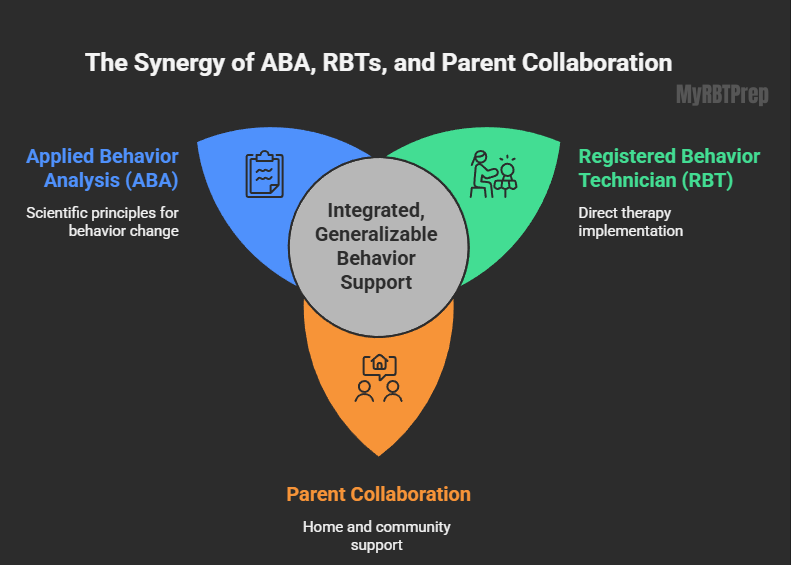
To appreciate the intricacies of this partnership, it is essential to first understand its foundational elements:
- Applied Behavior Analysis (ABA): ABA is a scientific discipline concerned with applying principles of behavior to improve socially significant behaviors. It involves systematic observation, measurement, and analysis of behavior, followed by the design and implementation of interventions to achieve meaningful and positive changes. ABA is data-driven, individualized, and focuses on teaching functional skills and reducing challenging behaviors.
- Registered Behavior Technician (RBT): An RBT is a certified paraprofessional who works directly with clients, implementing behavior-analytic services under the close supervision of a Board Certified Behavior Analyst (BCBA). RBTs are highly trained to deliver individualized treatment plans, teach new skills, reinforce desirable behaviors, and collect data on client progress. They are the frontline implementers, providing direct, one-on-one therapy and ensuring the consistent application of intervention strategies.
- Parent Collaboration: In the context of ABA, parent collaboration refers to the active, ongoing partnership between parents (or primary caregivers) and the ABA therapy team (including RBTs and BCBAs). This collaboration involves sharing information, participating in training, consistently applying strategies in the home and community, and contributing to goal-setting to ensure that therapeutic gains generalize and are maintained in natural environments.
Understanding the Roles: RBTs as the Frontline Implementers in ABA
RBTs play a pivotal role in the day-to-day delivery of ABA services. They are the individuals who spend the most direct time with the client, putting the treatment plan into action. Their responsibilities are clearly defined and carried out under the direct supervision of a BCBA. These responsibilities typically include:
- Direct Implementation of Treatment Plans: RBTs meticulously follow the skill acquisition and behavior reduction plans developed by the supervising BCBA. This involves teaching communication skills, social skills, daily living activities, and academic readiness, as well as implementing strategies to reduce challenging behaviors.
- Data Collection and Reporting: A cornerstone of ABA is data-driven decision-making. RBTs are responsible for accurately collecting data on target behaviors and skills during sessions. They meticulously record occurrences, durations, frequencies, and other relevant metrics, providing essential information to the BCBA for ongoing program evaluation and adjustment.
- Skill Modeling and Prompting: RBTs use various techniques, such as modeling desired behaviors, providing verbal or physical prompts, and systematically fading these prompts as the client gains independence.
- Positive Reinforcement: RBTs consistently apply positive reinforcement strategies to increase the likelihood of desired behaviors occurring in the future. They identify and deliver reinforcers effectively, tailoring them to the individual client’s preferences.
- Communication with Supervisors: RBTs maintain regular communication with their supervising BCBA, reporting on client progress, any observed challenges, and potential barriers to implementation. This ensures that the BCBA is always informed and can make necessary modifications to the treatment plan.
It is crucial to note that while RBTs are highly skilled and integral to the therapy process, their role is not to design treatment plans, conduct assessments, or provide clinical interpretations. These responsibilities fall under the purview of the BCBA, who oversees the RBT’s work and makes all clinical decisions. The RBT’s expertise lies in the consistent and skilled execution of these plans.
The Indispensable Nature of Parental Involvement in ABA Success
While RBTs deliver direct intervention, parental involvement is not merely supplementary; it is profoundly critical for the overall success and long-term impact of ABA therapy. Parents are the constant in a child’s life, uniquely positioned to facilitate the generalization and maintenance of learned skills across diverse, natural environments.
One primary reason for this indispensable role is the generalization of skills. Skills learned in a structured therapy setting, whether in a clinic or at home with an RBT, must be able to transfer to everyday situations and different people.
For instance, a child who learns to request a preferred item from an RBT during a session needs to be able to make that same request to a parent, sibling, or teacher at home, school, or in the community. Parents, by consistently applying ABA strategies in these natural contexts, create innumerable opportunities for practice and reinforcement, ensuring that skills are not confined to therapy sessions but become integral parts of the child’s behavioral repertoire.
Furthermore, active parental participation accelerates progress and leads to more long-lasting results. When parents are equipped with the knowledge and tools to consistently reinforce target behaviors and manage challenging ones, the therapeutic impact extends far beyond the RBT’s scheduled sessions. This continuous and widespread application of principles helps to embed new skills more deeply and reduce the likelihood of regression.
Parents also possess invaluable insight into their child’s unique needs, preferences, and challenging behaviors. They are the experts on their child’s history, family dynamics, and daily routines. This intimate knowledge is essential for the clinical team to develop truly individualized and effective treatment plans that align with the family’s values and daily life.
An RBT might observe a challenging behavior during a session, but a parent can often provide critical context about its historical occurrences or triggers specific to the home environment, allowing the BCBA to refine the intervention strategy. For example, a parent might share that a child’s tantrum behavior consistently occurs when transitioning from screen time to homework, information that is vital for designing proactive strategies.
Mechanisms of RBT-Parent Collaboration: Bridging the Therapeutic Gap
The collaboration between RBTs and parents is a dynamic process built on practical engagement. RBTs are often the direct conduit through which ABA principles are brought into the family’s daily life.
One key mechanism is direct modeling and coaching. RBTs frequently demonstrate specific techniques, such as how to effectively deliver positive reinforcement for a desired behavior or how to implement a visual schedule for transitions. They might invite parents to observe sessions and then provide opportunities for parents to practice these techniques with their child while the RBT offers immediate, constructive feedback. For instance, an RBT might model using a “first/then” board to transition from playtime to snack time, then guide the parent through the same process, offering praise for accurate implementation and gentle correction for areas needing refinement.
RBTs also play a crucial role in supporting parent training initiatives led by the supervising BCBA. While the BCBA designs the formal parent training curriculum, RBTs reinforce these teachings in practical settings. They can help parents understand the “why” behind an intervention by relating it to their child’s specific behaviors and progress data. They act as on-the-ground support, translating theoretical concepts into actionable steps within the family’s routine. This might involve demonstrating Behavioral Skills Training (BST) models, which typically include instruction, modeling, rehearsal, and feedback, directly with parents during home-based sessions.
Furthermore, RBTs assist parents in integrating ABA strategies into daily routines. They work with families to identify natural opportunities for skill practice and behavior management. This could involve showing parents how to use choice boards during meal preparation, incorporate communication practice during grocery shopping, or apply token economies for chore completion. By embedding ABA into everyday life, RBTs help parents create a consistent, therapeutic environment that extends beyond scheduled sessions, making the interventions more sustainable and effective.
Strategies for Effective Communication and Partnership Building
Effective collaboration hinges on robust and reciprocal communication between RBTs and parents. Given the RBT’s direct and frequent interaction with the child and family, their communication skills are paramount.
A primary strategy is to establish open, non-judgmental, and regular communication channels. This means fostering an environment where parents feel comfortable sharing observations, asking questions, and expressing concerns without fear of being critiqued. While the BCBA is the primary clinical contact, RBTs can facilitate this openness by actively listening and maintaining a respectful demeanor. Consistent, brief updates at the start or end of sessions can help maintain continuity.
Crucially, RBTs must utilize clear, jargon-free language when discussing ABA concepts and intervention strategies. ABA often uses technical terms, but explaining these in plain language, perhaps with analogies or real-life examples, ensures parents understand the rationale and application. For instance, instead of saying, “We’re implementing differential reinforcement of other behavior (DRO),” an RBT might explain, “We’re going to praise and reward your child when they play appropriately for a few minutes, which means we’re not focusing on the challenging behavior right now, but rather on encouraging positive play.” This clarity fosters comprehension and enhances parental buy-in.
Collaborative goal-setting, though primarily driven by the BCBA, is significantly supported by the RBT. RBTs often relay parents’ daily observations, priorities, and cultural considerations to the BCBA. They can act as invaluable informants, ensuring that treatment goals are not only clinically sound but also contextually relevant and meaningful to the family. For example, if a parent expresses a desire for their child to independently dress for school, the RBT can share observations on current dressing skills and challenges, which the BCBA can then incorporate into a comprehensive skill acquisition plan.
Underlying all these communication strategies is the need for mutual respect and trust. Parents are the primary caregivers and experts on their child; RBTs are trained professionals in behavioral intervention. Acknowledging and valuing each other’s expertise creates a strong foundation for partnership. RBTs demonstrate respect by listening attentively, valuing parental input, and clearly explaining their role and the plan they are implementing.
Empowering Parents as Co-Therapists: The RBT’s Contribution
One of the most profound impacts of RBT-parent collaboration is the empowerment of parents to become effective “co-therapists” in their child’s development journey. While not clinically qualified therapists, empowered parents significantly extend the reach and consistency of ABA interventions.
RBTs contribute to this empowerment by building parental confidence in applying ABA techniques. Through consistent modeling, practice, and feedback, parents gain proficiency in strategies like positive reinforcement, prompting, and managing challenging behaviors. This hands-on training, often directly provided by the RBT during in-home or clinic sessions, helps parents feel more capable and in control. For instance, an RBT might guide a parent on how to use a token board system effectively for completing homework. Over several sessions, the parent gains confidence, applying the system independently. This increased caregiver competence often leads to a reduction in family stress and an improved overall family dynamic.
The focus on consistency in implementing strategies across environments is key. RBTs help parents understand that the strategies applied during therapy sessions are most effective when they are also applied in other settings. They work with parents to adapt techniques to fit various contexts, ensuring that the child receives consistent messages and expectations, thereby facilitating faster skill acquisition and generalization. This not only reinforces therapeutic gains but also strengthens the parent-child bond as parents feel more equipped to support their child’s growth.
Addressing Challenges in the RBT-Parent Dynamic
Despite the immense benefits, the RBT-parent dynamic can present challenges that require careful navigation to maintain an effective partnership.
One common hurdle is differing expectations regarding treatment pace or specific intervention strategies. Parents might expect faster progress than is realistic or may initially resist certain interventions due to misconceptions or personal beliefs. RBTs, while respecting parental perspectives, must maintain professional boundaries. When such challenges arise, the RBT’s role is to patiently explain the rationale behind the strategies, share observed data on the child’s progress (without making clinical interpretations), and always defer complex discussions or clinical adjustments to the supervising BCBA. For example, if a parent expresses skepticism about a particular behavior reduction plan, the RBT can highlight the data collected during sessions and communicate the parent’s concerns directly to the BCBA for further discussion and explanation.
Another challenge can be resistance to specific intervention strategies or difficulty for parents in consistently implementing them. RBTs can address this by providing continued modeling, simplifying instructions, breaking down complex tasks into smaller steps, and celebrating small successes. They also play a vital role in identifying barriers to implementation, such as a parent’s work schedule or other family demands, and communicating these to the BCBA so that the treatment plan can be realistically adjusted.
It is paramount for RBTs to understand and maintain professional boundaries, avoiding inadvertently crossing into the role of a clinical supervisor. RBTs do not independently modify programs, assess behavior, or provide clinical advice. If a parent requests a change to the treatment plan or asks for clinical interpretations, the RBT must respectfully redirect these requests to the supervising BCBA. This clear demarcation of roles ensures ethical practice and protects both the client and the RBT. A brief, hypothetical scenario might involve an RBT explaining to a parent, “That’s an excellent question about adjusting the reinforcement schedule. I’ll make sure to pass that on to our BCBA, [Supervisor’s Name], and they will reach out to discuss it with you.”
The Ecosystem of Support: Enhancing Collaboration Through Broader Resources
Interaction between parents, their child, and the ABA support modules are only one part of the overall ecosystem, where parents will also gain strength as part of a collaborative unit. The parent support group (PSG) around the family will provide them with emotional support (safety), ideas and practical solutions for dealing with traffic, and a support system that will provide them with a community feel.
Families going through child therapy at the same time often benefit from being a part of parent support groups because they are able to relate to each other – sharing their story, feelings of frustration, celebrating wins, and knowing that they are not alone. Having a place to share practical ideas and how to address issues in the same manner help to increase the confidence of the parent to advocate for their child. As the parent feels more in control of his/herself, the parent’s overall stress level will decrease, allowing for more resiliency and better engagement and positivity in regard to the child’s therapy.
When a parent has a new scheduling technique to use from another parent in the support group, the parent may be willing to attempt the same technique when they see it demonstrated by an RBT during a session with their child. Peer-to-peer learning through PSG helps to provide an emotional safe space for parents, which in turn creates an environment where parents feel empowered to play the role of parent advocate (RBT) for their child as well as the entire ABA team. By providing a systemic/overall approach to parent involvement, the picture becomes clear that parent involvement within the ABA space is not an isolated task but rather a complete ongoing support system to ultimately support the child’s development.
Conclusion
The synergy between Registered Behavior Technicians and parents is a cornerstone of effective Applied Behavior Analysis therapy. RBTs, as the direct implementers, bring consistency and skilled application of interventions to the client’s daily life. Parents, as the child’s primary advocates and constant presence, provide invaluable context, facilitate skill generalization, and ensure the long-term maintenance of therapeutic gains.
By establishing open communication, utilizing jargon-free language, fostering mutual respect, and strategically empowering parents through modeling and coaching, RBTs significantly bridge the therapeutic gap. Navigating challenges such as differing expectations and maintaining professional boundaries are crucial for sustaining this partnership. Ultimately, when RBTs and parents work hand-in-hand, supported by the clinical oversight of a BCBA and a broader community of resources, they create a powerful, consistent, and supportive environment that maximizes the child’s potential for meaningful and lasting behavioral growth. This collaborative model is not merely a best practice; it is an ethical imperative that underpins the success of ABA interventions.
Frequently Asked Questions (FAQs)
Q: What is the RBT’s primary role in communicating treatment plan changes to parents?
A: The RBT implements the plan designed by the BCBA and should relay parent suggestions or concerns directly to their supervisor for clinical decision-making.
Q: How does consistent collaboration between RBTs and parents ensure skill generalization?
A: Parents provide critical, consistent practice across natural environments, reinforcing skills learned in therapy sessions so they become automatic.
Q: If I have a clinical concern about the treatment plan, who should I speak to first?
A: Always discuss clinical adjustments or complex issues directly with your supervising Board Certified Behavior Analyst (BCBA) for accurate guidance.
Q: Can RBTs offer suggestions or make changes to my child’s behavior intervention plan?
A: No, RBTs must adhere to the written plan and are ethically required to redirect any requests for program changes to their BCBA supervisor.
Q: How can I effectively share important home behavior insights with the RBT?
A: Share observations clearly and concisely during check-ins, focusing on objective behaviors and environmental context rather than interpretations.