One of the most important requirements for maintaining Registered Behavior Technician (RBT) certification is ongoing supervision. Unlike many certifications that only require continuing education or periodic renewals, the RBT credential is built around a supervision model designed to ensure that behavior technicians continue providing high-quality services while developing their professional skills.
Many new RBTs are surprised to learn that supervision is not optional. The Behavior Analyst Certification Board (BACB) requires all RBTs to receive ongoing supervision from qualified supervisors throughout their certification period. Failing to meet supervision requirements can place an RBT’s certification at risk and may prevent them from legally providing RBT services.
Because supervision requirements can sometimes seem confusing, many technicians ask questions such as: How many hours of supervision do I need each month? Does supervision have to be in person? Who can supervise an RBT? What happens if I don’t meet the supervision requirement? Understanding the answers to these questions is essential for maintaining compliance and protecting your certification.
In this guide, we’ll explain exactly how RBT supervision works, how supervision hours are calculated, who can provide supervision, common mistakes to avoid, and why supervision plays such a critical role in professional development.
What Is RBT Supervision?
RBT supervision is an ongoing process in which a qualified supervisor monitors, evaluates, and supports the work of a Registered Behavior Technician. The purpose of supervision is to ensure that behavior technicians are implementing interventions correctly, following ethical guidelines, collecting accurate data, and providing high-quality services to clients.
Supervision is much more than simply checking paperwork or observing a session. Effective supervision involves coaching, feedback, performance evaluation, skill development, and ongoing professional support. Supervisors help RBTs improve their clinical skills while ensuring that services remain consistent with ABA principles and treatment plans.
Because RBTs work directly with clients and implement behavior intervention programs, supervision serves as an important quality-control system that protects both clients and practitioners.
Why Does the BACB Require Supervision?
The BACB requires supervision because RBTs are considered paraprofessionals who work under the direction of qualified behavior analysts. Unlike BCBAs, RBTs are not authorized to independently design treatment plans, conduct assessments, or make clinical decisions.
Instead, RBTs implement services developed by supervisors. Ongoing supervision ensures that interventions are being delivered correctly and consistently.
Without supervision, treatment quality could decline, ethical issues could go unnoticed, and clients might not receive the support they need. Regular supervision also allows technicians to ask questions, receive feedback, and continue improving their skills throughout their careers.
Benefits of RBT Supervision
| Benefit | Why It Matters |
|---|---|
| Quality Assurance | Ensures treatment integrity |
| Skill Development | Improves professional competence |
| Ethical Compliance | Supports ethical practice |
| Client Protection | Promotes safe service delivery |
| Feedback Opportunities | Encourages continuous improvement |
How Many Hours of Supervision Does an RBT Need?
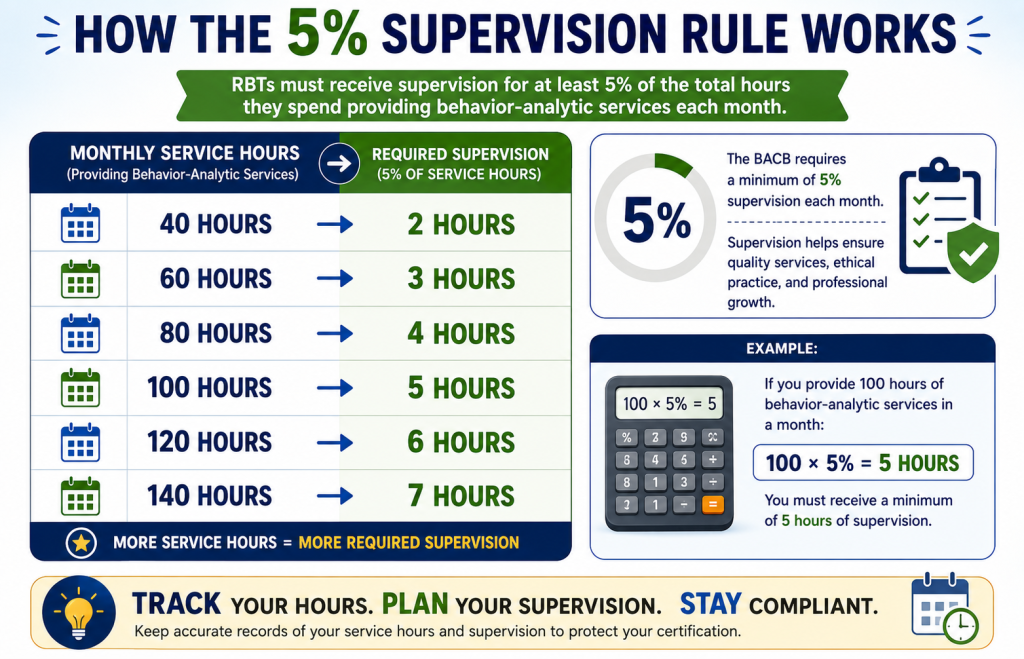
The BACB requires RBTs to receive supervision for a minimum percentage of the hours they spend providing behavior-analytic services each month.
Currently, RBTs must receive supervision for at least 5% of the total hours spent delivering behavior-analytic services during a calendar month.
This means the exact number of supervision hours varies depending on how many client-service hours an RBT works.
For example, if an RBT provides 100 hours of behavior-analytic services during a month, they would need at least 5 hours of supervision. If they provide 80 hours of services, they would need at least 4 hours of supervision.
The requirement is based on a percentage rather than a fixed number of hours because RBT schedules can vary significantly between organizations and settings.
Supervision Hour Examples
| Monthly Service Hours | Required Supervision (5%) |
|---|---|
| 40 Hours | 2 Hours |
| 60 Hours | 3 Hours |
| 80 Hours | 4 Hours |
| 100 Hours | 5 Hours |
| 120 Hours | 6 Hours |
| 140 Hours | 7 Hours |
Understanding this calculation helps RBTs verify that they are meeting supervision requirements each month.
What Counts as Behavior-Analytic Services?
To calculate supervision requirements correctly, it’s important to understand what qualifies as behavior-analytic services.
Behavior-analytic services generally include activities such as:
- Direct therapy sessions
- Skill acquisition programs
- Behavior reduction interventions
- Data collection activities
- Program implementation
- Client-specific ABA services
However, administrative duties, staff meetings, general training sessions, and unrelated work activities may not count toward service hours.
Because organizations may track service hours differently, RBTs should consult their supervisors when calculating supervision requirements.
How Often Must Supervision Occur?
Meeting the required percentage alone is not enough. Supervision must also occur regularly throughout the month.
The BACB expects supervision to be distributed across the month rather than concentrated into a single session. Regular supervision helps ensure continuous support and monitoring rather than last-minute compliance.
For example, receiving all supervision during the final day of the month may technically satisfy the hourly requirement but would not provide the same level of ongoing guidance as multiple supervision contacts throughout the month.
Most organizations schedule supervision weekly or biweekly to maintain consistency.
What Happens During a Supervision Session?
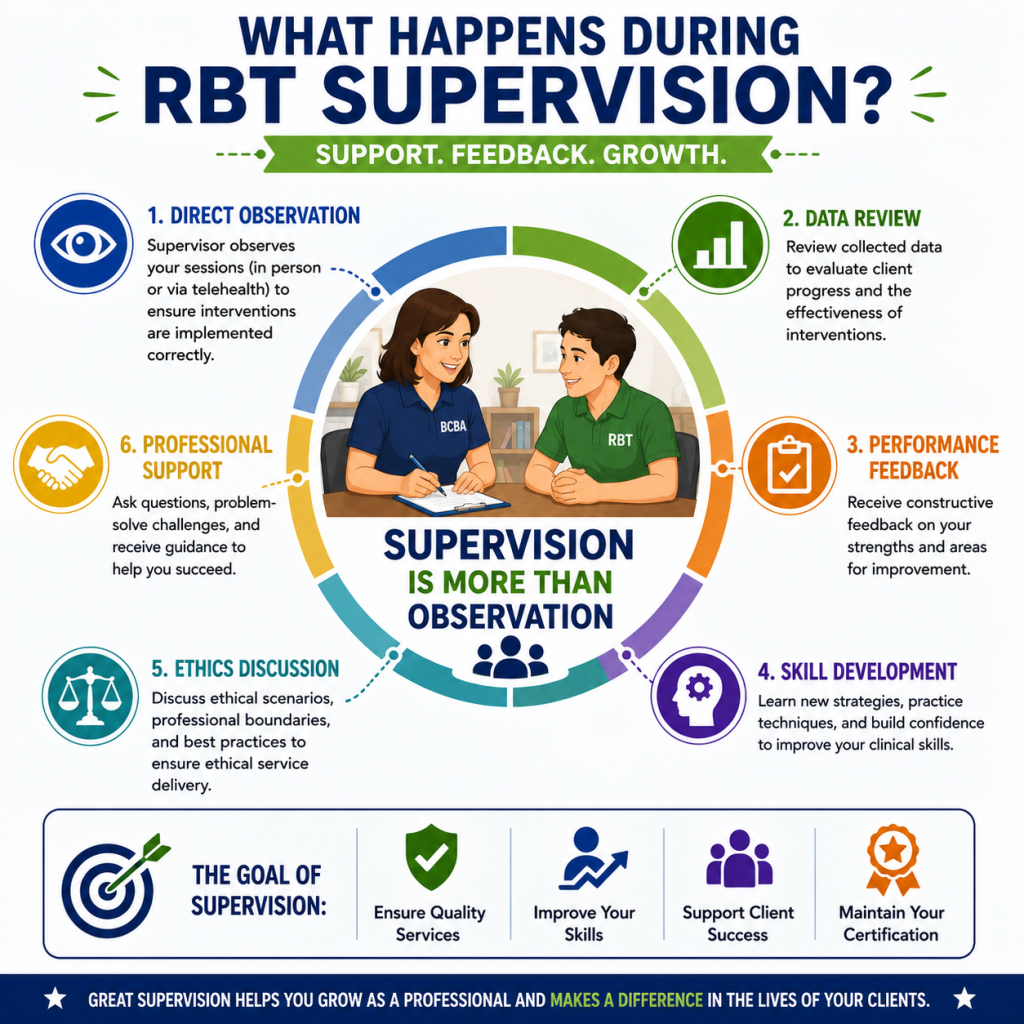
Many new RBTs assume supervision consists only of someone watching them work. While direct observation is certainly important, effective supervision often includes several components.
A supervisor may:
- Observe client sessions
- Review collected data
- Evaluate treatment fidelity
- Provide performance feedback
- Answer clinical questions
- Model intervention procedures
- Review ethical considerations
- Discuss professional development goals
The goal is not to criticize performance but to help technicians become more effective practitioners.
Common Supervision Activities
| Activity | Purpose |
|---|---|
| Direct Observation | Evaluate service delivery |
| Feedback Sessions | Improve performance |
| Data Review | Ensure accuracy |
| Skill Training | Build competence |
| Ethical Discussions | Promote compliance |
Who Can Supervise an RBT?
Not everyone is qualified to supervise an RBT.
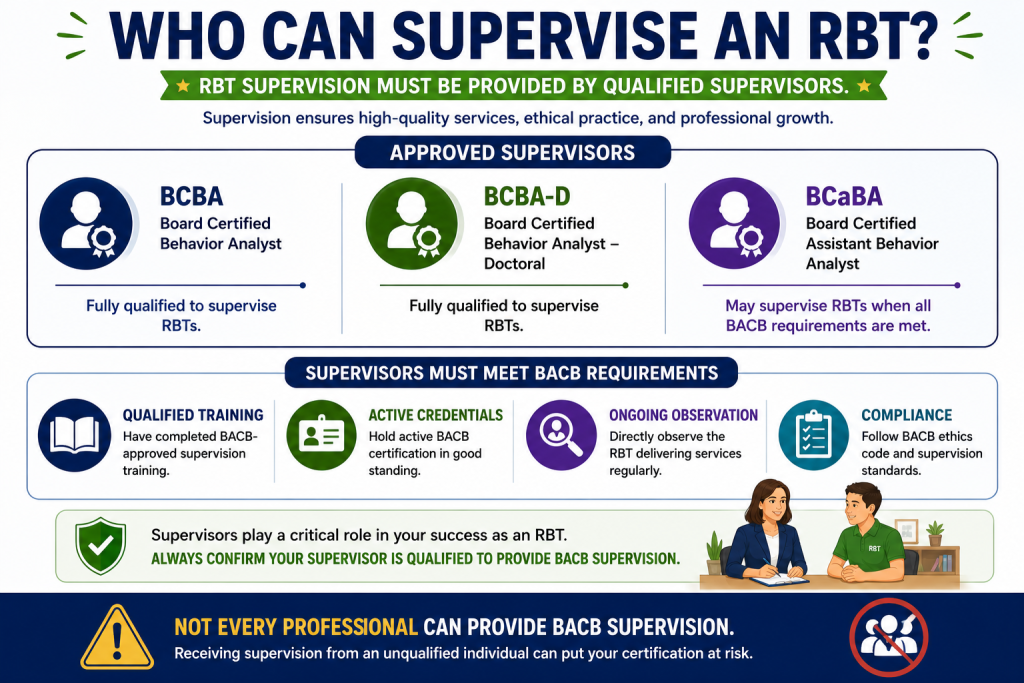
The BACB requires supervision to be provided by qualified professionals who meet supervision requirements.
These may include:
- Board Certified Behavior Analysts (BCBAs)
- Board Certified Assistant Behavior Analysts (BCaBAs)
- Other qualified supervisors approved by BACB requirements
The supervisor must have the necessary credentials and meet supervision-related training requirements established by the BACB.
Before accepting supervision from anyone, RBTs should verify that the individual is authorized to provide supervision.
Does Supervision Have to Be In Person?
Modern technology has increased flexibility in how supervision is conducted.
Depending on circumstances and applicable requirements, supervision may include:
- In-person observation
- Telehealth supervision
- Video conferencing
- Remote performance feedback
However, supervisors must still directly observe the RBT delivering services. Observation remains a critical component of effective supervision regardless of whether it occurs physically or remotely.
Remote supervision can be especially beneficial for providers serving rural or underserved areas where access to behavior analysts may be limited.
Why Direct Observation Is So Important
One of the most valuable aspects of supervision is direct observation.
When supervisors observe sessions, they can evaluate whether interventions are being implemented correctly and whether treatment plans are producing desired outcomes.
Direct observation allows supervisors to identify strengths and areas for improvement that may not be apparent through written documentation alone.
For example, an RBT may accurately collect data but unknowingly provide prompts inconsistently. Observation helps identify these issues and allows supervisors to provide immediate feedback.
Without direct observation, important implementation errors could go unnoticed.
Common Supervision Mistakes RBTs Should Avoid
Many supervision-related problems are completely preventable.
One common mistake is failing to track service hours accurately. If an RBT does not know how many hours they worked, it becomes difficult to verify whether supervision requirements have been met.
Another mistake is assuming supervisors are solely responsible for compliance. While supervisors play an important role, RBTs should actively monitor their own supervision records and ensure requirements are being satisfied.
Waiting until the end of the month to schedule supervision can also create unnecessary stress and increase the risk of noncompliance.
Common Supervision Errors
| Mistake | Potential Consequence |
|---|---|
| Not Tracking Hours | Missed requirements |
| Delaying Supervision | Compliance issues |
| Poor Documentation | Verification problems |
| Ignoring Feedback | Reduced performance |
| Assuming Others Handle Everything | Certification risk |
What Happens If an RBT Does Not Meet Supervision Requirements?
Failing to meet supervision requirements can have serious consequences.
Because supervision is a certification requirement, missing supervision hours may place an RBT’s credential at risk. Organizations may also have internal policies requiring immediate correction of supervision deficiencies.
If supervision requirements are not met consistently, certification status could be affected depending on the circumstances and applicable regulations.
For this reason, both RBTs and supervisors should monitor supervision carefully throughout each month.
How to Get the Most Out of Supervision
The best RBTs view supervision as an opportunity rather than an obligation.
Instead of simply attending supervision to satisfy requirements, use these meetings to improve your professional skills and deepen your understanding of ABA.
Before supervision sessions:
- Prepare questions
- Review client concerns
- Identify challenging situations
- Reflect on areas needing improvement
The more engaged you are during supervision, the more valuable the experience becomes.
Many highly successful BCBAs and clinical leaders credit strong supervision experiences for helping them develop early in their careers.
Can Supervision Help You Advance Your Career?
Absolutely.
Supervision is one of the most important professional development tools available to RBTs.
Through supervision, technicians gain:
- Clinical knowledge
- Ethical decision-making skills
- Treatment implementation expertise
- Professional communication abilities
- Problem-solving strategies
These skills become valuable if an RBT later pursues advanced roles such as:
- BCaBA
- BCBA
- Clinical Supervisor
- Special Education Professional
- Behavioral Consultant
Consistent supervision often accelerates professional growth and prepares technicians for future leadership opportunities.
Final Thoughts
Supervision is a critical component of maintaining RBT certification and delivering high-quality ABA services. Rather than viewing supervision as simply another requirement, RBTs should recognize it as an opportunity to receive guidance, improve clinical skills, strengthen ethical decision-making, and enhance client outcomes.
The current requirement of at least 5% supervision each month ensures that technicians receive ongoing support while working directly with clients. By understanding how supervision hours are calculated, who can provide supervision, and how to actively participate in the supervision process, RBTs can remain compliant while maximizing their professional development.
Ultimately, effective supervision benefits everyone involved—RBTs, supervisors, organizations, and most importantly, the clients receiving services.
Frequently Asked Questions
1. How many supervision hours does an RBT need each month?
RBTs must receive supervision equal to at least 5% of the behavior-analytic services they provide during a calendar month.
2. Who can supervise an RBT?
Qualified supervisors such as BCBAs and BCaBAs who meet BACB supervision requirements can supervise RBTs.
3. Does remote supervision count?
Yes, remote supervision may be permitted when conducted appropriately and in accordance with BACB requirements.
4. What happens if I miss supervision hours?
Failing to meet supervision requirements may affect compliance and could place certification status at risk.
5. Why is direct observation required during supervision?
Direct observation helps supervisors evaluate treatment implementation, provide feedback, and ensure high-quality service delivery.