Children with Autism Spectrum Disorder (ASD) often experience challenges that affect communication, social interaction, emotional regulation, learning, and daily living skills. While every child with autism has unique strengths and needs, many benefit from structured support that helps them build important life skills and become more independent. One of the most valuable professionals involved in this process is the Registered Behavior Technician (RBT).
RBTs are trained professionals who work directly with children under the supervision of Board Certified Behavior Analysts (BCBAs). Using principles of Applied Behavior Analysis (ABA), they help children learn new skills, reduce challenging behaviors, and increase independence in meaningful ways. Their work is highly individualized, meaning that every intervention is tailored to the specific needs and goals of the child.
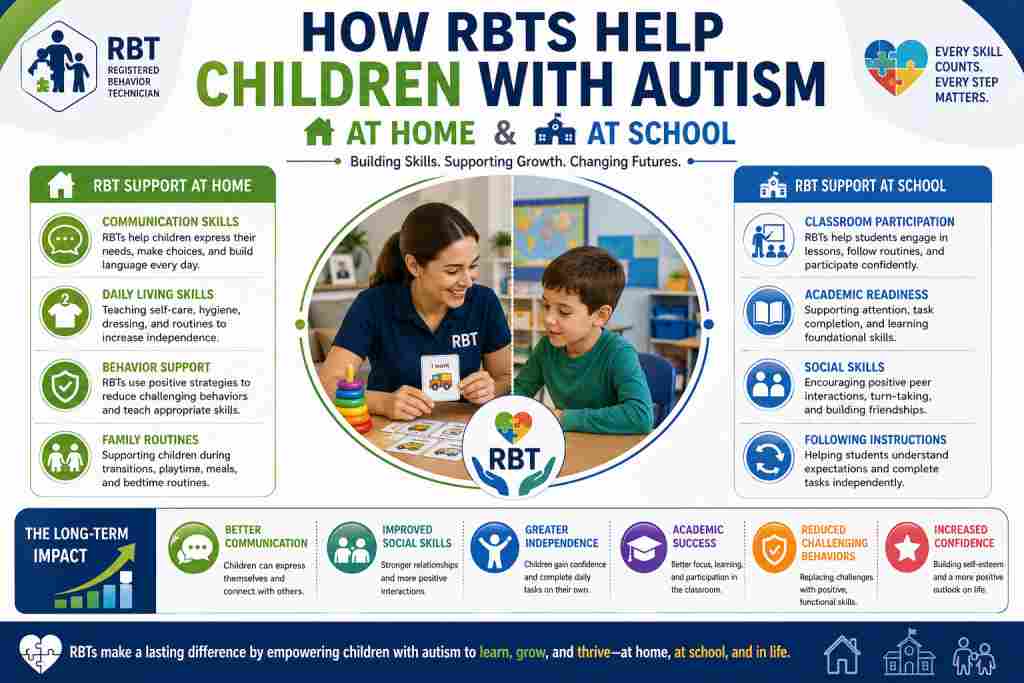
The impact of an RBT extends far beyond therapy sessions. Whether working in a family home, a school classroom, a clinic, or the community, RBTs help children apply learned skills in real-world situations. By providing consistent support across different environments, they help children become more successful academically, socially, and emotionally.
In this article, we’ll take an in-depth look at how RBTs help children with autism both at home and at school, why their role is so important, and how their work contributes to long-term growth and independence.
Understanding the Role of an RBT
A Registered Behavior Technician (RBT) is a paraprofessional credentialed by the Behavior Analyst Certification Board (BACB). RBTs work directly with clients while implementing treatment plans developed by supervising BCBAs. Although they do not independently create treatment programs, they are responsible for carrying out interventions, teaching skills, collecting data, and supporting children during everyday learning opportunities.
Because RBTs spend significant time working one-on-one with children, they often develop a deep understanding of each child’s learning style, preferences, strengths, and challenges. This allows them to deliver highly individualized instruction while building strong therapeutic relationships.
The primary goal of an RBT is to help children make meaningful progress toward specific behavioral, communication, social, and adaptive goals. Every activity during therapy is designed with a purpose, whether it’s teaching a child to request a toy appropriately, follow classroom instructions, or complete a self-care routine independently.
RBT Responsibilities Overview
| Area | Example Tasks |
|---|---|
| Communication | Teaching requests, conversations, and language skills |
| Behavior Support | Reducing tantrums, aggression, and disruptive behaviors |
| Daily Living Skills | Dressing, hygiene, and self-care routines |
| Social Development | Sharing, turn-taking, and peer interactions |
| Data Collection | Tracking progress and treatment outcomes |
Why Children With Autism Benefit From RBT Support
Children with autism often learn differently than their peers. Skills that may develop naturally for some children frequently require direct teaching, repetition, reinforcement, and structured practice for children with ASD. This is where RBT support becomes particularly valuable.
One of the greatest advantages of ABA therapy is its individualized approach. Rather than using the same teaching method for every child, RBTs adjust their strategies based on the child’s unique needs, abilities, and learning style. This personalized support helps children make progress at a pace that is appropriate for them.
RBTs also provide consistency, which is especially important for many children with autism. Consistent expectations, routines, and reinforcement help children feel secure while promoting learning. When skills are practiced regularly across different environments, children become more likely to retain and generalize those skills.
Additionally, RBTs focus on measurable outcomes. Progress is carefully tracked through data collection, allowing treatment teams to identify what is working and make adjustments when needed. This data-driven approach ensures that intervention remains effective and tailored to the child’s needs.
How RBTs Help Children at Home
The home environment provides countless opportunities for learning and skill development. Since children spend a significant portion of their lives at home, many ABA programs include home-based therapy sessions where RBTs work directly with children in their natural environment.
Teaching skills at home offers several advantages. Children are often more comfortable in familiar surroundings, and the skills being taught can immediately be applied to real-life situations. Rather than practicing skills in an artificial setting, children learn within the environment where those skills will be used most frequently.
Home-based ABA therapy focuses on helping children become more independent and successful in daily life. RBTs work closely with parents and caregivers to identify meaningful goals that improve family functioning and support long-term independence.
For example, an RBT may help a child learn to follow household routines, clean up after playtime, complete bedtime routines, or participate more successfully during family activities. These seemingly small skills can have a significant impact on a child’s confidence and overall quality of life.
Home-Based ABA Goals
| Skill Area | Example Goal |
|---|---|
| Hygiene | Brush teeth independently |
| Dressing | Put on clothes without assistance |
| Communication | Request desired items appropriately |
| Household Skills | Clean up toys after playtime |
| Safety | Respond to safety instructions |
Teaching Daily Living Skills
Daily living skills are essential for independence and self-sufficiency. Many children with autism require direct instruction and repeated practice to master these important life skills. RBTs use structured teaching techniques to help children learn tasks that they will use throughout their lives.
Examples of daily living skills include:
- Brushing teeth
- Washing hands
- Getting dressed
- Using the bathroom independently
- Eating with utensils
- Cleaning up personal belongings
- Following morning and bedtime routines
To make learning easier, RBTs often use a strategy called task analysis. This involves breaking a complex task into smaller, manageable steps. Instead of expecting a child to master an entire routine at once, each step is taught individually and reinforced until mastery is achieved.
For example, learning to brush teeth may involve first learning to pick up the toothbrush, then applying toothpaste, then brushing for an appropriate amount of time, and finally rinsing and putting supplies away. Over time, these small steps combine into a fully independent routine.
Teaching daily living skills not only increases independence but also improves self-confidence and reduces reliance on caregivers.
Improving Communication Skills at Home
Communication development is one of the most common and important goals in ABA therapy. Many children with autism experience difficulties expressing their needs, understanding language, maintaining conversations, or responding appropriately in social situations.
When communication challenges exist, children may become frustrated because they are unable to express themselves effectively. This frustration can sometimes contribute to challenging behaviors. By improving communication skills, RBTs help children develop more effective ways to interact with the world around them.
Depending on the child’s abilities, communication instruction may involve:
- Spoken language
- Picture Exchange Communication System (PECS)
- Speech-generating devices
- Sign language
- Communication boards
RBTs teach children how to request items, ask for help, answer questions, make choices, express feelings, and participate in conversations. These skills are practiced repeatedly in natural situations throughout the day.
As communication improves, children often experience greater independence, stronger family relationships, reduced frustration, and increased confidence in social situations.
Reducing Challenging Behaviors at Home
Many challenging behaviors serve a purpose for the child. Behaviors such as tantrums, aggression, self-injury, or property destruction often occur because the child is attempting to communicate a need, escape a difficult situation, gain attention, or access a preferred item.
Rather than simply attempting to stop these behaviors, ABA focuses on understanding why they occur and teaching more appropriate alternatives.
RBTs work closely with BCBAs to implement behavior intervention plans that address the function of challenging behaviors. They teach replacement skills that allow children to achieve the same outcome in a safer and more socially appropriate manner.
For example, if a child screams when they want attention, the RBT may teach them to appropriately request attention through words, gestures, or a communication device. If a child becomes aggressive when asked to complete difficult tasks, the RBT may teach them how to request a break appropriately.
Over time, these replacement skills reduce challenging behaviors while increasing independence and communication.
How RBTs Support Children in School Settings
School is one of the most important environments for a child’s social, academic, and behavioral development. For many children with autism, navigating the demands of a classroom can be challenging. RBTs help bridge the gap by providing individualized support within educational settings.
School-based RBT services focus on helping students participate successfully in classroom activities while gradually increasing independence. Rather than completing tasks for students, RBTs provide the support necessary for students to succeed on their own.
Common responsibilities include:
- Supporting classroom participation
- Assisting with transitions
- Reinforcing appropriate behaviors
- Encouraging peer interactions
- Supporting academic engagement
- Helping students follow classroom routines
By working closely with teachers and school staff, RBTs help create a supportive learning environment where students can thrive.
School-Based Support Areas
| Area | Example Support |
|---|---|
| Academics | Completing classwork and assignments |
| Communication | Asking and answering questions |
| Social Skills | Interacting with peers appropriately |
| Behavior | Following classroom expectations |
| Independence | Managing schedules and transitions |
FAQs
1. What does an RBT do for children with autism?
RBTs provide direct ABA therapy, helping children improve communication, social skills, behavior, academic readiness, and independence.
2. Can RBTs work in schools?
Yes. Many RBTs support students in classrooms by helping them participate in lessons, follow routines, and develop social and behavioral skills.
3. How do RBTs help children at home?
RBTs teach daily living skills, communication, behavior management, and independence within the child’s natural home environment.
4. Do RBTs create treatment plans?
No. Treatment plans are developed by BCBAs, while RBTs implement the interventions and collect data on progress.
5. Why is consistency between home and school important?
Consistency helps children generalize skills across different environments, leading to faster learning and long-term success.