In daily life, we constantly respond to signals that guide our actions, often without realizing it. A red traffic light tells us to stop, and a green light signals us to go. In Applied Behavior Analysis (ABA), this concept is known as a Discriminative Stimulus or SD, which acts as a behavioral cue to indicate when a behavior is likely to receive reinforcement.
These signals are essential for behavior modification because they help individuals learn which actions lead to desired outcomes. Understanding Discriminative Stimuli enhances skill acquisition, improves communication, and shapes behavior effectively in both children and adults.
Pass Your RBT® Exam on the First Attempt
Practice with 1,000+ realistic scenario questions, multiple full-length timed mock exams, and detailed rationales formatted exactly like the real Pearson VUE test.
What is a Discriminative Stimulus?

A Discriminative Stimulus is a signal that indicates a certain behavior will be reinforced. In simple terms, it is a green light for behavior. For example, a child may learn that asking politely for a cookie when their parent is present results in receiving one.
The presence of the parent becomes the SD. This behavioral cue helps the child understand when behavior will be rewarded. In Applied Behavior Analysis (ABA), SDs guide skill acquisition and task analysis. They help therapists and teachers control behavior through stimulus control.
Each SD creates learning opportunities and strengthens positive reinforcement patterns. Without SDs, teaching and behavior modification would become unpredictable and less effective.
Importance of Discriminative Stimuli in Behavior Analysis


RBT® Exam Flashcards & Study App (3rd Edition)
Master essential ABA terminology and clinical discrimination across all 6 BACB task list areas with 500+ printable and digital flashcards, real exam cues, and full mobile app access.
Discriminative Stimuli are central to behavior analysis because they make learning predictable. They allow individuals to understand which actions will receive reinforcement. In classrooms, SDs help students know when to respond, and in therapy, they guide children toward correct behaviors.
Environmental triggers for behavior provide clear cues that shape behavior, reducing confusion and improving outcomes. SDs also improve communication skills and behavior shaping. By signaling the likelihood of reward, they encourage positive behavior change.
Therapists and parents can use SDs for problem behavior reduction and to promote skill acquisition. These signals increase the efficiency of behavior training and make interventions more effective.
Types of Discriminative Stimuli
There are two main types of SDs. The first is SD (reinforcing stimulus), which signals that a behavior will be followed by a reward.
The second is SΔ (extinction stimulus), which signals that a behavior will not be reinforced. Understanding the difference is key in behavior modification and operant conditioning.
|
Both types are essential in Applied Behavior Analysis (ABA). They guide task analysis, teaching strategies, and reinforcing behavior effectively. Identifying discriminative stimuli helps improve behavioral intervention plans.
Examples of Discriminative Stimuli
SDs appear everywhere in daily life. Traffic lights are a classic example: green means go, red means stop. School bells act as SDs signaling that it is time to change classes. In therapy, a token board can act as an SD indicating that completing a task leads to a reward.
These motivation triggers make behaviors predictable and encourage learning. Parent-child interactions also provide rich examples. When a parent is present, a child may ask politely for a toy or snack.
If previous behavior has been rewarded, the parent’s presence acts as an SD. These environmental cues are stimuli that prompt action and support reward-based learning.
How to Identify a Discriminative Stimulus
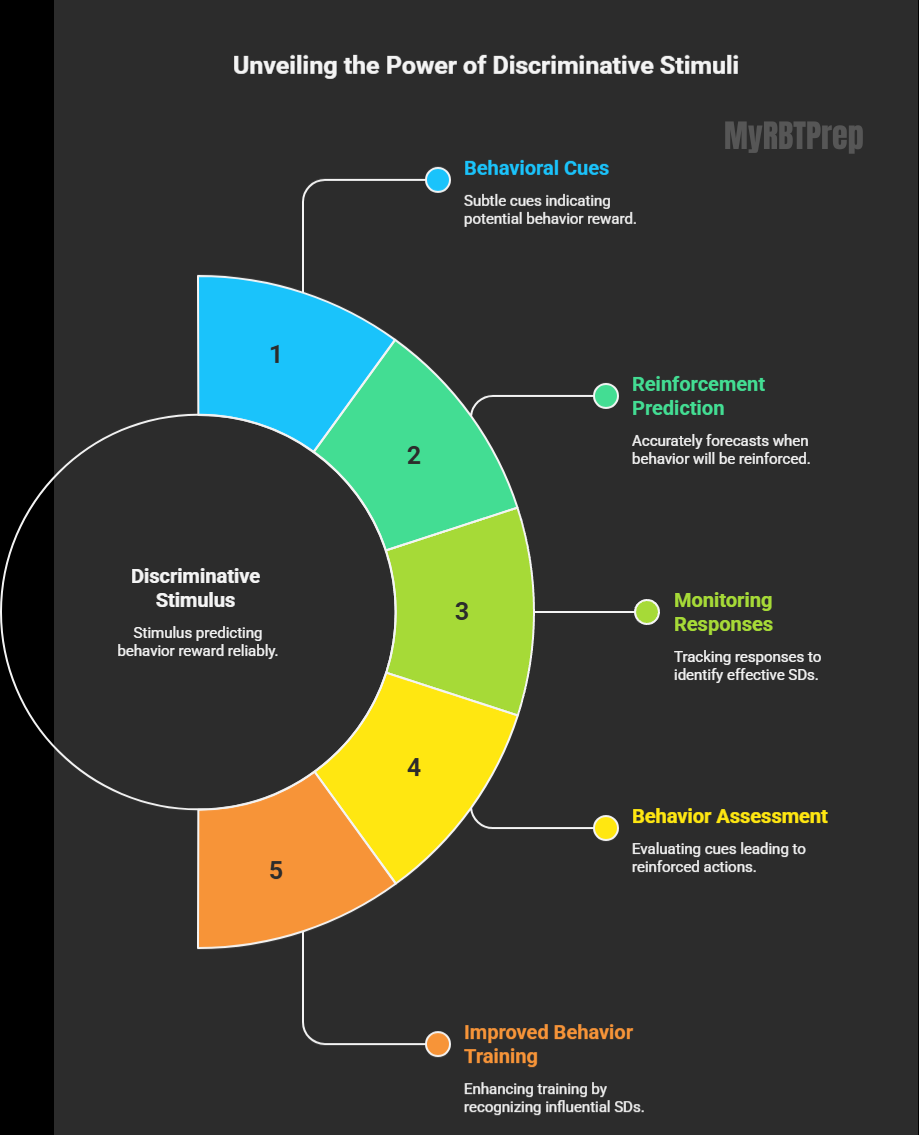
Identifying an SD requires observing behavioral cues carefully. A stimulus becomes discriminative when it reliably predicts when behavior will be rewarded. For instance, a child asking for attention only when a teacher is watching shows an SD is in place.
These signals that predict reinforcement are often subtle but highly influential.Therapists and teachers can track SDs by monitoring responses and outcomes.
Behavior assessment helps pinpoint which cues lead to action likely to be reinforced. Recognizing these SDs allows for better behavior training, following instructions, and encouraging positive behavior in structured environments.
Discriminative Stimulus vs. Other Behavioral Concepts
SDs are often confused with conditioned stimuli or general cues. While a conditioned stimulus might trigger a response due to past associations, an SD specifically signals that a behavior will receive reinforcement.
This difference is important in contingency-based learning and operant conditioning. For example, a bell signaling lunch in school is a conditioned stimulus, but a teacher’s presence signaling participation will be rewarded is an SD.
Understanding the distinction improves behavior modification, stimulus control, and teaching strategies in both classrooms and therapy settings.
Using Discriminative Stimuli in Applied Behavior Analysis (ABA)
In Applied Behavior Analysis (ABA), SDs are essential for skill acquisition and behavior shaping. Therapists use SDs to teach communication skills, daily living skills, and social behaviors.
A visual cue can act as an SD that signals when a task will be reinforced, promoting positive reinforcement. SDs also help in reducing problem behaviors. By providing clear environmental triggers for behavior, therapists can guide a child toward desired actions.
Behavioral intervention becomes more predictable, efficient, and effective when SDs are implemented correctly.
Challenges and Common Misconceptions
One common misconception is that SDs automatically guarantee reinforcement. If past reinforcement patterns are inconsistent, the SD may lose its power.
Misidentifying SDs can lead to problem behavior reduction failures and confusion in learning.Another challenge is differentiating SDs from general cues.
For example, a child may assume any parent presence is an SD, while only specific situations actually predict reward. Accurate identifying discriminative stimuli and using behavior assessment are critical to avoid these errors.
Practical Tips for Parents, Teachers, and Therapists
To use SDs effectively, ensure consistency and clarity. Visual cues, verbal prompts, and consistent positive reinforcement help establish strong stimulus control.
Parents and teachers should monitor outcomes and adjust cues as needed for skill acquisition.
Creating predictable learning opportunities enhances behavior shaping. Using SDs strategically in classrooms, therapy, or home routines improves communication skills, following instructions, and overall behavior modification.
Motivation triggers should be tailored to individual needs for maximum impact.
How Discriminative Stimuli Shape Behavior in Everyday Life
Discriminative stimuli are signals that guide behavior by indicating when a specific action will lead to reinforcement. From traffic lights to classroom cues, these environmental cues help individuals understand the consequences of their actions.
In Applied Behavior Analysis (ABA), discriminative stimuli, or SDs, are used to improve skill acquisition, enhance communication skills, and promote positive behavior. Understanding SDs allows teachers, therapists, and parents to create structured learning opportunities, reduce problem behaviors, and implement effective behavioral interventions.
For example, a child may ask for a snack only when a parent is present, demonstrating how SDs act as a signal that predicts reinforcement. In therapy settings, visual prompts and token boards serve as SDs that guide the learner toward the correct response.
By recognizing and using discriminative stimuli, caregivers and educators can shape behaviors more efficiently, improve behavior modification, and enhance the learner’s confidence. Everyday life is full of these signals, and learning to identify them improves both teaching strategies and real-world problem-solving. Integrating SDs into learning routines ensures contingency-based learning and predictable outcomes for desired behaviors.
Mastering SD in ABA: Practical Strategies for Parents and Educators
Discriminative stimuli (SDs) are a key tool in Applied Behavior Analysis (ABA) for guiding behavior and teaching new skills. They act as behavioral cues that tell the learner when behavior will be rewarded, making reinforcement predictable.
Parents and teachers can use SDs to improve task analysis, strengthen communication skills, and encourage positive behavior. For instance, a visual card can signal to a child that completing a specific task will earn a reward. Using SDs consistently promotes stimulus control and reduces confusion in learning environments.
Effective SD strategies include pairing verbal instructions with visual cues, reinforcing correct responses, and gradually fading prompts to increase independence. In classrooms, SDs help with classroom management by signaling expected behavior during transitions or activities.
Therapists also use SDs during skill acquisition programs, helping children learn new social, communication, and daily living skills. By understanding environmental triggers for behavior, educators and caregivers can implement practical strategies that make learning more efficient and enjoyable.
SDs ensure behaviors are predictable, measurable, and positively reinforced, which strengthens overall behavior modification efforts.
Discriminative Stimulus in ABA: Types, Examples, and Behavior Control
Discriminative Stimulus (SD) is much more than a cue; they are a valuable, valuable element of the process in ABA that indicates to the learner a behavior that will be or has been reinforced.
There are two types of SDs to consider: those that signal reinforcement or nonreinforcement, the latter of which is referred to as SΔ (while there may not be much a difference, it is still helpful to differentiate between the two.).
In any case, knowing about these is important because they form the basis necessary for therapist and educator to develop behavior change programs. Here is an example of an SD. Traffic signals, the presence of a parent, or a visual prompt to completing a task.
SDs are also an important component of stimulus control, skill acquisition, and behavior shaping; they allow learners to forecast an outcome or to modify a behavior, as an example. A child may wait until their parent is in the room and only remembers to ask to borrow a toy using “Please”.
Again, SDs are indication a learner to show certain behavior; it is to assist the educator or therapist to considered a way to reduce problem behavior, increase communication skills, and provide an successive, organized and preplanned learning opportunity.
When behavior changes are made to accompany a program that are again SD’s followed by constant or repeated form of reinforcement the behaviors can learn appropriate levels and efficiency can improve while promoting more complex meaningful behavior all while using the SD’s as a consistent control to the environment as a certain value or property attached to the S.
In this way we make sure the learner is responding appropriately to the environmental factors and illustrates so even in their multiple environments.
Conclusion
Understanding Discriminative Stimuli (SDs) is essential for anyone involved in Applied Behavior Analysis (ABA), teaching, or parenting. These behavioral cues act as a signal that predicts reinforcement, guiding learners toward desired behaviors while reducing confusion and problem behaviors.
By recognizing and using SDs effectively, you can improve skill acquisition, strengthen communication skills, and enhance overall behavior modification.
Everyday environmental cues like traffic lights, classroom signals, or parental presence demonstrate how SDs operate in real life, making learning predictable and consistent.
Integrating SDs into task analysis, behavioral intervention, and contingency-based learning ensures behaviors are appropriately reinforced. Whether in therapy, home, or school settings, understanding and applying Discriminative Stimuli creates better learning opportunities, supports positive behavior, and strengthens the effectiveness of teaching strategies.
Faqs
- What is a discriminative stimulus example?
A child asking for a cookie only when their parent is in the room is an example of a discriminative stimulus (SD). - What is an example of stimulus discrimination?
A student raising their hand only when the teacher is paying attention shows stimulus discrimination. - Which of the following is an example of a discriminative stimulus?
Any signal or cue that indicates a behavior will be reinforced, like a green traffic light for driving. - What is discriminative stimulus SD in ABA?
In ABA, an SD is a cue that signals a behavior will be followed by reinforcement. - What is an example of DRC in ABA?
A child receives a token for completing homework instead of engaging in problem behavior, illustrating Differential Reinforcement of Compatible behavior (DRC).

Everything You Need to Pass Your RBT® Exam
Study with our complete, all-in-one preparation package covering every task on the BACB Task List 3.0:
- 1,000+ Practice Questions & Timed Simulator
- 3rd Edition Task List Study Guide & Workbook
- Active Recall Flashcards System + Mobile App
- 20-Task Competency Assessment Mastery Guide