Preparing for the RBT Competency Assessment can feel challenging, but the right resources make it manageable. Using a practice test and a structured RBT study guide is essential to understand the RBT Task List and master applied behavior analysis principles. Many candidates wonder how to pass the RBT exam on the first try and which strategies improve the first-time RBT exam success rate.
Practicing real-world scenarios, reviewing key tasks, and following step-by-step guidance can reduce exam anxiety for RBT test takers and strengthen confidence. With a clear study plan, consistent practice, and layered learning, passing the competency assessment becomes achievable and prepares you for a successful career in ABA.
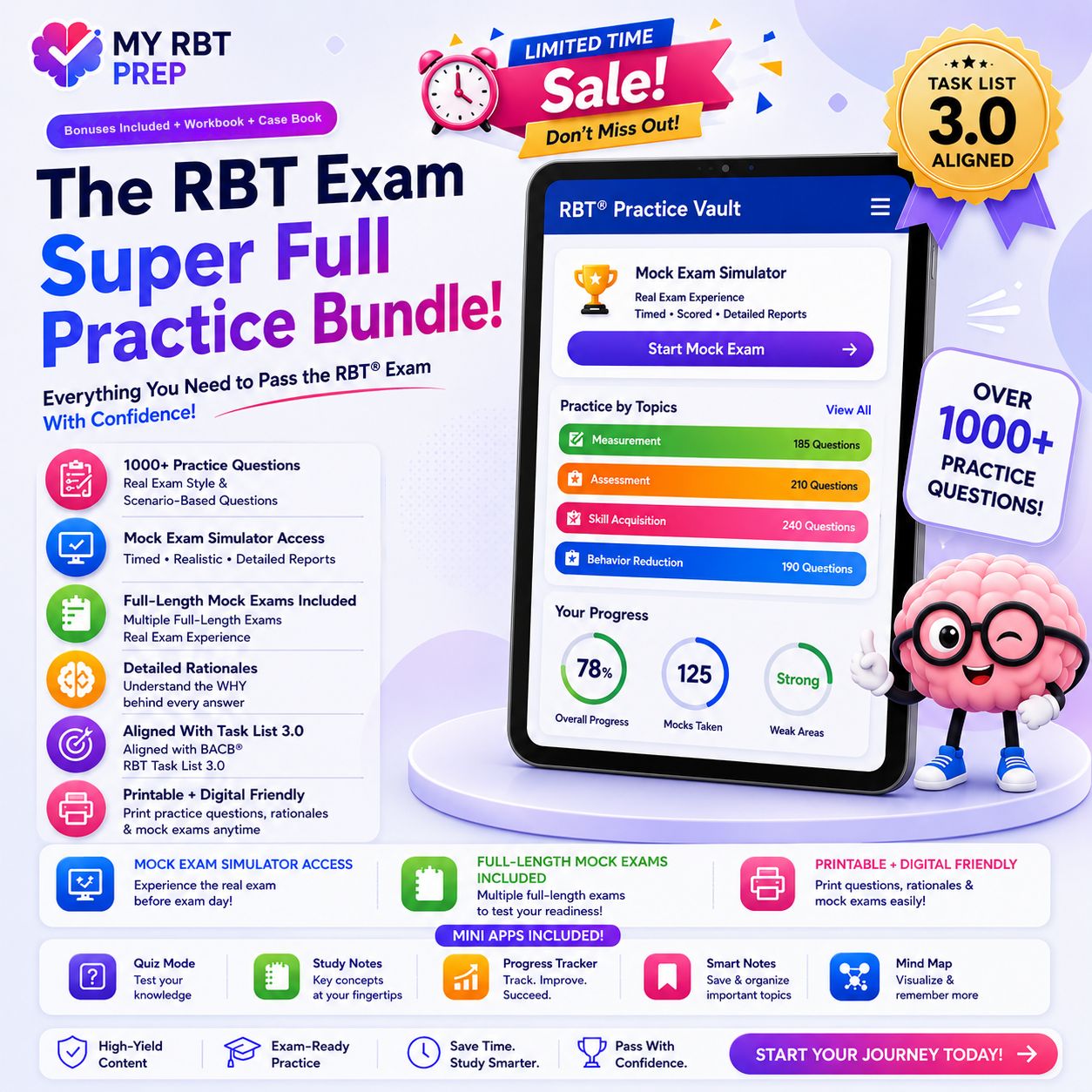
Pass Your RBT® Exam on the First Attempt
Practice with 1,000+ realistic scenario questions, multiple full-length timed mock exams, and detailed rationales formatted exactly like the real Pearson VUE test.
Click Here To Prepare & Get Yours Now!
What Is the RBT Competency Assessment?
The RBT Competency Assessment measures your ability to apply applied behavior analysis principles in real situations. Unlike the written exam, this assessment evaluates hands-on skills, including data collection, skill acquisition, and behavior reduction techniques. Meeting RBT certification requirements means demonstrating competence under supervision from a BCBA.
Passing the assessment ensures you are ready to perform ABA therapy certification tasks effectively. Using a practice test or study guide allows students to familiarize themselves with procedures, spot weak areas, and build confidence before the actual evaluation.
| Aspect | Details |
| Purpose of RBT Competency Assessment | Measures ability to apply applied behavior analysis principles in real situations, not just recall facts. |
| Skills Evaluated | Hands-on skills including data collection, skill acquisition, and behavior reduction techniques. |
| Certification Requirement | Must demonstrate competence under supervision from a BCBA to meet RBT certification requirements. |
| Importance of Passing | Ensures readiness to perform tasks effectively as part of ABA therapy certification. |
| Role of Practice Tests & Study Guides | Familiarizes students with procedures, highlights weak areas, and builds confidence before the actual assessment. |
Why Practice Tests and Study Guides Matter

Practice tests simulate the real RBT assessment environment. They help you understand the RBT exam format and identify which concepts you need to review. A good RBT study guide explains not only what to do but why each technique matters. Students who rely on memorization alone often fail to pass.

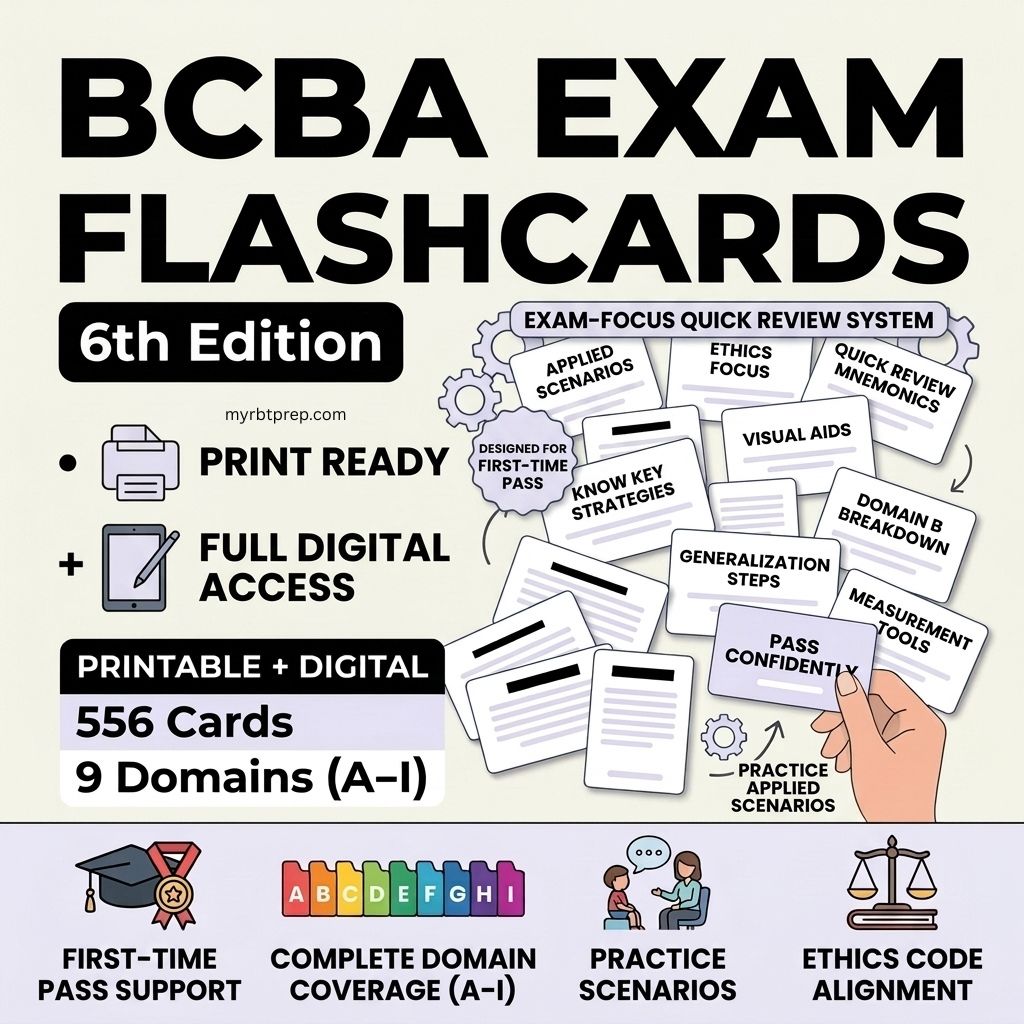
RBT® Exam Flashcards & Study App (3rd Edition)
Master essential ABA terminology and clinical discrimination across all 6 BACB task list areas with 500+ printable and digital flashcards, real exam cues, and full mobile app access.
Using structured resources improves comprehension and application, which is crucial for chances of passing the RBT exam. Consistent practice helps reduce test-day anxiety and ensures you are fully prepared for practical, scenario-based questions.
How to Use an RBT Competency Practice Test
Start by attempting a full practice test under realistic conditions. Time yourself and follow the instructions as if it’s the actual assessment. Afterward, review your results carefully. Focus on areas where you made mistakes, and revisit those sections in your RBT study guide.
Repeat this cycle until you can consistently demonstrate the correct procedures. Many students find tracking progress on repeated practice tests significantly improves their success rate for first-time RBT test takers.
| Step / Strategy | Explanation / Details |
| Attempt Full Practice Test | Simulate the actual assessment by timing yourself and following instructions exactly. This builds familiarity with the RBT Competency Assessment environment. |
| Review Results Carefully | After completing the test, analyze mistakes to identify weak areas and knowledge gaps. |
| Revisit Study Guide Sections | Focus on the topics where errors occurred, using your RBT study guide to deepen understanding and correct misconceptions. |
| Repeat the Cycle | Consistently practice, review, and revise until you can demonstrate correct procedures reliably. |
| Track Progress | Monitoring repeated practice test results helps improve confidence and increases success rate for first-time RBT test takers. |
Components of an Effective RBT Study Guide
A high-quality RBT study guide includes the following:
| Component | Purpose / Details |
| RBT Task List Review | Covers all essential tasks such as measurement, skill acquisition, behavior reduction, and documentation. |
| Step-by-Step Instructions | Provides detailed procedures for hands-on skills required in the competency assessment. |
| Applied Examples | Demonstrates how to handle real ABA therapy situations effectively. |
| Practice Scenarios | Offers sample situations to apply principles and decision-making. |
| Assessment Tips | Guidance on avoiding common mistakes and managing time and stress during the evaluation. |
Best Strategies for Using the Study Guide
Getting the most out of your RBT study guide requires more than just reading through it. One of the most effective approaches is to study consistently in small daily sessions rather than trying to cram all at once. Short, focused study periods help your brain retain information better and prevent burnout. Even just 30–45 minutes a day can make a huge difference over time.
Another key strategy is to focus on understanding tasks instead of memorizing words. The RBT Competency Assessment tests your ability to apply principles, not just recall definitions. For example, it is more important to know how to implement a behavior reduction plan correctly than to memorize the steps without comprehension.
You should also apply each concept to real or simulated client scenarios. Practicing skills in a practical context, like role-playing or using case examples, bridges the gap between theory and real-world application. This method helps reduce exam anxiety for RBT test takers and builds confidence in performing tasks during the assessment.
Using practice questions to identify weak areas is another essential step. After attempting a question or scenario, review your mistakes carefully and revisit the corresponding section of the study guide. This ensures that you don’t repeat errors and gradually strengthens your competency across all tasks.
Finally, the most effective approach combines the study guide with practice tests for layered learning. While the study guide helps you understand principles, the practice test simulates the assessment environment and evaluates how well you can perform under pressure. Layering these tools increases your chances of passing the RBT exam on the first try and ensures you are prepared for both knowledge-based and applied components of the assessment.
| Strategy | Explanation / Details |
| Study consistently in small daily sessions | Short, focused study periods of 30–45 minutes help your brain retain information better and prevent burnout. Avoid cramming all at once. |
| Focus on understanding tasks, not memorizing words | Comprehension is key. Know how to implement a behavior reduction plan correctly rather than just memorizing steps. |
| Apply concepts to real or simulated client scenarios | Role-playing or case examples bridge theory and real-world application, reducing exam anxiety for RBT test takers and building confidence. |
| Use practice questions to identify weak areas | Review mistakes carefully and revisit the relevant study guide sections. This strengthens understanding and prevents repeated errors. |
| Combine study guide with practice tests for layered learning | Study guides teach principles, while practice tests simulate the assessment. Layering improves both knowledge and applied skills, increasing chances of passing the RBT exam on the first try. |
Common Mistakes Students Make
Even with a study guide, errors happen:
| Mistake | Impact / Explanation | How to Avoid |
| Relying only on memorization | May help recall facts but leaves you unprepared for applied scenarios. | Focus on practicing procedures and applied examples. |
| Skipping practice tests | Reduces familiarity with assessment format and timing. | Take multiple timed practice tests. |
| Ignoring weak areas | Can result in failing the competency assessment despite studying. | Review mistakes carefully and repeat difficult tasks until mastered. |
| Overstudying without breaks | Causes fatigue and lowers retention. | Take regular breaks and maintain a balanced study schedule. |
How to Combine Study Guide and Practice Test

Many students succeed by layering resources. Begin with the study guide to learn procedures, review the RBT Task List, and understand each task’s purpose. Next, use the practice test to apply your knowledge under realistic conditions. This combination improves both memory and applied skills, reduces exam anxiety for RBT test takers, and boosts first-time RBT exam success rates.
Test-Day Tips
On assessment day, arrive early and calm. Review key steps mentally, but avoid last-minute cramming. Take deep breaths to manage stress and focus on demonstrating procedures correctly. Remember, the competency assessment evaluates both knowledge and real-world application, so confidence and preparation are more important than speed.
| Tip / Strategy | Explanation / Details |
| Arrive Early and Calm | Being on time reduces stress and allows you to settle mentally before the assessment begins. |
| Review Key Steps Mentally | Go over procedures in your mind to reinforce memory, but avoid last-minute cramming which can increase anxiety. |
| Take Deep Breaths to Manage Stress | Simple breathing techniques help reduce nervousness and improve focus during tasks. |
| Focus on Correct Procedures, Not Speed | The assessment evaluates knowledge and real-world application, so performing tasks correctly is more important than finishing quickly. |
| Confidence and Preparation Matter Most | Being well-prepared boosts confidence and ensures that you can demonstrate practical skills effectively during the RBT Competency Assessment. |
How to Track Your Progress Effectively

Tracking progress is essential when preparing for the RBT Competency Assessment. Use checklists from the RBT Task List to mark which skills you’ve mastered and which need improvement. Record scores from practice tests and note time taken for each task.
Reviewing progress regularly allows you to identify patterns, focus on weak areas, and adjust your study plan. Keeping a visual record of your improvement increases motivation and confidence. Many students find that tracking progress not only shows how far they’ve come but also highlights areas that require repeated practice, improving the success rate for first-time RBT test takers.
Incorporating Real-World Scenarios
The RBT exam emphasizes applied skills, so practicing in real or simulated environments is critical. Role-play sessions with a mentor, peer, or supervisor allow you to implement behavior plans, collect data, and handle problem behaviors safely.
Using applied examples from your study guide in these scenarios reinforces understanding and prepares you for test-day challenges. Practicing real-world scenarios helps reduce exam anxiety for RBT test takers, strengthens decision-making skills, and ensures you can apply principles rather than just recall definitions. Students who simulate client sessions often feel more confident and perform better under assessment conditions.
| Strategy / Tip | Explanation / Details |
| Practice in Real or Simulated Environments | Role-play with a mentor, peer, or supervisor to implement behavior plans, collect data, and handle problem behaviors safely. |
| Use Applied Examples from Study Guide | Applying examples reinforces understanding and prepares you for real assessment challenges. |
| Reduce Exam Anxiety for RBT Test Takers | Hands-on practice builds familiarity with scenarios, lowering stress and increasing confidence during the assessment. |
| Strengthen Decision-Making Skills | Simulated sessions help you make quick, correct choices in applied settings rather than just recalling definitions. |
| Increase Confidence and Performance | Students who practice real-world scenarios perform better on the RBT Competency Assessment and feel more prepared on test day. |
Balancing Study and Self-Care

Intensively preparing for the Competency Assessment can cause a person burnout if they do not practice self-care. Good sleep, nutrition, and breaks while preparing enhance memory and attention retention. In addition to regular workouts or relaxation activities, managing stress enhances clarity of thought.
Balance in studying will provide you with maximum energy and confidence prior to taking your practice tests and the actual assessment. Most candidates who successfully passed the RBT exam the first time stated that their combination of self-care and productive study habits helped them pass on their first attempt. Self-care is as important as mastery of the RBT Task List for the mental and physical well-being of the future professional.
| Strategy / Tip | Explanation / Details |
| Prioritize Sleep and Nutrition | Adequate sleep and proper nutrition enhance memory retention, attention, and overall cognitive function during study and practice sessions. |
| Take Regular Breaks | Short breaks prevent burnout and allow your brain to consolidate learning, improving focus and performance. |
| Include Workouts or Relaxation Activities | Physical exercise or relaxation techniques reduce stress, increase mental clarity, and enhance study efficiency. |
| Maintain Balance Between Study and Self-Care | Combining productive study habits with self-care provides maximum energy and confidence for both practice tests and the actual assessment. |
| Self-Care Improves Exam Success | Many candidates who passed the RBT exam the first time attribute their success to balancing self-care with mastery of the RBT Task List. |
Conclusion
The RBT Competency Assessment can be mastered with the right tools. Using a structured RBT study guide alongside practice tests ensures strong understanding of the RBT Task List, prepares you for applied scenarios, and increases your chances of passing the RBT exam on the first try.
Consistent practice, applied learning, and careful review of weak areas are the keys to success. Layering these resources builds confidence, reduces anxiety, and sets you up for a thriving career as a Registered Behavior Technician.
FAQ’s
What is the best study guide for the RBT exam?
The best study guide covers the RBT Task List in detail, includes applied examples, and provides practice scenarios. Combining it with a practice test is recommended for optimal preparation.
What is the hardest part of the RBT exam?
The hardest part is applying principles to real-world scenarios rather than memorizing definitions. Practice with realistic examples improves success.
How many questions are on the Pearson RBT exam?
The Pearson RBT exam has 85 multiple-choice questions, with 75 scored and 10 pilot questions, completed in 90 minutes.
How to pass the RBT exam on the first try?
Study consistently, use a mix of study guides and practice tests, focus on applied learning, and manage stress effectively to boost your first-time RBT exam success rate.
How many questions can I miss on the RBT exam and still pass?
You must score at least 200 points out of 250. Typically, you can miss around 10–12 scored questions and still pass, depending on scoring distribution.

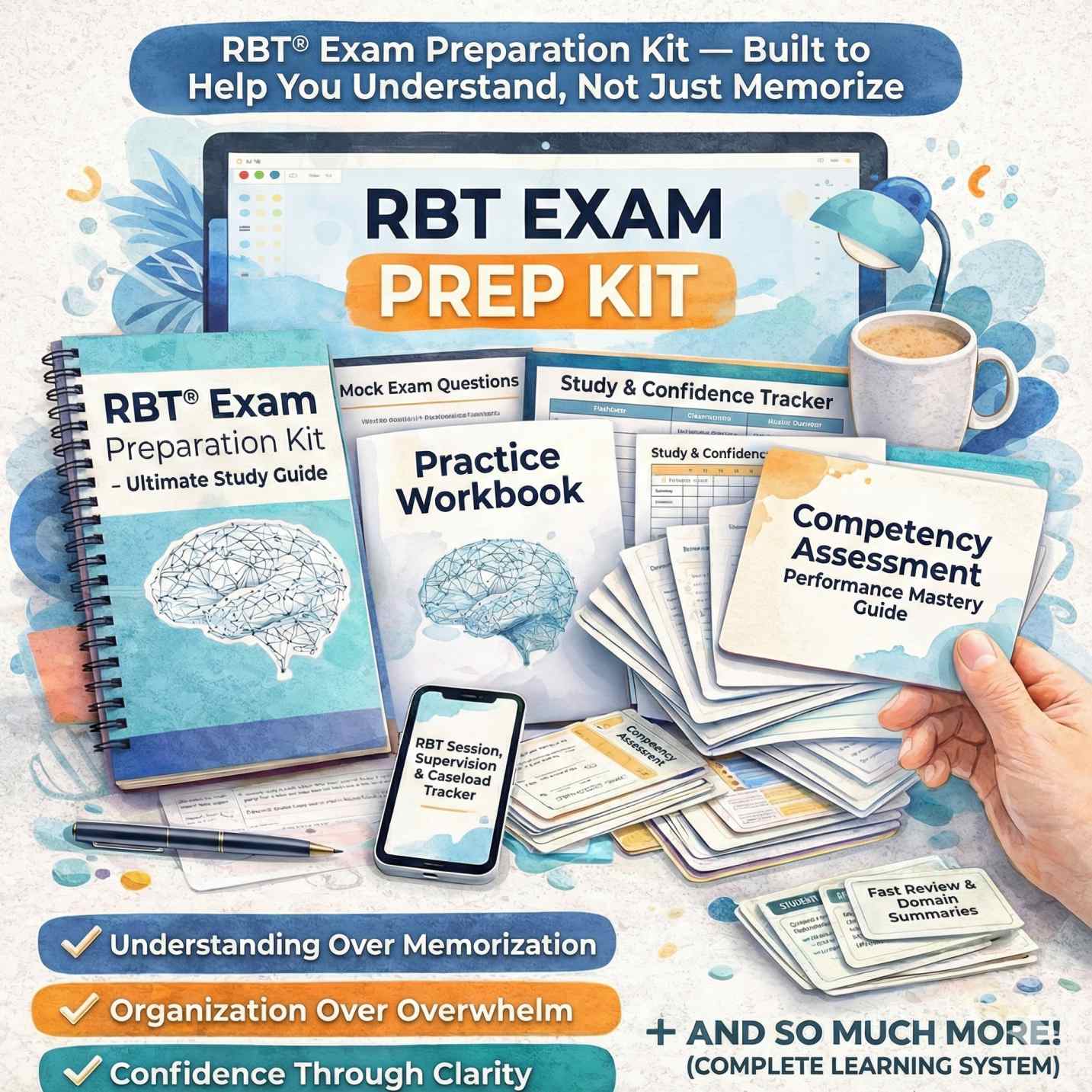
Everything You Need to Pass Your RBT® Exam
Study with our complete, all-in-one preparation package covering every task on the BACB Task List 3.0:
- 1,000+ Practice Questions & Timed Simulator
- 3rd Edition Task List Study Guide & Workbook
- Active Recall Flashcards System + Mobile App
- 20-Task Competency Assessment Mastery Guide