The RBT Competency Assessment is a vital step toward becoming a Registered Behavior Technician (RBT®) under the Behavior Analyst Certification Board (BACB®) guidelines. This practical evaluation ensures that future technicians can confidently apply Applied Behavior Analysis (ABA) principles in real-life settings.
During the RBT Initial Competency Assessment, you’ll demonstrate skills like behavior measurement, data recording, and implementing effective teaching strategies. Whether you’re working under a Board Certified Behavior Analyst (BCBA) or a BCaBA, mastering these core areas proves your readiness for professional certification.
Understanding this process deeply can help you pass smoothly and begin your rewarding journey as a qualified RBT professional.
What Is the RBT Initial Competency Assessment?
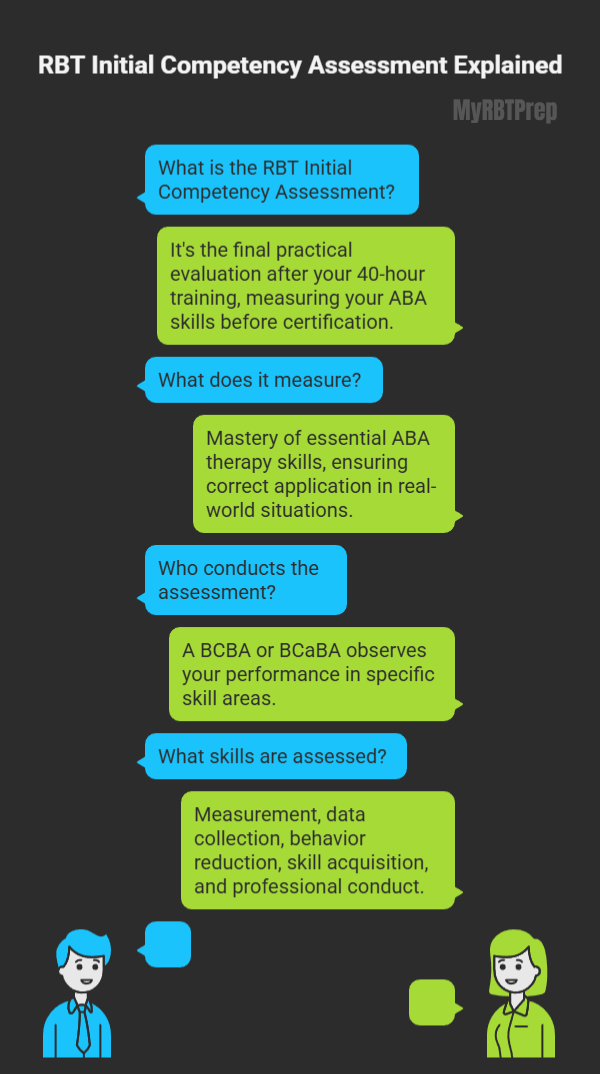
The RBT Initial Competency Assessment is the final practical evaluation you complete after your 40-hour training course and before you apply for certification through the Behavior Analyst Certification Board (BACB®).
It measures your mastery of essential ABA therapy skills, ensuring that you can apply applied behavior analysis techniques correctly in real-world situations. During this process, a Board Certified Behavior Analyst (BCBA) or a Board Certified Assistant Behavior Analyst (BCaBA) observes your performance in specific skill areas listed on the RBT task list 2.0 and RBT task list 3.0.
The assessment verifies your competence in measurement and data collection, behavior reduction, skill acquisition, and professional conduct in ABA. You’ll also demonstrate abilities like frequency recording, duration recording, and using applied behavior data graphs accurately.
What to Expect During the RBT Competency Assessment
The assessment is usually conducted by your BCBA supervisor in a clinic, home, or naturalistic teaching environment. Sometimes, it’s completed through secure video conferencing. It typically lasts between one and three hours, depending on how quickly you demonstrate each skill.
Expect to perform both role-play and real-life demonstrations. You may show how you conduct ABC data recording, identify antecedent interventions in ABA, or implement token economy system methods.
The BCBA observation process involves watching how you communicate, follow client dignity and ethics, and apply clinical direction in behavior analysis. You might also be asked to explain what you’re doing aloud—so study the definitions and steps carefully before your RBT initial competency test.
Key Skill Areas Tested in the Assessment
Every RBT Competency Assessment Study Guide covers seven major areas defined by the BACB®. These include measurement, assessment, skill acquisition, behavior reduction, documentation, and professional conduct. Let’s explore what you’ll need to demonstrate.
You’ll show continuous measurement examples such as counting the number of times a learner claps or speaks. You’ll also practice discontinuous measurement methods like partial interval recording, whole interval recording, and momentary time sampling.
The assessor checks if you can graph data clearly and interpret applied behavior data graphs accurately. In preference assessment procedures, you determine what motivates the learner most—perhaps a toy, a snack, or social praise. The goal is to prove you understand both data-driven decision-making and behavior measurement fundamentals.
Behavior Reduction and Teaching Strategies
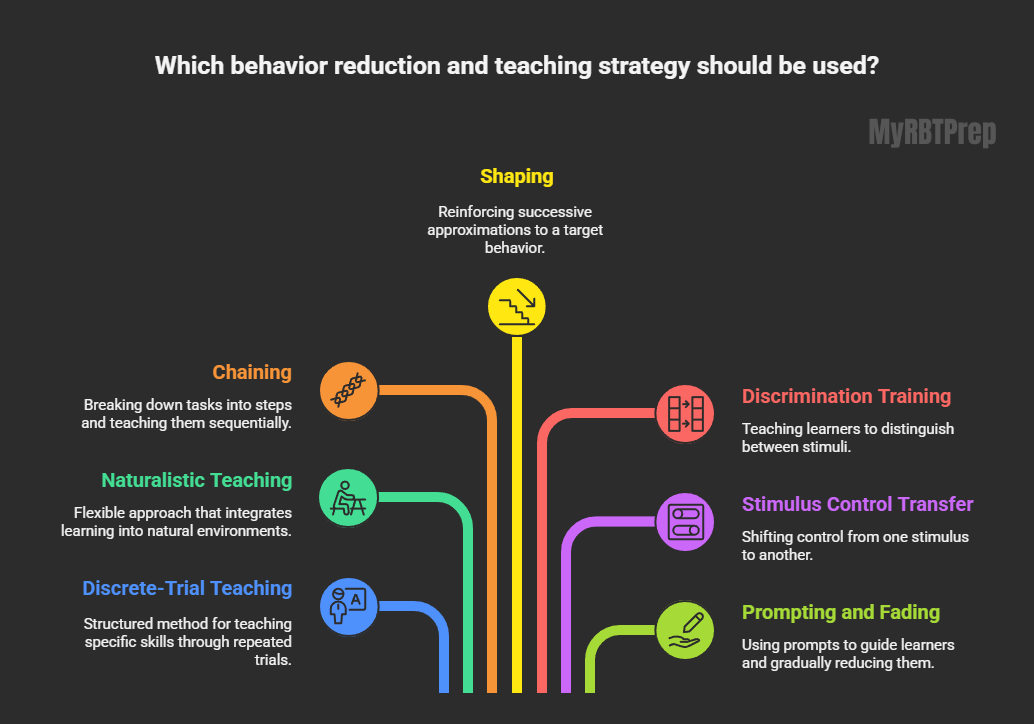
Effective behavior technicians know how to reduce problem behaviors while teaching new, positive ones. This section evaluates your ability to use different applied behavior analysis techniques that encourage learning and independence.
You’ll practice structured methods like Discrete-Trial Teaching (DTT) and flexible naturalistic teaching strategies. You may also demonstrate chaining and shaping techniques, including forward chaining, backward chaining, and total task chaining.
In shaping behavior, you reinforce each small step toward the target action—like encouraging clearer speech or independent dressing. You’ll also need to know discrimination training, stimulus control transfer, and prompting and fading to guide learners effectively while reducing prompts over time.
Reinforcement and Behavior Management Techniques

In this area, you’ll show your understanding of reinforcement and proactive behavior management. Reinforcement keeps motivation alive and strengthens desired behaviors.
You’ll demonstrate knowledge of the token reinforcement system, differential reinforcement (DRA, DRO, DRI, DRL), and extinction in ABA. Each system has unique benefits. For instance, in differential reinforcement examples, you might reward quiet sitting instead of shouting. Extinction burst describes the short-term increase in unwanted behavior after you stop reinforcing it. You’ll also apply antecedent interventions in ABA to prevent problems before they start. A simple example might be giving choices to reduce defiance or using visual cues to help transitions run smoothly.
Ethical and Professional Responsibilities
Working as an RBT means upholding strong ethical values and maintaining professional boundaries. You must respect client confidentiality, protect privacy, and maintain client dignity and ethics at all times.
The BACB Ethics Code (2025) expects RBTs to demonstrate honesty, reliability, and professional conduct in ABA sessions. You’ll learn to handle ethical dilemmas—such as when to report safety concerns or how to respond if a parent asks for advice beyond your training.
Understanding supervision hours for RBT and how to receive supervision feedback from your BCBA ensures your professional growth continues. Each RBT must work under proper BCBA supervision requirements and never practice independently.
Documentation and Reporting
Accurate reporting is vital in applied behavior analysis (ABA). You’ll practice writing RBT documentation and session notes that describe what occurred during sessions. The assessor checks if your session documentation is clear, factual, and objective.
Good documentation includes date, time, behavior measurement, interventions used, progress made, and notes for your BCBA. Here’s a simple example of a clear data table you might use:
|
This shows how frequency recording, duration recording, and latency recording combine to track progress precisely.
Emergency and Safety Procedures
During your RBT initial competency test, you must also show readiness to manage emergencies. The emergency behavior procedures section ensures that every RBT can keep clients safe during unexpected events.
You’ll demonstrate calm and appropriate reactions during aggression, elopement, or self-injurious behavior. You’ll also discuss how to follow the agency’s crisis plan and document incidents accurately.
Understanding clinical ethics and behavior reduction plan guidelines prevents harm and ensures you act according to your supervisor’s instructions. Always prioritize safety first—both yours and your client’s.
Preparing for Success
Preparing well is the difference between stress and confidence. Review the RBT task list 3.0, learn measurement and data collection thoroughly, and practice each skill until it feels natural.
Use RBT study tips like watching training videos, joining study groups, and completing a RBT practical exam guide or mock tests. For U.S. learners, review materials from trusted sources like the Behavior Analyst Certification Board.
Understand every section of your RBT Competency Assessment Study Guide, and remember—practice in real settings builds confidence faster than memorizing notes.
What Is the RBT Initial Competency Assessment?
The RBT Initial Competency Assessment is the first major evaluation that ensures you have mastered the practical skills required to become a Registered Behavior Technician (RBT®). It’s not just a written test—it’s a hands-on performance assessment designed to show your ability to use Applied Behavior Analysis (ABA) techniques in real settings.
The Behavior Analyst Certification Board (BACB®) requires that this evaluation be conducted by a qualified Board Certified Behavior Analyst (BCBA) or Board Certified Assistant Behavior Analyst (BCaBA) who has completed supervision training.
During this process, your supervisor will observe how you apply fundamental ABA therapy skills, including behavior measurement, reinforcement, prompting, and data collection.
You’ll be asked to demonstrate both continuous measurement examples like frequency recording and duration recording, as well as discontinuous measurement methods such as partial interval recording or momentary time sampling.
This assessment ensures that every future RBT can handle real-life client situations while maintaining client dignity and ethics. It covers everything from setting up sessions to using Applied Behavior Analysis techniques for skill development and behavior reduction.
Successfully completing this evaluation is a sign that you’re ready for the next step—taking the official RBT initial competency test and earning your registered behavior technician certification. Understanding the expectations beforehand helps reduce anxiety and boosts your confidence going into the assessment.
What to Expect During the RBT Competency Assessment
When you arrive for your RBT Competency Assessment, expect a structured but supportive environment. The evaluation typically takes between one to three hours, depending on how quickly you can demonstrate each required task. A BCBA or BCaBA will observe you perform essential ABA therapy skills such as discrete trial training (DTT), naturalistic teaching strategies, and behavior measurement.
You’ll complete activities that simulate real therapy sessions. For instance, your supervisor may ask you to conduct a preference assessment, use prompting and fading, or record Antecedent-Behavior-Consequence (ABC) data during a mock scenario. You may also be interviewed about topics like differential reinforcement examples, extinction in ABA, or the token economy system. Each task is meant to test your ability to apply knowledge practically, not just memorize definitions.
The assessment is divided into multiple sections based on the RBT task list 3.0 and older RBT task list 2.0 guidelines. This includes measurement and data collection, behavior reduction, skill acquisition, documentation, and professional conduct. You might also face real-world questions about supervision hours for RBT, clinical direction in behavior analysis, and emergency behavior procedures.
Ultimately, the RBT Competency Assessment Study Guide helps you prepare for these steps. Knowing what to expect reduces stress, allowing you to focus on demonstrating your best work. Remember, it’s not about perfection—it’s about showing competence, professionalism, and a solid understanding of Applied Behavior Analysis (ABA) principles in practice.
Case Study Example: Sarah’s Journey to Becoming an RBT
Sarah recently graduated with a degree in psychology, finished her 40-hour ABA course, and then practiced under the BCBA supervision requirements for six weeks. When it was time for her RBT Initial Competency Assessment, she was a bit nervous, but she recalled all of her trainings which focused on chaining and shaping techniques and antecedent interventions in ABA.
Her assessor watched while Sarah conducted a preference assessment, implemented some examples of differential reinforcement, and used a token economy system for providing rewards for behavior. She was also able to maintain professional boundaries and kept professionally documented sessions. After her completed assessment, she reported that “it felt like a real job simulation, not just a test.” Sarah was able to be successful due to consistent practice and feedback—all that preparation and reflecting led to her success in certification!
Final Thoughts
Passing the RBT Initial Competency Assessment is more than earning a certificate—it’s your entry into a field that changes lives. When you master applied behavior analysis (ABA), maintain client dignity, and follow clinical ethics, you become part of a respected community improving behavior and independence daily.
Keep revising your RBT Competency Assessment Study Guide, follow your BCBA’s supervision feedback, and focus on real understanding rather than memorization. Whether it’s learning Differential Reinforcement (DRA, DRO, DRI, DRL) or mastering discrete-trial teaching (DTT), every skill prepares you to make a lasting difference.
Frequently Asked Questions
How Long Is the RBT Competency Assessment?
Most assessments last between one and three hours, depending on your pace. You must demonstrate each task from the RBT task list 3.0, and your BCBA will decide if additional time is needed.
Where Can You Take the RBT Competency Assessment?
You can complete it in a clinic, home program, school, or through secure video observation. The key is that your BCBA or BCaBA can directly observe your performance.
Who Can Conduct the RBT Competency Assessment?
Only a qualified Board Certified Behavior Analyst (BCBA) or Board Certified Assistant Behavior Analyst (BCaBA) with proper BACB® supervision rights can evaluate you.
Is the RBT Competency Assessment Hard?
Many ask, “is the RBT assessment hard?” The truth: it’s manageable when you’ve practiced well. Focus on understanding applied behavior analysis techniques instead of memorizing terms.
Can You Fail the RBT Competency Assessment?
Yes, if you can’t demonstrate a required skill, you’ll retake it after more supervision. The BCBA observation process helps identify weak spots so you can improve before your next attempt.