The Behavior Analyst Certification Board (BACB) establishes three core professional credentials in Applied Behavior Analysis (ABA): RBT, BCaBA, and BCBA. These roles form a crucial, hierarchical system for delivering behavior-analytic services.
Each credential signifies a distinct level of education, responsibility, and scope of practice. Understanding these differences is essential for aspiring professionals and service consumers alike.
The RBT acts as the entry-level, direct service provider, implementing interventions strictly under close supervision. The BCaBA functions as an assistant analyst, capable of limited supervision over RBTs, but always under the ultimate clinical responsibility of a BCBA.
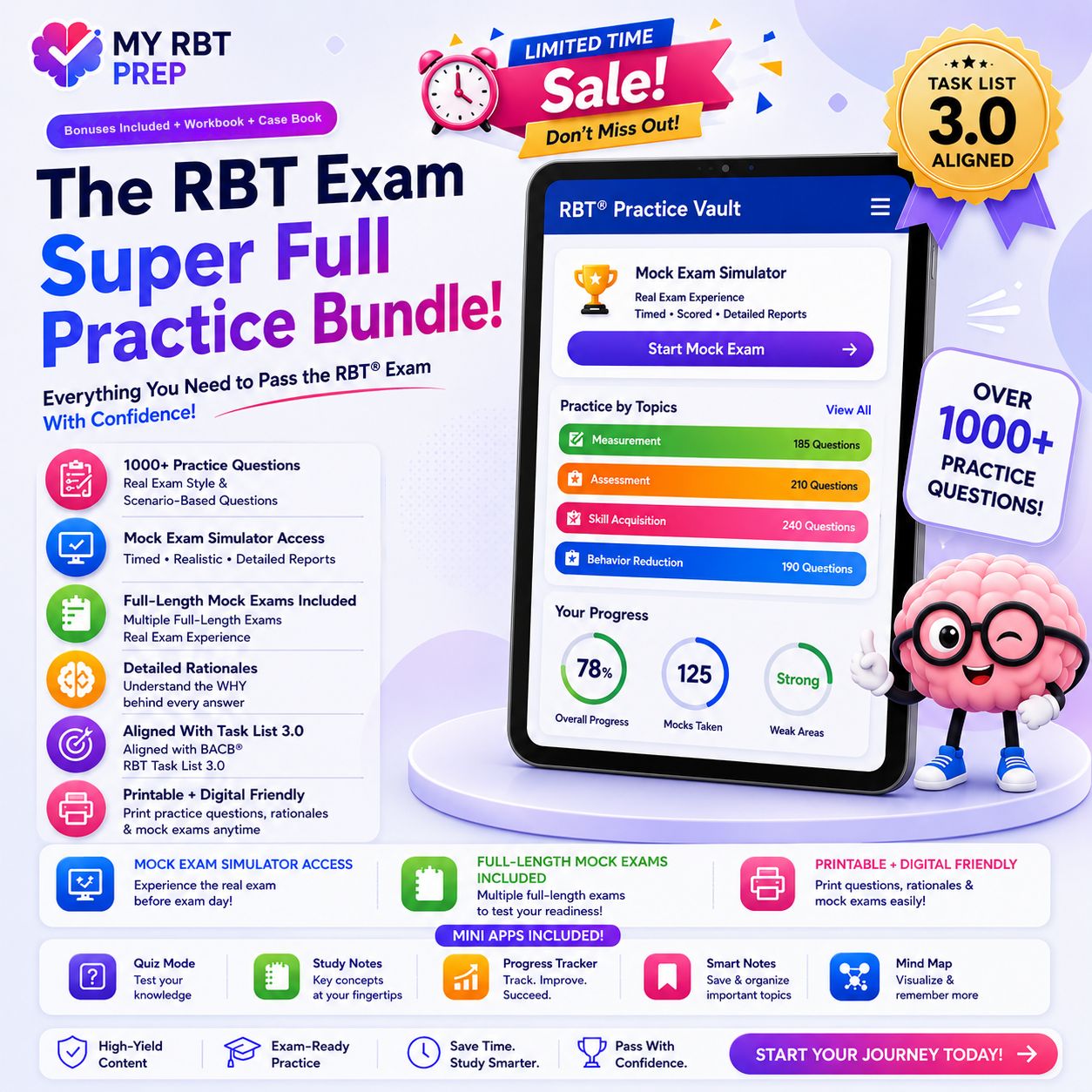
Pass Your RBT® Exam on the First Attempt
Practice with 1,000+ realistic scenario questions, multiple full-length timed mock exams, and detailed rationales formatted exactly like the real Pearson VUE test.
At the top of the structure, the BCBA is the independent practitioner. They are responsible for comprehensive behavioral assessment, program design, and advanced clinical oversight for the entire team.
Dissecting Educational and Certification Prerequisites
The requirements for certification involve increasingly stringent educational and experiential demands. These pathways are meticulously defined by the BACB to ensure professional competence.
BCBA Qualification Pathway
Achieving BCBA certification demands a significant commitment to graduate-level education. Candidates must typically hold a master’s or doctoral degree in behavior analysis, psychology, or a related field from an accredited institution.
This academic base must include specific graduate-level coursework, often part of a Verified Course Sequence (VCS). This ensures comprehensive knowledge across research methods and advanced ABA techniques.
Furthermore, substantial supervised fieldwork hours are required to gain practical experience applying ABA principles. The pathway culminates in passing a comprehensive BCBA examination, verifying readiness for independent clinical leadership.
BCaBA Qualification Pathway
The BCaBA certification is structured as an undergraduate-level credential. Aspiring BCaBAs generally require a bachelor’s degree from an accredited university.
They must also complete specific behavior-analytic coursework that adheres to BACB standards, establishing a strong foundational understanding of the science.

RBT® Exam Flashcards & Study App (3rd Edition)
Master essential ABA terminology and clinical discrimination across all 6 BACB task list areas with 500+ printable and digital flashcards, real exam cues, and full mobile app access.
Like the BCBA, candidates must accrue required supervised practice hours. Upon meeting these academic and experiential criteria, they must pass the BCaBA certification examination. This role is designed for professionals who can effectively implement and oversee programs under BCBA direction.
RBT Qualification Pathway
The Registered Behavior Technician (RBT) certification is the most accessible entry point into direct ABA service delivery. Candidates must be at least 18 years old and possess a high school diploma or equivalent.
Certification requires completing a structured 40-hour training program based on the RBT Task List. This training covers essential practical skills, documentation, and professional conduct.
Candidates must then pass a competency assessment performed by a qualified supervisor (BCBA or BCaBA). The final requirement is successfully passing the RBT examination, verifying core task understanding. RBTs focus on daily implementation and meticulous data collection.
Delineating Scope of Practice and Autonomy
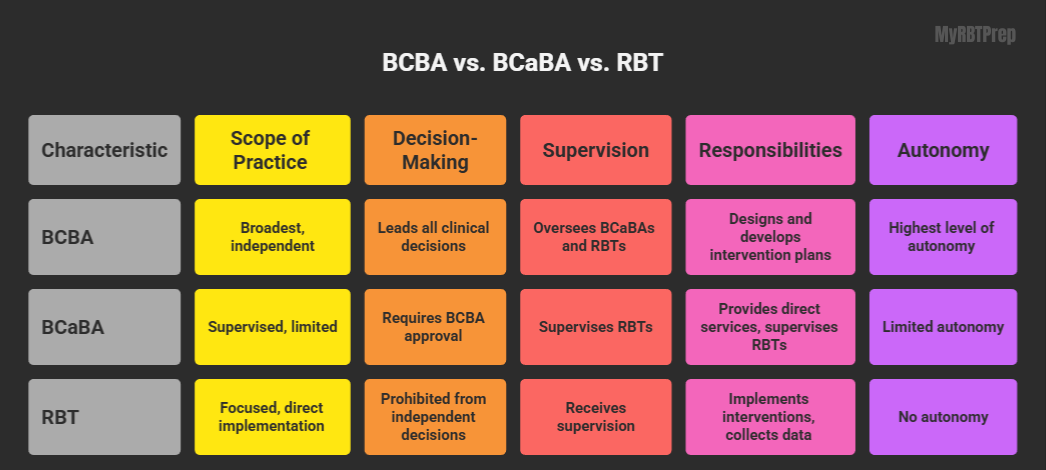
The educational differences directly translate into distinct scopes of practice, dictating decision-making authority and supervisory levels.
BCBA: Independent Practice and Comprehensive Clinical Leadership
Board Certified Behavior Analysts (BCBAs) operate with the broadest scope and highest level of autonomy in the field. They are independent practitioners authorized to lead all clinical decision-making.
BCBAs conduct comprehensive functional behavior assessments (FBAs) to determine the function of behaviors. Based on this analysis, they design, develop, and individualize data-driven behavior intervention plans (BIPs).
A core duty involves providing clinical leadership and supervision to BCaBAs and RBTs. BCBAs oversee implementation fidelity, manage caseloads, and make all necessary modifications to client programming to optimize outcomes.
BCaBA: Supervised Service Delivery and Limited Supervisory Capacity
Board Certified Assistant Behavior Analysts (BCaBAs) practice strictly under the supervision of a BCBA and cannot operate independently. While they provide direct behavior-analytic services, they must secure final BCBA approval for any substantial program changes.
A key function of the BCaBA is their authorized capacity to supervise Registered Behavior Technicians (RBTs). They can delegate implementation tasks and oversee direct service quality.
However, the ultimate clinical responsibility for all services delivered by the BCaBA and any RBTs they supervise remains with the overseeing BCBA. This role involves more responsibility than the RBT but is bound by BCBA oversight.
RBT: Direct Implementation and Data Collection
Registered Behavior Technicians (RBTs) have a focused scope centered entirely on direct service implementation. They spend the most time interacting with clients, applying specific interventions as written in the plan.
RBT responsibilities are technical and execution-oriented. They must follow instructions precisely, consistently applying techniques to teach new skills or reduce maladaptive behaviors.
Crucially, RBTs are prohibited from designing or modifying intervention plans independently. Their primary contribution is meticulous, systematic data collection, which supervisors use to evaluate intervention effectiveness.
Hierarchies of Supervision and Oversight Requirements
The ABA structure relies on clear supervisory lines to ensure quality control, ethical practice, and accountability at every service level.
The Comprehensive Supervisory Role of the BCBA
Board Certified Behavior Analysts (BCBAs) are responsible for the strategic oversight of the entire service delivery system. This includes monitoring the progress of all supervisees, including BCaBAs and RBTs.
BCBAs ensure that interventions are implemented with fidelity and that data collection is accurate. They provide necessary training and consistent feedback to their supervisees.
The BCBA remains ultimately accountable for the clinical outcomes of all clients receiving services under their supervision, confirming ethical and effective practice across the team.
Supervision Requirements for BCaBAs
Board Certified Assistant Behavior Analysts (BCaBAs) are mandated to receive ongoing supervision from a qualified BCBA to maintain certification. This relationship is critical for professional growth and compliance.
BACB standards dictate specific percentages of service hours that must be dedicated to BCBA supervision monthly, particularly during the initial phase of post-certification practice.
BCaBAs can supervise RBTs, operating as an intermediary supervisor. This arrangement ensures that while the BCaBA guides the RBT’s practical work, the ultimate clinical guidance rests with the overseeing BCBA.
Supervision Requirements for RBTs
Registered Behavior Technicians (RBTs) must operate under the direct and close supervision of either a BCBA or a BCaBA. This ongoing oversight is non-negotiable for active certification.
Supervision focuses on practical application, ensuring RBTs implement plans correctly and collect data accurately during direct client interactions. Supervisors provide necessary observation and feedback.
Supervisors are also responsible for conducting regular competency assessments. This process verifies that RBT skills remain sharp and that they adhere strictly to ethical guidelines while supporting direct service delivery.
Career Trajectories and Financial Implications
The level of education and responsibility inherent in each credential significantly impacts professional advancement and compensation within the ABA field.
Career Advancement and Specialization
The RBT role often serves as the foundational step, offering direct experience in implementing behavior plans and understanding intervention strategies firsthand.
Advancement to BCaBA requires a bachelor’s degree and involves taking on increased responsibility, including limited assessment duties and supervising RBTs.
The ultimate goal for many is the BCBA credential, requiring a graduate degree and extensive fieldwork. BCBAs gain full clinical autonomy, leading programming, and providing comprehensive supervision across the team. BCBAs can also branch into specializations like organizational behavior management.
Comparative Salary Expectations
Compensation levels directly reflect the investment in education, autonomy, and clinical responsibility associated with each certification tier.
Registered Behavior Technicians (RBTs) typically receive the lowest salary, reflecting their paraprofessional role focused primarily on direct implementation and data collection tasks.
Board Certified Assistant Behavior Analysts (BCaBAs) generally earn more than RBTs. Their compensation reflects their advanced knowledge, ability to conduct certain assessments, and capacity to supervise technicians.
Board Certified Behavior Analysts (BCBAs) command the highest salaries. This reflects their graduate-level expertise, independent practitioner status, and comprehensive responsibility for program design and clinical leadership.
Maintaining Certification and Professional Development
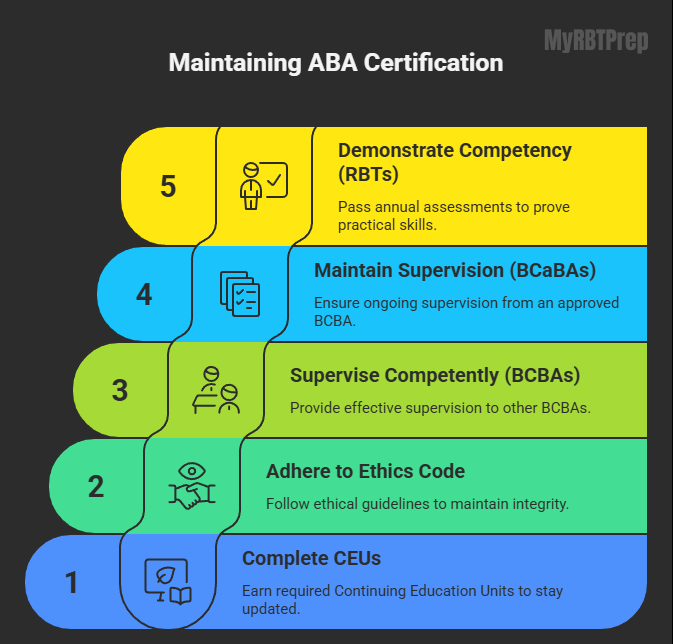
Each BACB certification requires continuing professional development and adherence to the ethics code to ensure practitioners remain competent in the field.
Continuing Education and Renewal of Certification: BCBAs.
BCBAs must participate in ongoing continuing education to keep their certification valid. Earning the required Continuing Education Units (CEUs) during the two-year recertification cycle is essential to ensure BCBAs have current knowledge of research and techniques.
All BCBAs who supervise other BCBAs must complete CEUs that focus on providing competent supervision. The Ethics Code must also be adhered to in order for BCBAs to maintain their certification.
Continuing Education and Renewal of Certification: BCaBAs.
Similarly, BCaBAs must complete continuing education during their recertification cycles in order to expand their knowledge base and maintain their skills.
Additionally, BCaBAs must work under the supervision of an approved BCBA and the supervisory relationship must be documented and on-going throughout the certification period in order for the BCaBA to retain good standing as an ABA practitioner.
Renewal and Competency for RBTs.
The purpose of the RBT renewal process is to ensure that RBTs demonstrate practical competency on an ongoing basis. In order to renew their certification annually, RBTs must demonstrate competency during an assessment conducted by their supervisor.
The competency assessment demonstrates that the RBT continues to be able to provide services in accordance with ethical standards and correctly implement interventions using ABA principles.
Faqs
What’s the difference between BCaBA and RBT?
A BCaBA supervises RBTs and implements behavior plans, while an RBT provides direct therapy under supervision.
What is the difference between a BCBA and a BCaBA?
A BCBA is a master’s-level professional who develops and oversees behavior plans, whereas a BCaBA is a bachelor’s-level assistant who supports and implements them.
What is the 80/20 rule in ABA?
The 80/20 rule means 80% of progress comes from 20% of high-impact behavioral interventions.
Will BCBA be replaced by AI?
No, BCBA roles require clinical judgment, supervision, and individualized planning that AI cannot fully replicate.
Which jobs will be gone by 2030?
Jobs at high risk include routine clerical work, cashiers, telemarketers, and some assembly line positions due to automation.

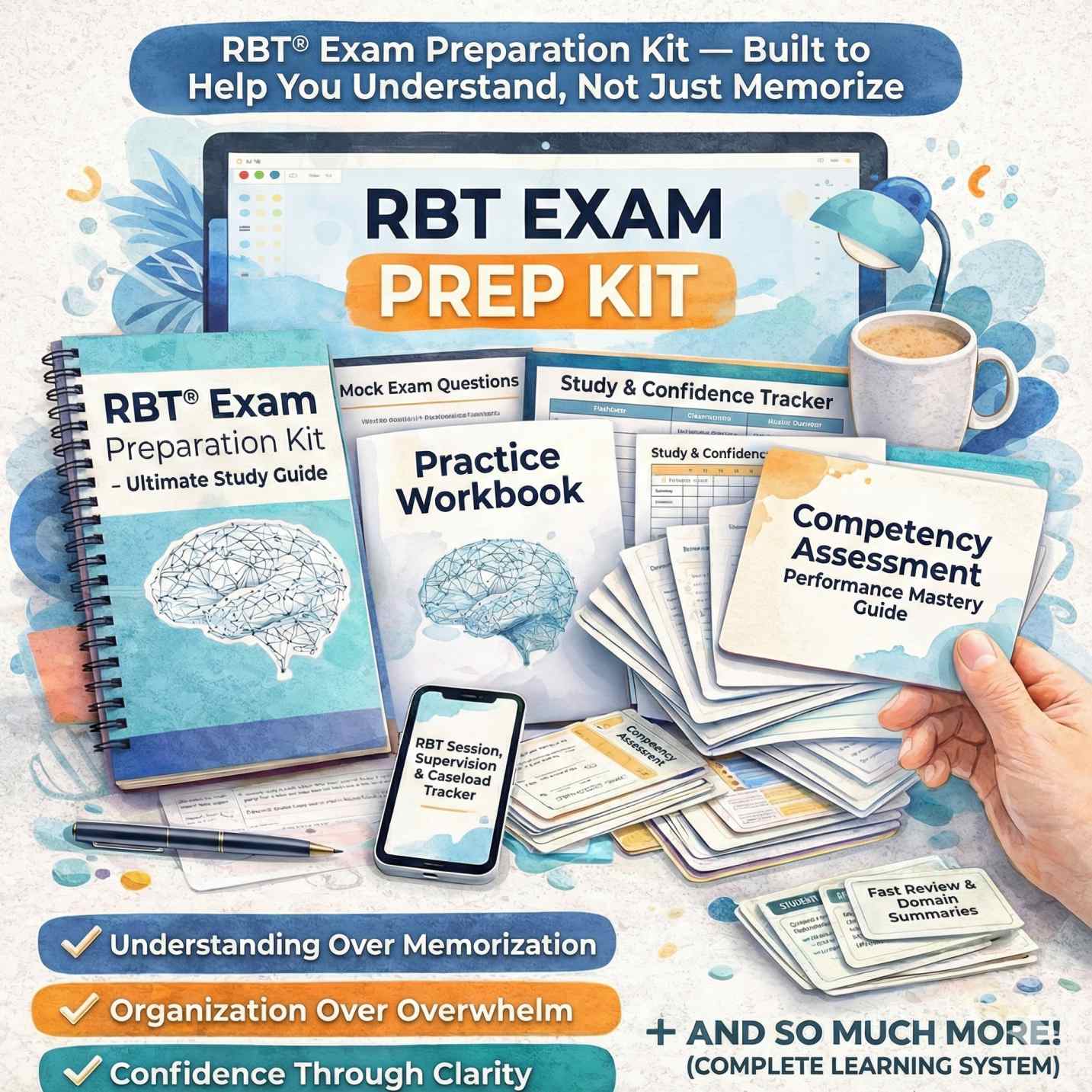
Everything You Need to Pass Your RBT® Exam
Study with our complete, all-in-one preparation package covering every task on the BACB Task List 3.0:
- 1,000+ Practice Questions & Timed Simulator
- 3rd Edition Task List Study Guide & Workbook
- Active Recall Flashcards System + Mobile App
- 20-Task Competency Assessment Mastery Guide