Applied Behavior Analysis (ABA) is one of the most widely used and research-supported approaches for helping individuals with autism spectrum disorder (ASD) and other developmental challenges build meaningful skills and reduce behaviors that interfere with learning. A key reason ABA is so effective is that it relies on objective data rather than opinions or assumptions.
At the center of every successful ABA program is data collection. Therapists, Registered Behavior Technicians (RBTs), and Board Certified Behavior Analysts (BCBAs) use data to understand behavior, track progress, and make informed treatment decisions. Without accurate data, it would be difficult to determine whether a child is improving, whether an intervention is working, or whether changes are needed.
For RBTs, data collection is one of the most important daily responsibilities. Every session provides opportunities to gather valuable information that helps shape a child’s treatment plan and long-term success.
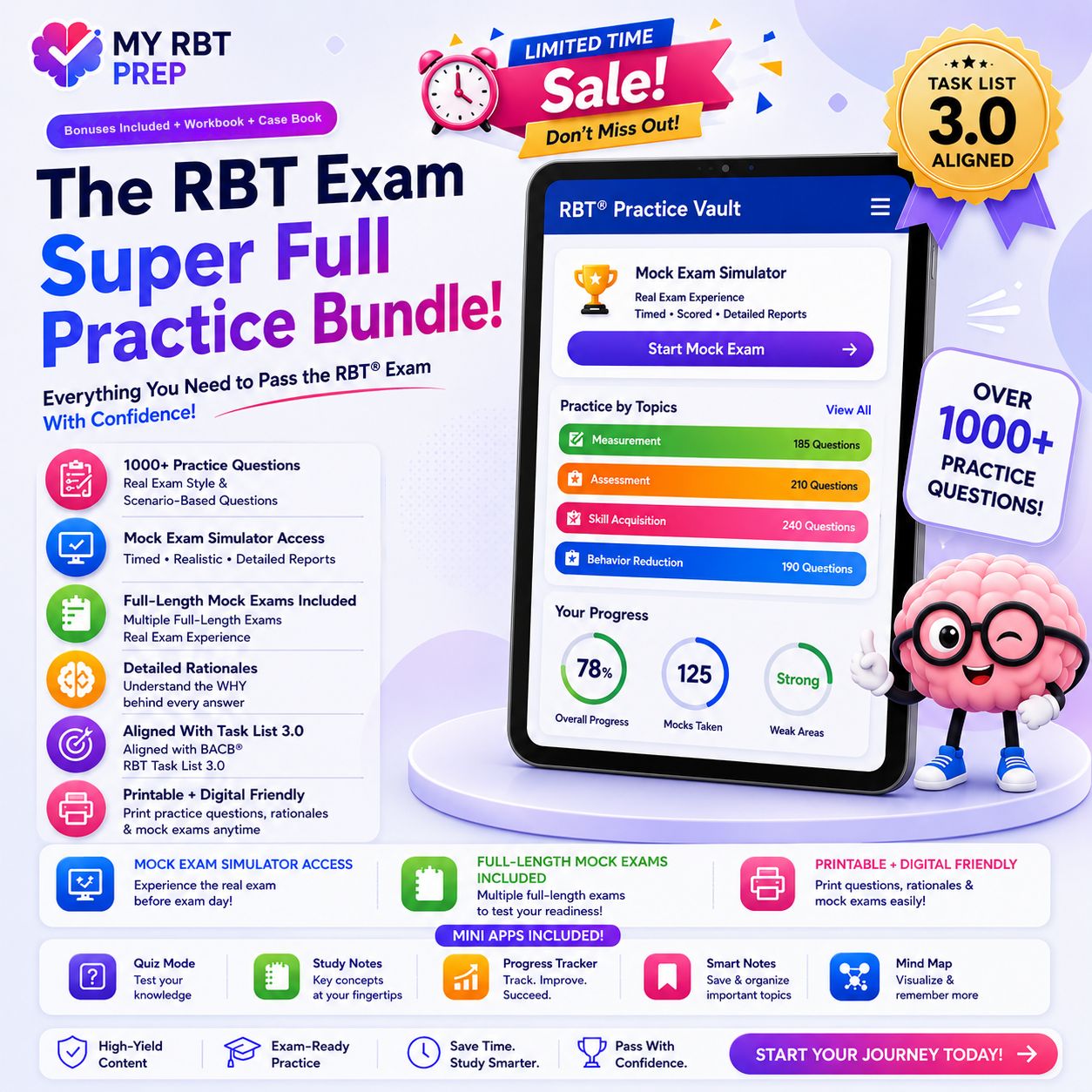
Pass Your RBT® Exam on the First Attempt
Practice with 1,000+ realistic scenario questions, multiple full-length timed mock exams, and detailed rationales formatted exactly like the real Pearson VUE test.
In this guide, we will explain what ABA data collection is, why it matters, the different types of data used in ABA, and the critical role RBTs play in collecting accurate information.
What Is ABA Data Collection?
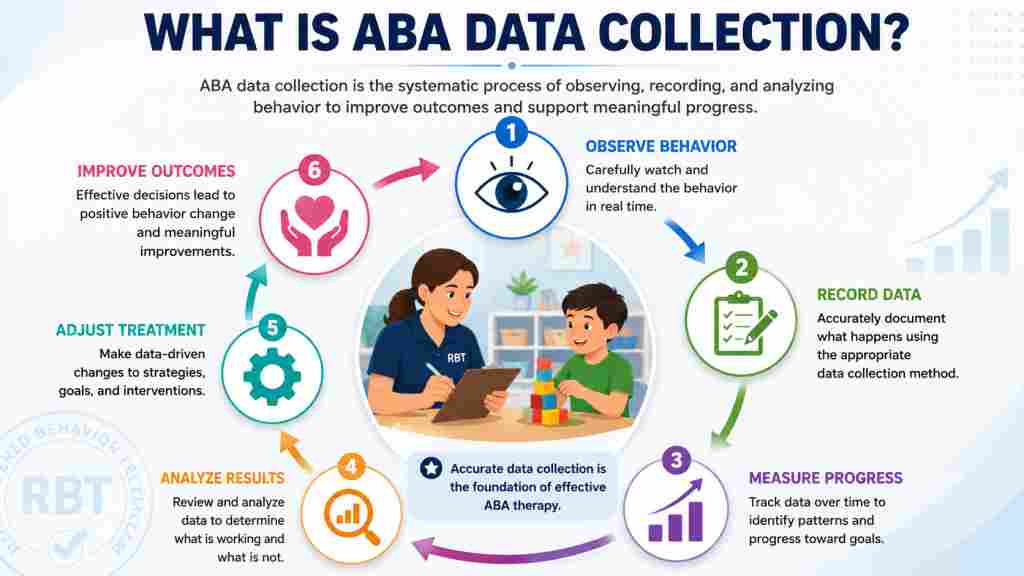
ABA data collection is the process of systematically recording information about behaviors, skills, and responses during therapy sessions.
The goal is to measure progress objectively rather than relying on memory or personal observations. Data provides a clear picture of how often a behavior occurs, how long it lasts, what triggers it, and whether interventions are producing positive results.
For example, instead of saying:
“The child seems to be talking more.”
An RBT can record:
“The child independently requested items 15 times during today’s session compared to 8 times last week.”

RBT® Exam Flashcards & Study App (3rd Edition)
Master essential ABA terminology and clinical discrimination across all 6 BACB task list areas with 500+ printable and digital flashcards, real exam cues, and full mobile app access.

This measurable information allows treatment teams to evaluate progress accurately.
ABA Data Collection at a Glance
| Component | Purpose |
|---|---|
| Behavior Tracking | Monitor target behaviors |
| Skill Acquisition Data | Measure learning progress |
| Treatment Evaluation | Determine intervention effectiveness |
| Progress Monitoring | Track improvement over time |
| Clinical Decision-Making | Guide treatment adjustments |
Why Is Data Collection Important in ABA?
Data collection is the foundation of evidence-based treatment.
Without reliable data, therapists would be forced to make decisions based on guesses or subjective opinions. Data ensures that every treatment decision is supported by measurable evidence.
Helps Measure Progress
One of the primary purposes of data collection is to determine whether a child is making progress toward specific goals.
Examples include:
- Learning new communication skills
- Following directions independently
- Reducing aggressive behaviors
- Increasing social interactions
- Improving academic participation
By collecting data consistently, therapists can identify patterns and evaluate growth over time.
Supports Individualized Treatment
Every child learns differently.
Data helps BCBAs determine:
- Which interventions are working
- Which goals have been mastered
- Which skills need additional support
- Whether modifications are necessary
This ensures treatment remains personalized.
Promotes Accountability
Families invest significant time, energy, and resources into therapy.
Data allows providers to demonstrate:
- Progress achieved
- Areas needing improvement
- Treatment effectiveness
- Goal completion rates
Objective measurements increase transparency and accountability.
The RBT’s Role in ABA Data Collection
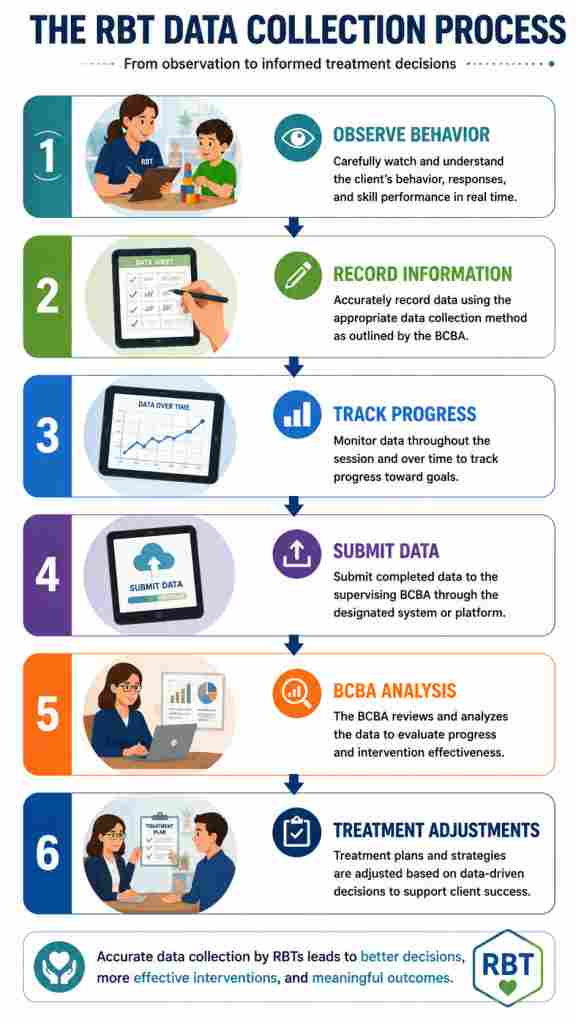
Registered Behavior Technicians are often the primary individuals responsible for collecting data during therapy sessions.
Because RBTs work directly with clients on a daily basis, they are uniquely positioned to observe behaviors and record information accurately.
Their responsibilities include:
- Recording skill acquisition data
- Tracking target behaviors
- Monitoring intervention effectiveness
- Maintaining data accuracy
- Reporting observations to supervisors
- Following BCBA-developed data collection procedures
While BCBAs analyze the data and make treatment decisions, RBTs provide the information that makes those decisions possible.
Key Data Collection Responsibilities of an RBT
| Responsibility | Description |
|---|---|
| Observation | Monitor behaviors and responses |
| Recording Data | Document information accurately |
| Following Protocols | Use approved data systems |
| Reporting Changes | Communicate concerns to supervisors |
| Maintaining Accuracy | Avoid assumptions or estimates |
Types of ABA Data Collection
There are several methods used to collect behavioral data in ABA therapy.
The method chosen depends on the behavior being measured and the goals of the intervention.
Frequency Data
Frequency measures how many times a behavior occurs.
Examples:
- Number of tantrums
- Number of requests made
- Number of aggressive incidents
- Number of correct responses
Example:
A child requests help 12 times during a session.
Frequency = 12
Duration Data
Duration measures how long a behavior lasts.
Examples:
- Length of tantrums
- Time spent engaged in work
- Duration of social interactions
Example:
A tantrum lasts 4 minutes and 30 seconds.
Duration = 4 minutes 30 seconds
Latency Data
Latency measures the time between an instruction and the child’s response.
Example:
The therapist says:
“Please sit down.”
The child sits down after 7 seconds.
Latency = 7 seconds
Latency data helps assess responsiveness and compliance.
Interval Recording
Interval recording involves observing behavior during specific time periods.
The session is divided into smaller intervals, such as:
- 10 seconds
- 30 seconds
- 1 minute
The RBT records whether the behavior occurred during each interval.
This method is useful for behaviors that happen frequently.
Common Interval Recording Methods
| Method | Purpose |
|---|---|
| Whole Interval | Behavior occurred throughout interval |
| Partial Interval | Behavior occurred at any point |
| Momentary Time Sampling | Behavior checked at specific moment |
ABC Data Collection
ABC stands for:
- Antecedent
- Behavior
- Consequence
This method helps identify why behaviors occur.
Example:
| Component | Example |
|---|---|
| Antecedent | Teacher asks child to complete work |
| Behavior | Child throws worksheet |
| Consequence | Work demand removed |
ABC data helps identify behavioral functions and guide intervention planning.
Skill Acquisition Data
ABA is not only about reducing challenging behaviors.
A large portion of therapy focuses on teaching new skills.
RBTs collect data on:
- Communication skills
- Academic skills
- Social skills
- Self-help skills
- Daily living skills
Examples include:
- Correct responses
- Prompt levels required
- Independent task completion
- Mastery percentages
This information helps determine whether learning is occurring successfully.
Technology and Digital Data Collection
Modern ABA programs increasingly use digital platforms for data collection.
Instead of paper data sheets, many clinics now use:
- Tablets
- Mobile applications
- Cloud-based systems
- Electronic health record platforms
Benefits include:
- Faster documentation
- Real-time reporting
- Automatic graph generation
- Improved accuracy
- Easier communication between team members
RBTs are often trained to use these digital systems during therapy sessions.
Benefits of Digital ABA Data Collection
| Benefit | Impact |
|---|---|
| Real-Time Updates | Immediate progress tracking |
| Automated Graphs | Easier data analysis |
| Improved Accuracy | Reduced paperwork errors |
| Better Collaboration | Faster communication with supervisors |
Challenges RBTs Face During Data Collection
Although data collection is essential, it can sometimes be challenging.
RBTs must balance:
- Delivering therapy
- Building rapport
- Managing behaviors
- Teaching skills
- Recording data accurately
Some common challenges include:
High Rates of Behavior
When behaviors occur frequently, recording every instance can be difficult.
Multiple Goals
A child may have numerous goals being targeted during one session.
RBTs must remain organized while tracking multiple variables.
Environmental Distractions
Home, school, and community settings can be unpredictable.
Despite distractions, accurate data collection remains essential.
Tips for Accurate ABA Data Collection
High-quality data is critical for effective treatment.
RBTs can improve accuracy by following several best practices.
Follow BCBA Instructions
Always use the specific procedures provided by supervisors.
Record Data Immediately
Avoid relying on memory.
Document observations as close to the event as possible.
Remain Objective
Record facts rather than opinions.
Instead of:
“The child was upset.”
Record:
“The child cried for 3 minutes after the demand was presented.”
Double-Check Entries
Review data regularly for completeness and accuracy. Practice continuous and discontinuous measurement scenarios with our interactive RBT Data Collection & Graphing Quiz, and keep client session data organized with our RBT Supervision & Caseload Tracker.
Best Practices for RBT Data Collection
| Best Practice | Why It Matters |
|---|---|
| Record Immediately | Reduces memory errors |
| Stay Objective | Improves reliability |
| Follow Procedures | Ensures consistency |
| Review Data | Identifies mistakes early |
How Data Helps BCBAs Make Decisions
After RBTs collect data, BCBAs analyze it to determine treatment effectiveness.
The data may reveal:
- Progress toward goals
- Behavioral trends
- Areas of difficulty
- Need for intervention changes
For example:
If data shows a child’s communication skills are improving steadily, the BCBA may introduce more advanced goals.
If challenging behaviors are increasing, modifications may be needed.
Without accurate RBT-collected data, these decisions become much more difficult.
The Future of ABA Data Collection
Technology continues transforming behavioral healthcare.
Future trends may include:
- AI-assisted data analysis
- Automated behavior tracking
- Wearable monitoring devices
- Advanced digital reporting systems
- Improved telehealth integration
However, even with technological advances, skilled RBTs will remain essential because accurate observation and professional judgment cannot be fully replaced by technology.
Final Thoughts
ABA data collection is the foundation of effective behavioral intervention. It provides objective information that helps treatment teams understand behavior, measure progress, and make informed decisions about care.
For Registered Behavior Technicians, data collection is one of the most important responsibilities. By accurately recording behaviors, skill acquisition, and treatment outcomes, RBTs help ensure that therapy remains effective, individualized, and evidence-based.
Whether working in homes, schools, clinics, or community settings, RBTs play a crucial role in gathering the information that drives meaningful progress. Their attention to detail and commitment to accurate data collection directly contribute to better outcomes for the individuals they serve.
Frequently Asked Questions
1. What is ABA data collection?
ABA data collection is the process of recording information about behaviors, skills, and responses during therapy to measure progress and guide treatment decisions.
2. Why is data collection important in ABA?
Data helps therapists evaluate intervention effectiveness, monitor progress, and make evidence-based treatment decisions.
3. What type of data do RBTs collect?
RBTs commonly collect frequency, duration, latency, interval, ABC, and skill acquisition data.
4. Do RBTs analyze the data they collect?
No. RBTs collect and record data, while BCBAs analyze the information and make treatment decisions.
5. Can ABA data be collected digitally?
Yes. Many ABA providers use tablets, mobile apps, and cloud-based platforms to collect and manage therapy data efficiently.

Everything You Need to Pass Your RBT® Exam
Study with our complete, all-in-one preparation package covering every task on the BACB Task List 3.0:
- 1,000+ Practice Questions & Timed Simulator
- 3rd Edition Task List Study Guide & Workbook
- Active Recall Flashcards System + Mobile App
- 20-Task Competency Assessment Mastery Guide