The BCBA Task List 6th Edition is the official blueprint for every question on the BCBA certification exam. The Behavior Analyst Certification Board (BACB) publishes it freely and most study guides simply reformat it. This guide goes further.
You will find: what each domain looks like in real clinical practice, which domains candidates most often underestimate (based on exam-prep feedback patterns not official BACB score data), a study strategy tailored to each domain, how questions are typically worded, and why this matters for the real clients behavior analysts serve.
What the Task List Is and What It Is Not
The Task List is a content outline derived from a practice analysis a large-scale survey of working BCBAs who reported what skills they use daily and how important each is to safe, effective practice. The 6th Edition (effective January 1, 2022) added 41 tasks, restructured ethics as a cross-cutting theme, and created two new domains: Domain H (Personnel Supervision) and Domain I (Collaboration and Generalization).
What it is NOT: a textbook. It does not explain how to do anything. That is your job as the student to map each task to the underlying concept and then to a clinical scenario.
Exam Structure
| Component | Detail |
| Total Questions | 185 (160 scored + 25 unscored pilot) |
| Time | 4 hours |
| Format | Multiple choice, 4 options, no penalty for guessing |
| Passing Score | Scaled score 400/500 |
| Vendor | Pearson VUE |
| Task List Version | 6th Edition — January 2022 |
| Renewal | Every 2 years, 32 CEUs (4 must be ethics) |
The Nine Domains With Clinical Reality
Domain A: Foundations (approx. 6%)
Covers: philosophical assumptions of behavior analysis, the 7 dimensions defined by Baer, Wolf, and Risley (1968) applied, behavioral, analytic, technological, conceptually systematic, effective, generality plus respondent vs. operant conditioning rooted in B.F. Skinner’s work.
Clinical reality: Every time a BCBA writes a treatment plan, all 7 dimensions apply. A plan must target a socially significant behavior, measure it directly, demonstrate a functional relationship, describe procedures specifically enough to replicate, and produce change that generalizes. When a BCBA skips any dimension for example, writing a vague procedure no one else can implement they violate the Technological dimension and put clients at risk of inconsistent treatment.
How exam questions are worded: “A BCBA implements an intervention that reduces self-injury but writes no replicable protocol. Which dimension is missing?” Answer: Technological. Questions are situational, not definitional.

Domain B: Concepts and Principles (approx. 10%)
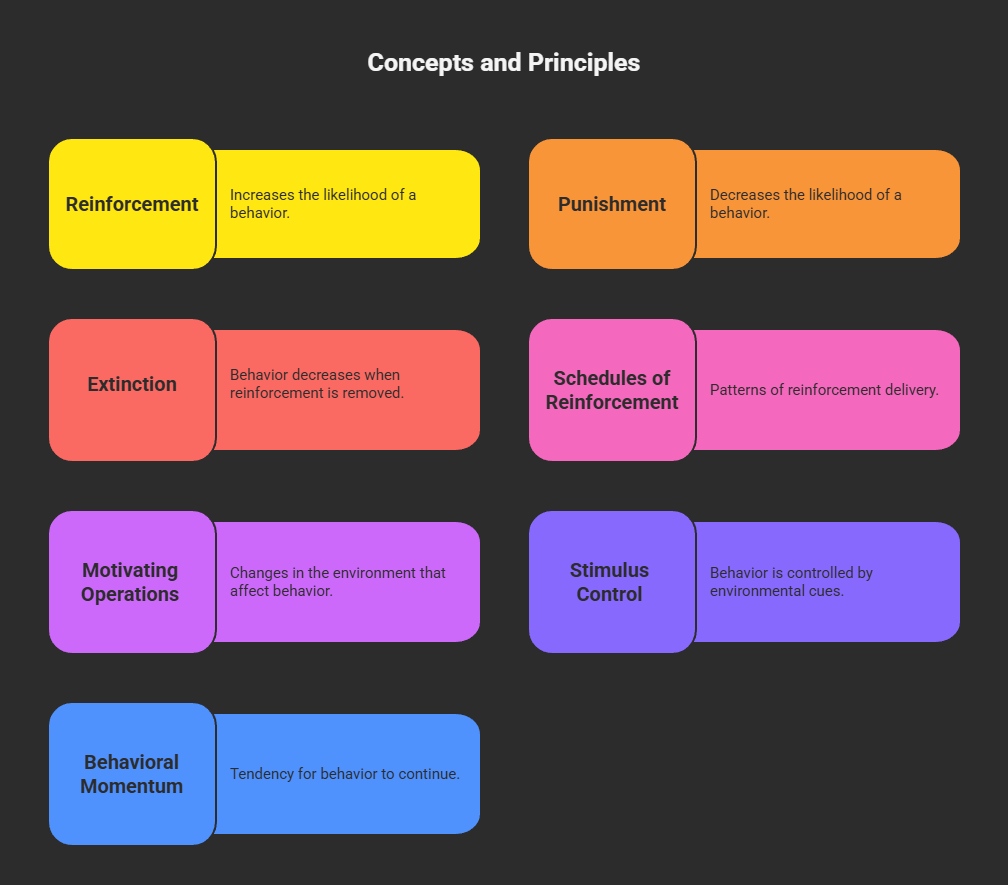
Covers: reinforcement (positive/negative), punishment (positive/negative), extinction, schedules of reinforcement, motivating operations (establishing/abolishing), stimulus control, behavioral momentum.
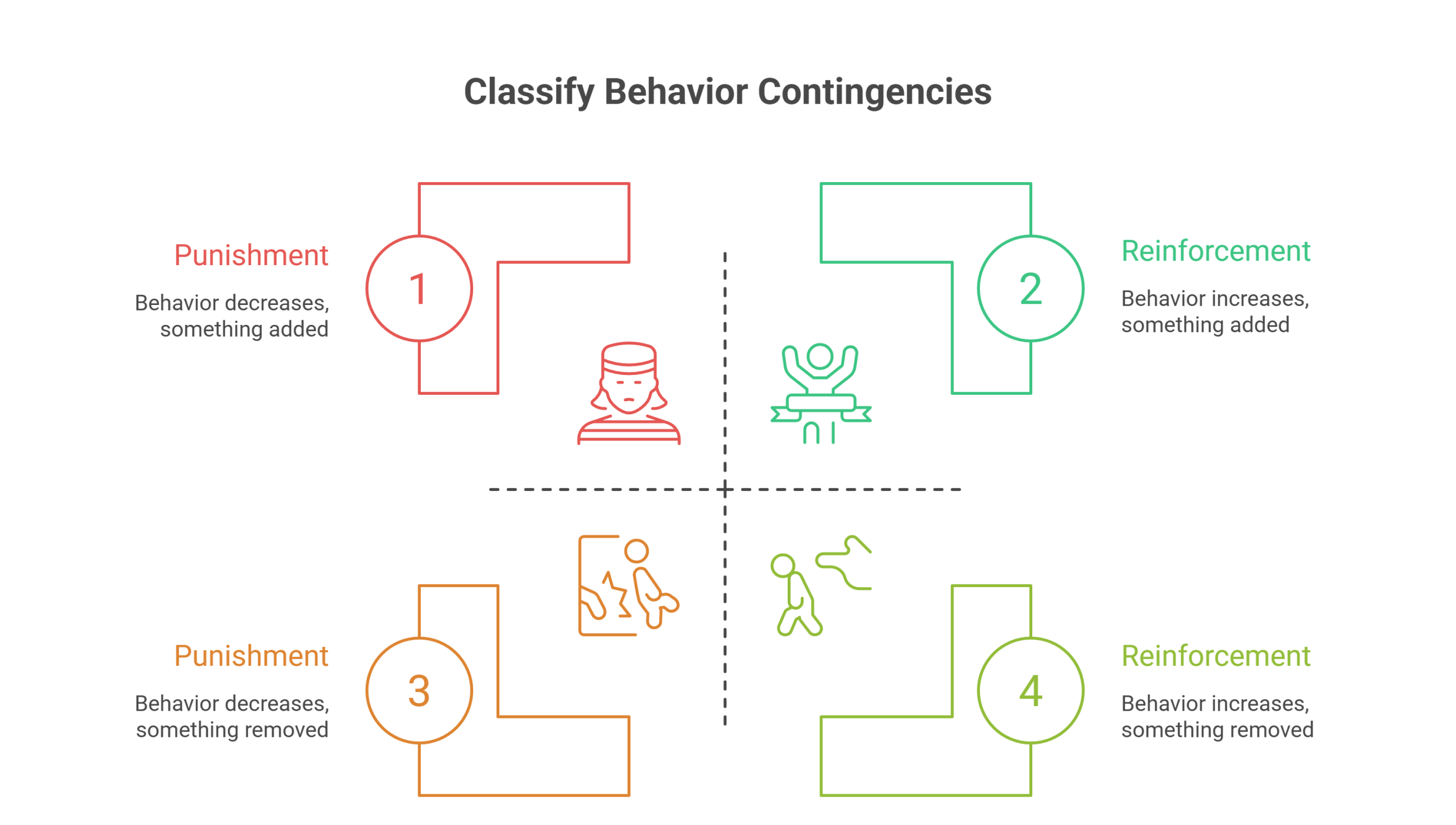
The classification trap: Many candidates memorize definitions correctly but fail scenario questions because they ask “does this feel positive or negative?” instead of the correct two-step: (1) Did the behavior increase or decrease? (2) Was something added or removed? Run those two steps in order and you will classify any contingency correctly.
Why this matters for real clients: Misclassifying reinforcement and punishment leads to misidentifying what is maintaining behavior. A child whose crying is inadvertently negatively reinforced by escape from tasks will not improve if the team thinks they are seeking attention. The consequence of a classification error is a behavior plan built on the wrong function.
Domain C: Measurement (approx. 12%)
Covers: frequency, rate, duration, latency, interresponse time (IRT), partial interval, whole interval, momentary time sampling (MTS), permanent product, IOA calculation, data interpretation (trend, level, variability).
| Method | Best For | Important Bias |
| Frequency/Rate | Discrete countable behaviors | None if onset/offset are clear |
| Duration | How long behavior lasts | None |
| Latency | Stimulus-to-response time | None |
| Partial Interval | High-rate or continuous behavior | OVERESTIMATES occurrence |
| Whole Interval | Sustained behaviors | UNDERESTIMATES occurrence |
| Momentary Time Sampling | Large groups, less intensive | MISSES brief occurrences |
Clinical humanity note: Choosing the wrong measurement system does not just create bad data — it can lead a team to believe a child’s behavior is improving when it is not, delaying necessary changes to treatment. Accurate measurement is a direct act of clinical care.
Domain D: Experimental Design (approx. 8%)
Covers: ABAB reversal, multiple baseline (across behaviors/settings/participants), alternating treatments, changing criterion, threats to internal validity.
Commonly underestimated: Domain D questions appear disguised as clinical questions. “Which design best demonstrates this intervention caused behavior change?” is a research design question wearing clinical clothing. Multiple baseline designs are preferred when reversing behavior is unethical or impossible. Know that distinction.
Domain E: Ethics (approx. 12%)
Covers: 2022 BACB Ethics Code — 6 core principles (beneficence/non-maleficence, autonomy, justice, fidelity, scientific integrity, public interest), client care standards, supervisory duties, professional conduct, BACB reporting.
Exam behavior: The Ethics Code is principles-based. Exam questions present situations the code does not explicitly script and ask what is most consistent with the underlying principles. The correct answer almost always: protects the client first, seeks guidance before acting, does not proceed without competence.
Domain F: Behavior Assessment (approx. 14%)
Covers: indirect assessment (interviews, rating scales), direct observation (ABC, scatter plots), functional behavior assessment (FBA) process, functional analysis (FA), preference assessments (free operant, paired stimulus/MSWO), skill assessments (VB-MAPP, ABLLS-R, AFLS).
Critical distinction to know: An FBA is the whole process indirect + direct methods to form a hypothesis. A functional analysis is one experimental method within the FBA process the one that provides the highest level of evidence. On the exam: if asked which provides the strongest evidence for a behavior’s function, the answer is always functional analysis, not FBA.
Clinical humanity note: Choosing the right assessment is not just a clinical checkbox it determines whether the behavior plan addresses the real cause of a client’s distress. A child engaging in self-injury maintained by pain (automatic function) needs a very different intervention than one whose self-injury is attention-maintained. Getting assessment wrong means the child suffers longer.
Domain G: Behavior-Change Procedures (approx. 24%)
Covers: DTT, naturalistic teaching (incidental teaching, PRT), prompting and fading, shaping, chaining (forward/backward/total task), verbal operant training (mand, tact, intraverbal, echoic), differential reinforcement (DRO/DRA/DRI/DRL), extinction, FCT, antecedent modifications, punishment procedures.
Highest-weighted domain. The BACB consistently tests whether candidates apply reinforcement-based and function-based procedures before more intrusive ones. A question with a punishment-first answer is almost always wrong unless every other option has been ruled out.
Domain H: Personnel Supervision and Management (approx. 10%)
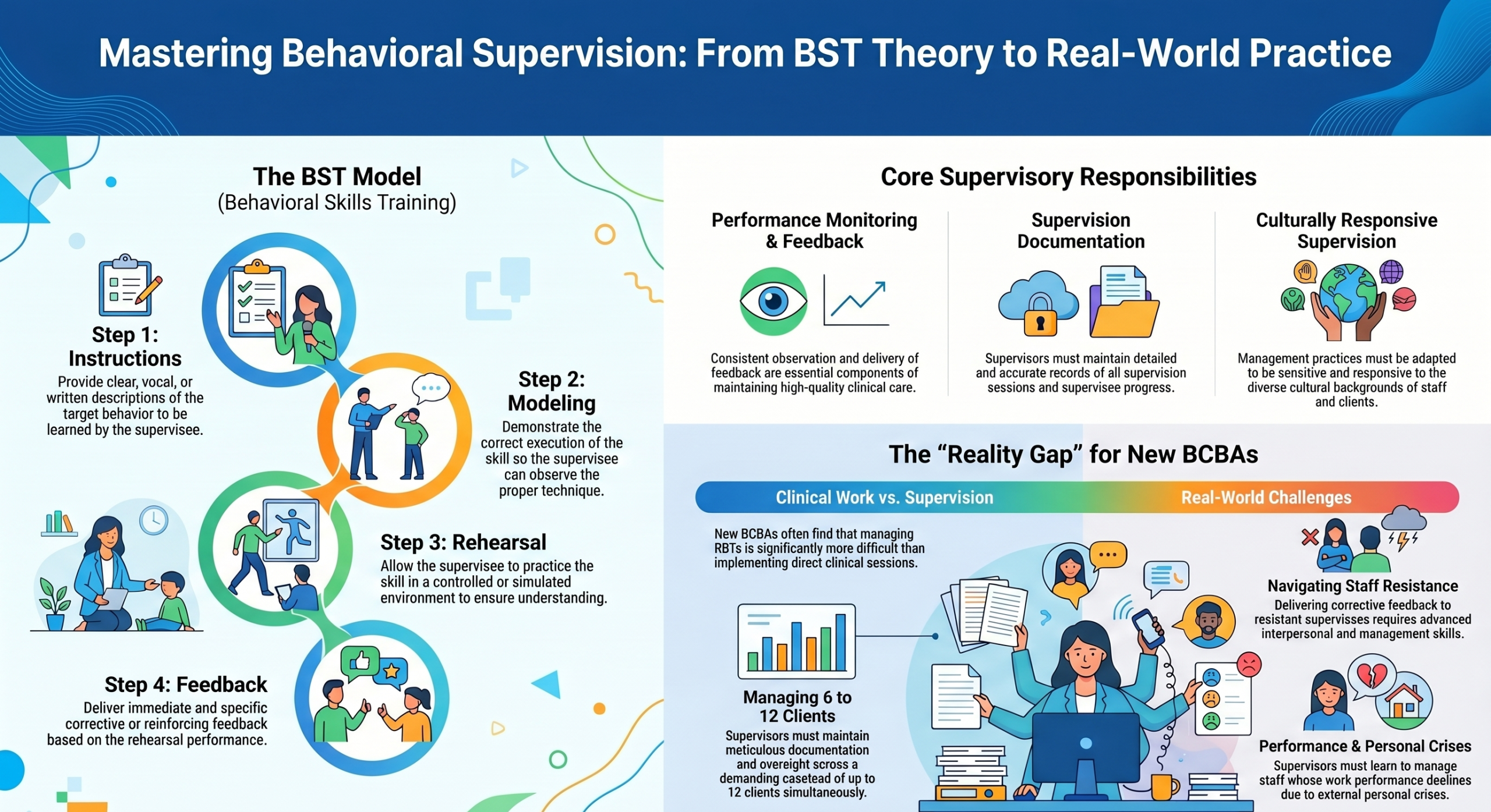
Covers: Behavioral Skills Training (BST) — Instructions → Modeling → Rehearsal → Feedback; performance monitoring; feedback delivery; supervision documentation; culturally responsive supervision.
Real supervision reality: New BCBAs often discover that supervising RBTs is harder than implementing sessions themselves. Giving corrective feedback to a resistant supervisee, managing staff whose performance declines after a personal crisis, and maintaining documentation across a caseload of 6 to 12 clients simultaneously is genuinely demanding. Domain H questions often present these realistic challenges.
Domain I: Collaboration and Generalization (approx. 4%)
Covers: Interdisciplinary collaboration (SLPs, OTs, psychologists, physicians), caregiver training, cultural humility, advocacy, generalization and maintenance programming.
Why it was added: The BACB recognized that behavior analysts who work in isolation even with excellent clinical skills often produce change that does not generalize to natural environments. Domain I formalizes the expectation that BCBAs actively coordinate, train families, and plan explicitly for how behavior change transfers beyond the therapy room.
Domain Weighting Table
| Domain | Name | Approx. Exam % | Study Priority |
| A | Foundations | 6% | Medium |
| B | Concepts & Principles | 10% | High |
| C | Measurement | 12% | High |
| D | Experimental Design | 8% | Medium-High |
| E | Ethics | 12% | High — read the full code |
| F | Behavior Assessment | 14% | Very High |
| G | Behavior-Change Procedures | 24% | Highest — most questions |
| H | Personnel Supervision | 10% | High |
| I | Collaboration & Generalization | 4% | Lower — do not skip |
5th Edition vs 6th Edition: What Changed
| Feature | 5th Edition | 6th Edition |
| Total Tasks | 155 | 196 (+41 tasks) |
| Domains | 7 | 9 |
| Ethics treatment | One isolated domain | Integrated throughout + Domain E |
| Supervision | Brief section | Full Domain H |
| Collaboration | Not formalized | New Domain I |
| Cultural responsiveness | Minimal | Explicit in multiple domains |
| Telehealth/Technology | Not addressed | Included in supervision and assessment tasks |
Domain-by-Domain Study Strategy
| Domain | Best Study Method |
| A | Read Baer/Wolf/Risley 1968 paper. Know all 7 dimensions with clinical examples. |
| B | Use the 2-question classification method. Drill schedules with scenario practice. |
| C | Build a measurement selection guide. Practice IOA calculations from raw data. |
| D | Draw each design from memory. Practice identifying designs from clinical scenarios. |
| E | Read the full 2022 Ethics Code twice. Practice scenario-only questions. |
| F | Map the FBA process as a flowchart. Know each assessment’s purpose and output. |
| G | Study by category: acquisition, reduction, least-restrictive hierarchy. Heavy scenario practice. |
| H | Memorize BST 4 steps cold. Practice giving corrective feedback in role-play scenarios. |
| I | Study generalization strategies (general case, multiple exemplar). Review collaboration cases. |
Frequently-Underestimated Domains (Based on Candidate Feedback Patterns)
Note: The following reflects patterns commonly reported by BCBA exam candidates in prep communities and exam coaching contexts — not official BACB score data, which is not released publicly at the domain level.
| Domain | Why Candidates Underestimate It | Fix |
| E: Ethics | Overthinking — choosing most dramatic response instead of most measured one | Read the code directly. Do scenario-only ethics practice. |
| F: Assessment | Collapsing FBA and FA; not knowing preference vs. reinforcer assessment differences | Study FBA as a process flowchart. Know what each method answers. |
| D: Experimental Design | Treating it as academic/irrelevant; missing disguised design questions | Practice identifying design needs from clinical scenarios. |
| B: Concepts | Classification errors when consequences are presented situationally | Stop using intuition. Always: behavior up/down first, then added/removed. |
| G: Behavior-Change | Choosing punishment before function-based options; missing least-restrictive principle | Ask: is there a reinforcement-based option first? Always. |
How Exam Questions Are Typically Worded
Domain B: “A child stops hitting after his mother takes away his tablet every time he hits. Hitting has decreased. This is…” Positive punishment. The behavior decreased; something was removed. Wait something was ADDED (response cost: tablet removed = taking away a preferred item = adding an aversive consequence). Correct answer: positive punishment.
Domain C: “A behavior analyst checks each of 6 students every 5 minutes to see if stereotypy is occurring at that exact moment.” — Momentary time sampling.
Domain G: “A BCBA identifies property destruction is escape-maintained. Before implementing extinction, what is the most appropriate first step?” — Teach a functional replacement behavior (FCT).
Domain E: “A BCBA discovers her colleague bills for sessions not conducted. What should she do first?” Attempt to resolve directly with the colleague before escalating to the BACB.
Common Candidate Mistakes
- Using 5th Edition materials. If your study guide or flashcards predate 2022, you are studying the wrong content outline. Forty-one tasks were added in the 6th Edition.
- Reading Cooper/Heron/Heward cover to cover without scenario practice. The textbook builds concepts. Scenarios build exam readiness. You need both.
- Skipping Domain D because it feels academic. Design questions appear regularly in clinical disguise. “Which evidence confirms a functional relationship?” is Domain D.
- Not reading the actual Ethics Code. Many candidates study ethics from summaries. Exam questions use precise code language. If you have not read the source document, you are guessing.
- Never practicing under timed conditions. The exam gives you 1 minute 18 seconds per question. Your first timed experience should not be the real exam.
FAQ
When did the 6th Edition take effect?
January 1, 2022. All BCBA exams since that date are based on the 6th Edition.
What domain is hardest on the BCBA exam?
Based on candidate feedback patterns shared in exam-prep communities, Domains E (Ethics) and F (Behavior Assessment) generate the most unexpected missed questions — not because the content is hardest, but because candidates underestimate the nuance required. Domain G has the most questions overall.
How many hours should I study for the BCBA exam?
Most candidates who pass on their first attempt report 150 to 300 total study hours over 3 to 5 months. Prior clinical experience matters — candidates actively implementing ABA programs daily need less conceptual review.
Is the BCBA exam harder than the RBT exam?
Yes, substantially. The RBT exam tests procedural knowledge. The BCBA exam tests clinical judgment — designing, evaluating, and making decisions about programs. The reasoning depth required is qualitatively different.
Can I pass without fieldwork experience?
You cannot sit for the exam without completing required fieldwork hours. And candidates who have completed hours without deeply reflecting on clinical work often struggle with application questions. The best-prepared candidates connect every Task List skill to something they have seen or done in practice.
Do I need to memorize all 196 tasks?
Understand them — not memorize them verbatim. The exam presents scenarios, not definitions. Your goal is reasoning, not recall.
Where can I download the Task List?
Free from bacb.com. Download it before studying and use it as your primary checklist.
Summary
The BCBA Task List 6th Edition contains 196 tasks across 9 domains. Domain G (behavior-change procedures, approx. 24%) deserves the most study time. Domains E, F, and D are frequently underestimated based on candidate feedback patterns. Study each domain with a specific strategy not the same approach for every section. Connect every concept to clinical application, because that is exactly how the exam tests you.
A Note on Scenario Practice
After working through the domains conceptually, many candidates find it useful to apply that understanding through scenario-based practice questions — the same reasoning format the real exam uses. Our BCBA Practice Exam is built around 6th Edition Task List scenarios with full rationales for every answer