

The RBT Task List (2026 BACB Update) marks a practical shift in how Registered Behavior Technicians build and maintain real-world skills. Instead of memorizing tasks, the updated framework emphasizes applied competence across measurement, assessment, skill acquisition, behavior reduction, documentation, and ethics. This update aligns closely with new recertification expectations and reflects how ABA services actually operate in clinical settings. For BCBAs and RBTs, the RBT Task List 2026 serves as a roadmap for training, supervision, and professional development. The BACB update also supports smoother transitions into PDUs, stronger ethical decision-making, and better client outcomes. Understanding these changes early helps you stay compliant and confident.
Pass Your RBT® Exam on the First Attempt
Practice with 1,000+ realistic scenario questions, multiple full-length timed mock exams, and detailed rationales formatted exactly like the real Pearson VUE test.
Overview of RBT Recertification Changes in 2026
After 2026, the BACB introduces a shift from annual to biennial recertification. RBTs no longer complete yearly competency renewals. Instead, they enter a two-year cycle focused on skill-based learning and documented development. This affects every RBT renewal process 2026 decision made by supervisors.
These changes align renewal expectations with real work. Skills such as measurement, documentation, and ethical compass are emphasized through ongoing learning. The updated approach reflects BACB RBT Handbook updates designed to modernize supervision and accountability.
| Topic | Details |
| Recertification Cycle | After 2026, RBTs move from annual to biennial recertification. |
| Competency Renewal | Yearly competency assessments are replaced by ongoing skill-based development. |
| Focus | Two-year cycle emphasizes skill-based learning and documented development. |
| Supervisor Role | All RBT renewal process 2026 decisions require careful oversight by BCBAs. |
| Key Skills Highlighted | Measurement, documentation, and ethical compass are prioritized. |
| Purpose | Aligns renewal expectations with real-world ABA practice and BACB RBT Handbook updates. |
Why BACB Is Moving to a Two-Year Recertification Cycle
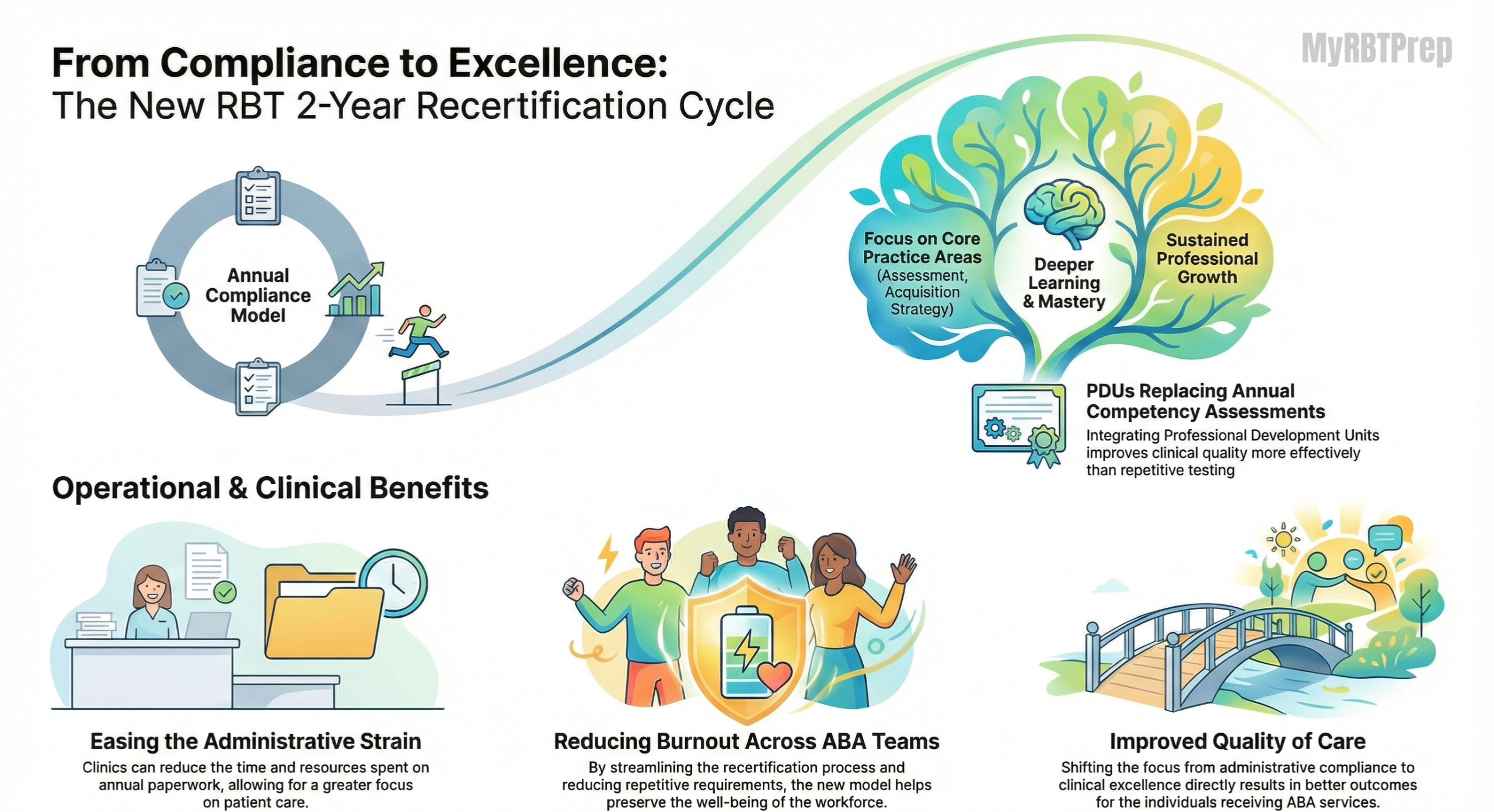
The RBT two-year recertification cycle supports deeper learning instead of surface-level assessments. Annual competency checks confirmed minimum skill. The new model encourages growth across core practice areas like assessment and acquisition strategy.
This change also eases administrative strain. Clinics spend less time repeating paperwork and more time improving care. The BACB believes replacing competency assessments with PDUs improves quality while reducing burnout across ABA teams.

RBT® Exam Flashcards & Study App (3rd Edition)
Master essential ABA terminology and clinical discrimination across all 6 BACB task list areas with 500+ printable and digital flashcards, real exam cues, and full mobile app access.
RBT PDU Requirements for 2026 Explained
The RBT PDU requirements 2026 require twelve hours of learning every two years. Each hour must directly improve service delivery and reflect current standards. PDUs must support aligning PDUs with the RBT Task List, including Task List 3.0 domains.
Approved learning addresses measurement, behavior reduction, and documentation, along with ethics and assessment skills. Accepted sources include ACE provider PDUs for RBTs, supervised in-services, and college coursework. All learning must meet BACB PDU compliance expectations.
| Requirement | Details |
| Total PDUs | 12 every two years |
| Focus Areas | Measurement, assessment, ethics |
| Approved Sources | ACE, in-services, coursework |
| Oversight | BCBA verification |
Goodbye Annual Competency Assessment — What Replaced It?
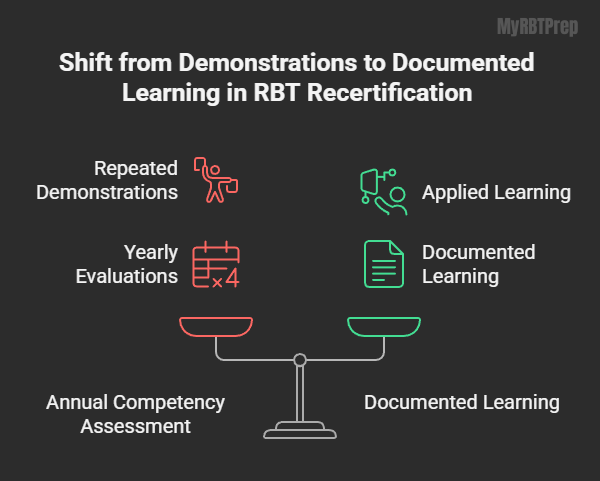
The RBT competency assessment 2026 represents the final annual recertification assessment. After this year, PDUs fully replace yearly evaluations. The BACB now values applied learning over repeated demonstrations.
Initial competency assessments remain for new RBTs. However, recertification now depends on documented learning. This approach strengthens long-term skill retention in behavior reduction and ethical practice while reducing unnecessary testing.
Updated BCBA Responsibilities Under 2026 Rules
Under the new model, BCBA RBT supervision responsibilities expand. Supervisors must review PDU relevance, confirm training quality, and ensure learning aligns with Task List 3.0. Supervisor verification and record retention become critical compliance duties.
You also safeguard ethics. The ethical compass domain requires ongoing attention. Monitoring PDUs ensures RBTs receive training that supports client dignity, data accuracy, and professional conduct. Strong oversight reduces risk and improves outcomes.
| Responsibility Area | Details |
| Supervision Expansion | BCBA RBT supervision responsibilities expand under the new model. |
| PDU Review | Supervisors must review PDU relevance and confirm training quality. |
| Task Alignment | Ensure all learning aligns with RBT Task List 3.0 domains. |
| Verification & Records | Supervisor verification and record retention become critical compliance duties. |
| Ethics Oversight | Ethical compass domain requires ongoing attention to protect clients. |
| Outcome Improvement | Monitoring PDUs ensures training supports client dignity, data accuracy, and professional conduct. |
Step-by-Step RBT Documentation Checklist for 2026
Strong documentation anchors compliance. RBT supervision documentation must clearly track PDUs, training dates, and verification signatures. Digital systems improve accuracy and reduce audit stress.
The BACB enforces a strict seven-year documentation requirement. Records must be accessible at any time. Creating an audit-ready documentation system now supports long-term stability and faster reviews.
| Document Type | Retention |
| PDU Certificates | 7 years |
| In-Service Forms | 7 years |
| Supervision Logs | 7 years |
Transitioning to 2026: Common Pitfalls & How to Avoid Them
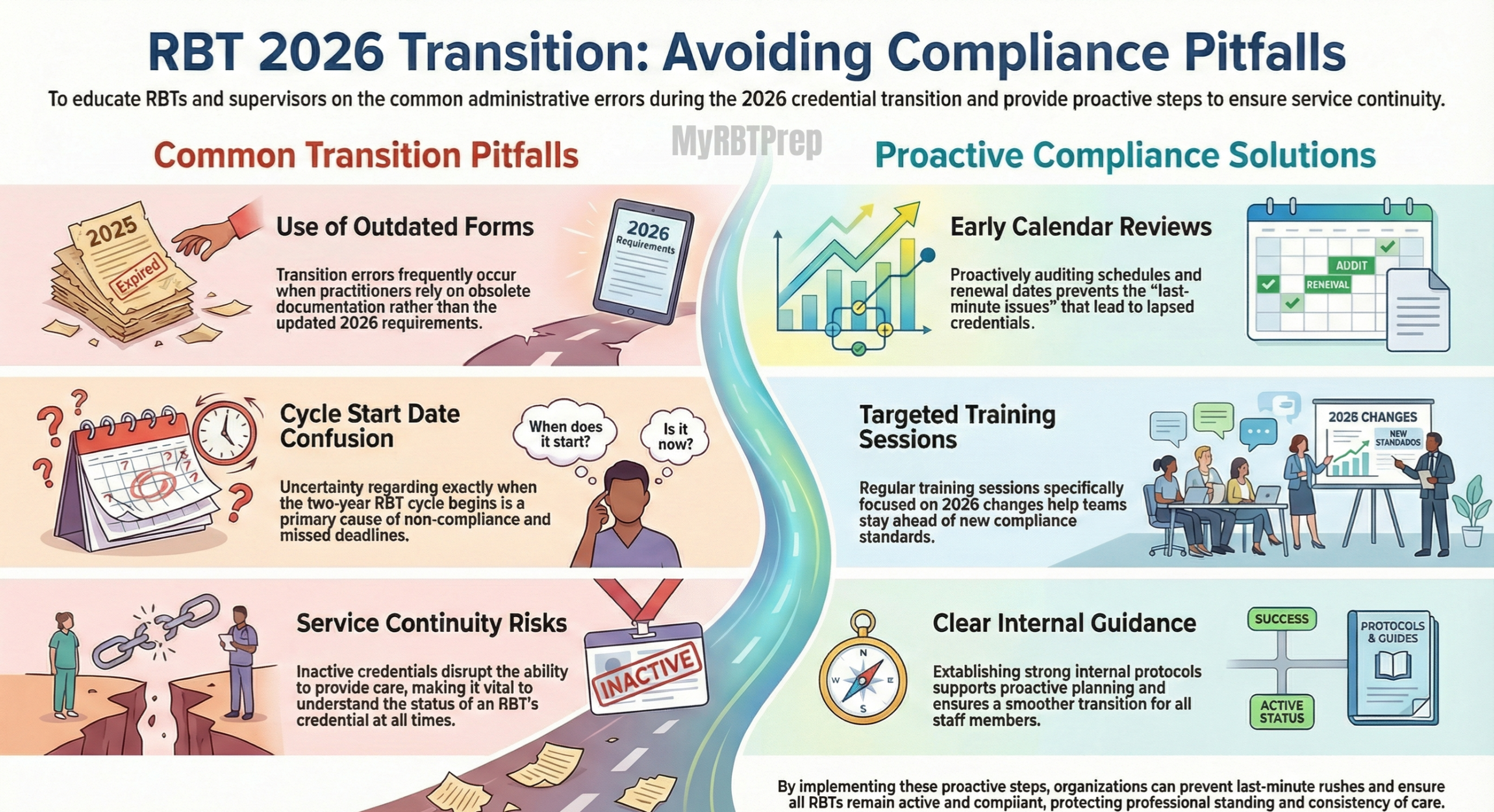
Transition errors often involve outdated forms or confusion about when does the two-year RBT cycle start. Early calendar reviews and training sessions prevent last-minute issues.
Another risk involves inactive credentials. Understanding what happens if an RBT becomes inactive protects service continuity. Clear internal guidance supports proactive compliance planning and smooth transitions.
Timeline for RBT Recertification Changes (2025–2026)
Timing plays a major role. RBTs renewing in 2026 still follow old rules. Their next renewal occurs in 2028 under the PDU system. New RBTs certified in 2026 begin PDUs immediately.
Accurate RBT credential tracking prevents missed deadlines. Quarterly reviews help BCBAs stay ahead of compliance demands.
| Year | Requirement |
| 2025 | Annual assessment |
| 2026 | Final assessment year |
| 2028 | First PDU-based renewal |
What This Means for ABA Practices & Organizations

Organizations gain flexibility but assume responsibility. Training plans must now address measurement, assessment, acquisition strategy, and documentation through PDUs.
Strong ABA compliance documentation supports audits and growth. Clinics that build structured learning systems protect quality and reduce turnover. A clear BCBA compliance checklist strengthens leadership confidence.
Task List 3.0
Data Collection and Graphing
Data collection and graphing involve observing behavior carefully and recording it accurately. RBTs use methods like frequency, duration, latency, and interval recording to capture behavior trends. Graphing helps visualize progress over time, identify patterns, and make data-driven decisions. Accurate data is essential because treatment planning and supervision rely on it. Without proper measurement, decisions become guesswork, so this skill forms the foundation of effective ABA practice.
Behavior Assessment
Behavior assessment focuses on understanding the function and context of behavior rather than labeling it. RBTs assist BCBAs by preparing materials, collecting baseline data, and supporting preference or functional behavior assessments under supervision. This ensures that assessment results are precise, meaningful, and respectful to the client. Proper assessment provides the roadmap for designing effective intervention and acquisition plans.
Behavior Acquisition
Behavior acquisition emphasizes teaching new, meaningful skills that improve daily living. RBTs implement strategies such as prompting, shaping, chaining, and reinforcement as written in treatment plans. These skills may include communication, social, academic, or self-help abilities. Consistent and patient teaching ensures learners acquire these skills effectively, turning small steps into long-term progress. Proper acquisition strategies strengthen independence and overall client development.
Behavior Reduction
Behavior reduction focuses on decreasing challenging behaviors safely and ethically. RBTs follow behavior intervention plans that emphasize prevention, teaching alternative skills, and using reinforcement instead of punitive methods. Every intervention prioritizes client safety, dignity, and respect. The goal is to achieve meaningful behavior change while minimizing risk and supporting a positive learning environment.
Documentation and Reporting
Documentation and reporting involve writing clear, objective session notes, recording data, and reporting incidents accurately. Proper documentation supports treatment decisions, protects client rights, and ensures ABA services are audit-ready. Attention to detail is crucial because incomplete or inaccurate records can impact client care. Timely, precise documentation is central to compliance and professional accountability.
Ethics
Ethics guide professional behavior in all aspects of ABA work. RBTs maintain confidentiality, follow supervision rules, respect boundaries, and report concerns appropriately. Adhering to the BACB Ethics Code safeguards clients, strengthens trust with families, and protects the technician’s professional credential. Ethical practice underpins every interaction and decision in ABA services.
| Task List 3.0 Domain | Description | Key Skills / Examples |
|---|---|---|
| Data Collection and Graphing | Observing and recording behavior accurately using methods like frequency, duration, latency, and interval. Graphing visualizes trends for data-driven decisions. | Frequency counts, duration recording, latency measurement, interval recording, graphing progress |
| Behavior Assessment | Understanding behavior’s function and context. Assisting BCBAs with baseline data, preference assessments, and functional behavior assessments. | Baseline data collection, preference assessments, FBA support, observation notes |
| Behavior Acquisition | Teaching new, meaningful skills to improve daily living. Using strategies like prompting, shaping, chaining, and reinforcement. | Communication skills, social skills, self-help skills, academic skills, implementing reinforcement procedures |
| Behavior Reduction | Reducing challenging behaviors safely and ethically. Emphasizing prevention, teaching alternatives, and reinforcement rather than punishment. | Implementing BIPs, teaching replacement behaviors, ensuring client safety, monitoring outcomes |
| Documentation and Reporting | Writing clear, objective session notes, recording data, and reporting incidents accurately. Ensuring audit-ready and compliant documentation. | Session notes, data charts, incident reports, supervision logs, audit preparation |
| Ethics | Maintaining professional integrity through confidentiality, supervision adherence, boundaries, and reporting concerns. Following BACB Ethics Code. | Confidentiality, ethical decision-making, professional boundaries, reporting concerns, client trust |
Common BCBA Questions About RBT Recertification 2026

Many supervisory personnel inquire about the number of PDUs that need to be earned for recertification of Registered Behavior Technicians. The threshold continues to be a minimum of twelve (12) PDUs over two (2) year cycles. A typical inquiry of the supervisor is to ask what is counted as a PDU for RBTs. Any activity that contributes to service proficiency (Skill Sharpening) and is related to the content of Task List 3 (i.e., the PDU Requirement) is eligible to earn a credit (PDU) for RBT Recertification.
Another common question posed to the supervisor is whether competency assessments for RBT recertification must continue after 2026. The answer is no since the requirement was eliminated after 2026. There is also much inquiry regarding how BCBAs document PDUs earned by RBTs and how long BCBAs must maintain records of RBT credentialing. The answer is (7) seven years. Understanding BACB audits regarding RBTs prevents potential loss of credentials and primary commitments to quality service.
“Documentation isn’t busywork; it’s your only protection.”
FAQs
What are the new RBT requirements for 2026?
RBTs follow a two-year renewal cycle and complete 12 PDUs aligned with the updated task list instead of annual assessments.
What is on the RBT exam in 2025?
The 2025 exam reflects the transition period and still tests core ABA skills, ethics, and applied behavior principles.
When did the RBT task list change?
The latest task list update was released by the BACB to align with the 2026 certification and recertification changes.
What is the highest paid RBT?
Pay varies by state and setting, but experienced RBTs in high-demand regions can earn higher hourly rates with supervision.
Is RBT in high demand?
Yes, demand remains strong due to growing ABA services and increased need for trained behavior technicians.

Everything You Need to Pass Your RBT® Exam
Study with our complete, all-in-one preparation package covering every task on the BACB Task List 3.0:
- 1,000+ Practice Questions & Timed Simulator
- 3rd Edition Task List Study Guide & Workbook
- Active Recall Flashcards System + Mobile App
- 20-Task Competency Assessment Mastery Guide


