Reinforcement is the cornerstone of Applied Behavior Analysis (ABA) therapy, serving as the fundamental principle through which behavior change is achieved and sustained. For Registered Behavior Technicians (RBTs), a profound understanding and skillful application of reinforcement strategies are paramount to fostering meaningful progress in their clients. This article will delve into the core concepts of reinforcement, differentiate its various types, and provide practical, real-world examples specifically tailored to the daily responsibilities of an RBT, ensuring effective and ethical implementation of these powerful tools.
The Foundation of Behavior Change: Understanding Reinforcement
Pass Your RBT® Exam on the First Attempt
Practice with 1,000+ realistic scenario questions, multiple full-length timed mock exams, and detailed rationales formatted exactly like the real Pearson VUE test.
At its essence, reinforcement is any consequence that follows a behavior and increases the future probability of that behavior occurring under similar conditions. It is crucial to distinguish reinforcement from a mere “reward.” While a reward might be pleasant, it does not necessarily guarantee an increase in the preceding behavior. Reinforcement, by definition, strengthens behavior.
There are two primary types of reinforcement:
Positive Reinforcement
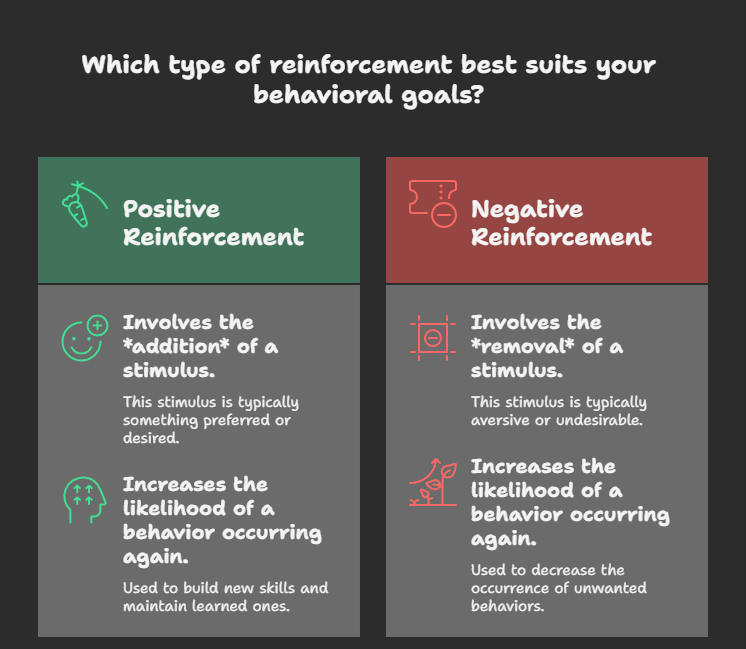
Positive reinforcement involves the addition of a stimulus following a behavior, which then increases the likelihood of that behavior happening again. This stimulus is typically something preferred or desired by the individual. RBTs frequently utilize positive reinforcement to build new skills, increase desired behaviors, and maintain previously learned skills.
Negative Reinforcement
Negative reinforcement involves the removal of an aversive or undesirable stimulus following a behavior, which also increases the likelihood of that behavior happening again. It’s essential to clarify that “negative” in this context refers to the subtraction or removal of something, not something “bad.” A common misconception is to confuse negative reinforcement with punishment; however, both positive and negative reinforcement serve to increase behavior.
Implementing Reinforcement: Practical RBT Examples
Effective reinforcement relies heavily on personalization, immediacy, and consistency. RBTs play a critical role in identifying client preferences, delivering reinforcers immediately and contingently, and maintaining consistency across sessions.
Positive Reinforcement in Action for RBTs
Positive reinforcers can take many forms, including tangible items, social praise, preferred activities, or edible treats. The choice of reinforcer is always client-specific and determined through preference assessments.
Tangible Reinforcement
Tangible reinforcers are physical objects that a client finds motivating.

RBT® Exam Flashcards & Study App (3rd Edition)
Master essential ABA terminology and clinical discrimination across all 6 BACB task list areas with 500+ printable and digital flashcards, real exam cues, and full mobile app access.

RBT Example: A client is learning to follow a two-step instruction. The RBT presents the instruction, “Touch head, then clap hands.” When the client successfully completes both steps, the RBT immediately presents a small preferred toy car, saying, “Nice job following those directions! Here’s your car.” The RBT ensures the client has brief access to the car before gently prompting them for the next trial. This immediate and contingent delivery increases the likelihood of the client following two-step instructions in the future.
Social Reinforcement
Social reinforcement involves positive attention or praise from another person, which can be highly motivating.
RBT Example: During a session focused on independent play, the RBT observes the client engaging with a puzzle for 30 seconds without prompting. The RBT approaches the client with a warm smile and says, “Wow, you are doing such a great job with that puzzle! Look how many pieces you put together all by yourself!” The RBT ensures the praise is specific to the behavior observed, making it more impactful than generic praise. This encourages the client to engage in independent play for longer durations.
Activity-Based Reinforcement
Activity reinforcers involve access to a preferred activity following a target behavior.
RBT Example: A client has difficulty completing academic tasks. The RBT implements a token economy system where the client earns a token for every math problem completed. After earning five tokens, the client can exchange them for 5 minutes of screen time on a tablet. Once the client completes the fifth problem, the RBT immediately gives the last token and says, “You earned all your tokens! Now you can have 5 minutes of tablet time.” This allows the client to access a highly preferred activity contingent upon task completion, making them more likely to complete academic tasks in the future.
Edible Reinforcement
Edible reinforcers are consumable items that a client enjoys. These are often used for clients with limited preferences or during initial skill acquisition, carefully considered for health and ethical implications.
RBT Example: An RBT is teaching a client to imitate novel motor actions, such as “clap hands.” After the RBT models the action and the client accurately imitates it, the RBT immediately provides a small piece of a preferred cracker, saying “Great clapping!” The edible is given quickly to establish a strong connection between the imitation and the reinforcing consequence.
Negative Reinforcement in Action for RBTs
Negative reinforcement is often misunderstood but is a powerful tool when applied correctly and ethically. It involves the removal of an aversive stimulus to increase a desired behavior.
RBT Example: A client often engages in crying and protesting when presented with non-preferred academic tasks. The RBT’s goal is to increase task initiation. The RBT defines task initiation as sitting at the table and picking up the pencil within 5 seconds of the instruction. If the client initiates the task within the timeframe, the RBT immediately announces, “Great job starting your work! We’ll take a 30-second break before the next problem.” By removing the demand (even briefly) contingent on task initiation, the client is reinforced for starting the task, making them more likely to initiate future non-preferred tasks. The break serves as the removal of the aversive (the task demand).
RBT Example 2: A client frequently engages in head-hitting when exposed to loud, unexpected noises in the environment. The RBT has been working on teaching the client to request “quiet place” when noises occur. When a loud noise happens, and the client immediately says “quiet place” instead of hitting their head, the RBT promptly guides the client to a pre-designated quiet space (e.g., a beanbag chair in a corner with noise-canceling headphones). The removal of the aversive noise is contingent on the functional communication response, increasing the likelihood of the client requesting “quiet place” in similar situations.
Precision Tool: Differential Reinforcement Strategies for RBT Implementation
Differential reinforcement is a sophisticated application of reinforcement principles used to decrease challenging behaviors while simultaneously increasing more appropriate, replacement behaviors. It involves reinforcing specific behaviors and withholding reinforcement for others.
Differential Reinforcement of Incompatible Behavior (DRI)
DRI involves reinforcing a behavior that cannot physically occur at the same time as the challenging behavior.
RBT Example: A client frequently engages in elopement (running away) during group activities. The RBT determines that sitting in their chair is a behavior incompatible with elopement. During a group circle time, every 2 minutes the client remains seated, the RBT provides a small token and verbal praise, “You’re doing a fantastic job staying in your seat!” If the client attempts to elope, no token or praise is given. By reinforcing sitting, an incompatible behavior, the RBT effectively reduces elopement.
Differential Reinforcement of Alternative Behavior (DRA)
DRA reinforces an alternative, appropriate behavior that serves the same function as the challenging behavior. This alternative behavior is not necessarily incompatible but is a desired replacement.
RBT Example: A client often screams to gain attention from the RBT. The RBT determines that raising a hand is an alternative, appropriate way to gain attention. During free play, if the client raises their hand, the RBT immediately walks over and gives attention (e.g., “Oh, you raised your hand! What do you need?”). If the client screams, the RBT ignores the screaming (as safely and ethically appropriate) and only provides attention when the hand-raising occurs. This reinforces raising a hand as an alternative to screaming for attention.
Differential Reinforcement of Other Behavior (DRO)
DRO involves reinforcing the absence of a target challenging behavior for a specified period, regardless of what other (appropriate) behaviors the client is engaging in.
RBT Example: A client has a history of disruptive vocalizations (e.g., loud, non-contextual noises). The RBT sets a timer for 5 minutes. If the client does not engage in any disruptive vocalizations during that entire 5-minute interval, the RBT delivers a preferred edible reinforcer and social praise, “You were so quiet for 5 whole minutes! Awesome work!” If a vocalization occurs within the interval, the timer is reset. This strategy aims to reduce the disruptive vocalizations by reinforcing their non-occurrence.
Critical Implementation Variables: Ensuring Reinforcement Effectiveness
For reinforcement to be maximally effective, RBTs must attend to several key variables:
Personalization
Reinforcers must be individualized and meaningful to the client. What motivates one client may not motivate another. RBTs should assist in conducting preference assessments (e.g., asking, observing, offering choices) to identify highly motivating items or activities, and these preferences should be regularly reassessed as they can change over time. Using varied reinforcers also prevents satiation.
Immediacy and Contiguity
The reinforcer must be delivered as soon as possible after the target behavior occurs. This close temporal proximity, known as contiguity, helps the client understand which specific behavior led to the reinforcement, strengthening the behavior-consequence association. Delayed reinforcement can weaken this association and be less effective.
Managing Access
To maintain the reinforcing power of an item or activity, RBTs should manage the client’s access to it outside of planned reinforcement opportunities. If a client has unlimited access to a preferred item, its value as a reinforcer may diminish (satiation). Strategic deprivation ensures that the reinforcer remains motivating when used contingently.
Consistency
Reinforcement strategies must be applied consistently across RBTs and settings. Inconsistent application can lead to confusion for the client and hinder the acquisition of new skills or reduction of challenging behaviors. RBTs must adhere to the behavior intervention plan (BIP) and communicate with their supervising BCBA regarding any challenges or observations.
Fading and Promoting Independence: Transitioning Off Continuous Reinforcement
The ultimate goal of ABA therapy is to promote independence and generalization of skills. This often requires systematically reducing reliance on artificial or continuous reinforcement through a process called “fading.”
Schedule Thinning
Initially, new behaviors are often reinforced on a continuous schedule (every time the behavior occurs) to establish a strong connection. As the behavior becomes more stable, RBTs, under BCBA guidance, transition to intermittent schedules. This means the behavior is reinforced only some of the time (e.g., after every few responses, or after varying intervals of time).
RBT Example: A client initially receives a token for every correct response during discrete trial training (DTT). After the client consistently achieves 90% accuracy for several sessions, the RBT might begin a fixed ratio 2 (FR2) schedule, where the client receives a token after every two correct responses. Later, this might thin to FR3, then variable ratio (VR) schedules, and eventually, the RBT can transition to naturally occurring social praise or self-reinforcement. This thinning promotes response durability and reduces dependency on constant external rewards.
Stimulus Fading
Stimulus fading involves gradually changing the stimulus (e.g., prompt, object proximity) that cues a behavior.
RBT Example: An RBT is teaching a client to mand for a preferred snack that is typically kept on a high shelf. Initially, the RBT holds the snack directly in front of the client to prompt a verbal request (“snack”). As the client consistently mands, the RBT might then hold the snack slightly further away, then place it on a nearby table, then on the original high shelf. The RBT continues to reinforce the mand at each step, gradually fading the proximity of the stimulus until the client mands for the snack from its usual location without direct prompting. This promotes generalization of the manding skill.
Natural Reinforcement
The ultimate aim is to shift from programmed reinforcement to natural reinforcement, where the behavior itself produces a desirable outcome.
RBT Example: An RBT teaches a client to initiate social greetings (“Hi”) to peers. Initially, the RBT might deliver a preferred token immediately after the client says “Hi” to a peer. As the client becomes more proficient, the RBT fades the token. The natural reinforcement of a peer responding with “Hi” or engaging in further interaction becomes the maintaining consequence for the greeting behavior.
Ethical Considerations for RBTs in Reinforcement Application
Ethical practice is paramount in ABA. RBTs must always ensure that reinforcement is applied in a manner that upholds the client’s dignity and promotes their well-being.
- Avoid Reinforcing Problem Behavior: RBTs must be vigilant not to inadvertently reinforce challenging behaviors. For example, giving attention to a mild tantrum can inadvertently increase the likelihood of future tantrums if attention is a reinforcer for the client.
- Developmentally Appropriate and Dignified Reinforcers: The chosen reinforcers must be age-appropriate, culturally sensitive, and respectful of the client’s dignity. Using cartoon stickers for an adolescent, for instance, might be less appropriate than access to a preferred activity or social praise.
- Least Restrictive and Most Natural: Whenever possible, RBTs should prioritize natural and least restrictive reinforcers (e.g., social praise, access to preferred activities) over more artificial or intrusive ones (e.g., edibles).
- Client Assent and Choice: RBTs should respect client preferences and assent, giving clients opportunities to choose their reinforcers whenever possible, thereby empowering them in their own learning process.
Sustaining Behavioral Gains Through Ongoing Data Review
RBTs collect important data that directly shapes how effective reinforcement practices are continuing. Through consistent and accurate collection of data regarding target behaviors and reinforcer effectiveness, RBTs provide important information for the supervising BCBA to use when determining whether or not to modify reinforcement schedules, develop new reinforcers in the case reinforcement sated, and/or alter the behavior intervention plan to ensure that the individual is making continuous progress toward desired outcomes.
The consistent, effective application of reinforcement strategies by RBTs, through the use of well-researched assessment protocols and sound ethical judgment, is what makes ABA so successful as a means of modifying behavior and creating lasting, positive change in individuals at all stages of development across many different environments.
Frequently Asked Questions (FAQs)
Q: What is the key difference between positive and negative reinforcement in ABA?
A: Positive reinforcement adds a desired consequence to increase behavior, while negative reinforcement removes an aversive consequence to increase behavior.
Q: How does an RBT practically use Differential Reinforcement (DR)?
A: DR involves selecting one specific behavior to reinforce (like using a functional communication phrase) while withholding reinforcement for the challenging behavior.
Q: Why is immediacy critical when delivering reinforcement as an RBT?
A: Immediate delivery strengthens the connection between the target behavior and the consequence, ensuring the client learns exactly what action was effective.
Q: When moving away from continuous reinforcement, what is schedule thinning?
A: Schedule thinning is the systematic transition from reinforcing every correct response to reinforcing responses only intermittently to build durability.
Q: Are “rewards” and “reinforcers” the same thing in ABA practice?
A: No; reinforcement must increase the future likelihood of the behavior, whereas a reward may not influence future responding.

Everything You Need to Pass Your RBT® Exam
Study with our complete, all-in-one preparation package covering every task on the BACB Task List 3.0:
- 1,000+ Practice Questions & Timed Simulator
- 3rd Edition Task List Study Guide & Workbook
- Active Recall Flashcards System + Mobile App
- 20-Task Competency Assessment Mastery Guide