
Fully Aligned with the Official RBT Test Content Outline 3rd Edition (Effective 2026) ·
This free RBT exam practice test is the most complete preparation resource available for the 2026 BACB certification exam, with scenario-based questions, timed full-length simulations, and detailed answer explanations covering all six 3rd Edition domains.
Candidates searching for an RBT practice test, RBT mock exam, RBT practice questions, or a free RBT exam simulation will find everything they need on this single page. Each RBT practice exam question is written directly from the official RBT Test Content Outline 3rd Edition, the same BACB blueprint used to build the real Pearson VUE exam. Taking a full RBT practice test before your exam date is the highest-leverage study strategy available because it shows you exactly which domains are losing you points and builds the applied clinical reasoning the BACB exam rewards.
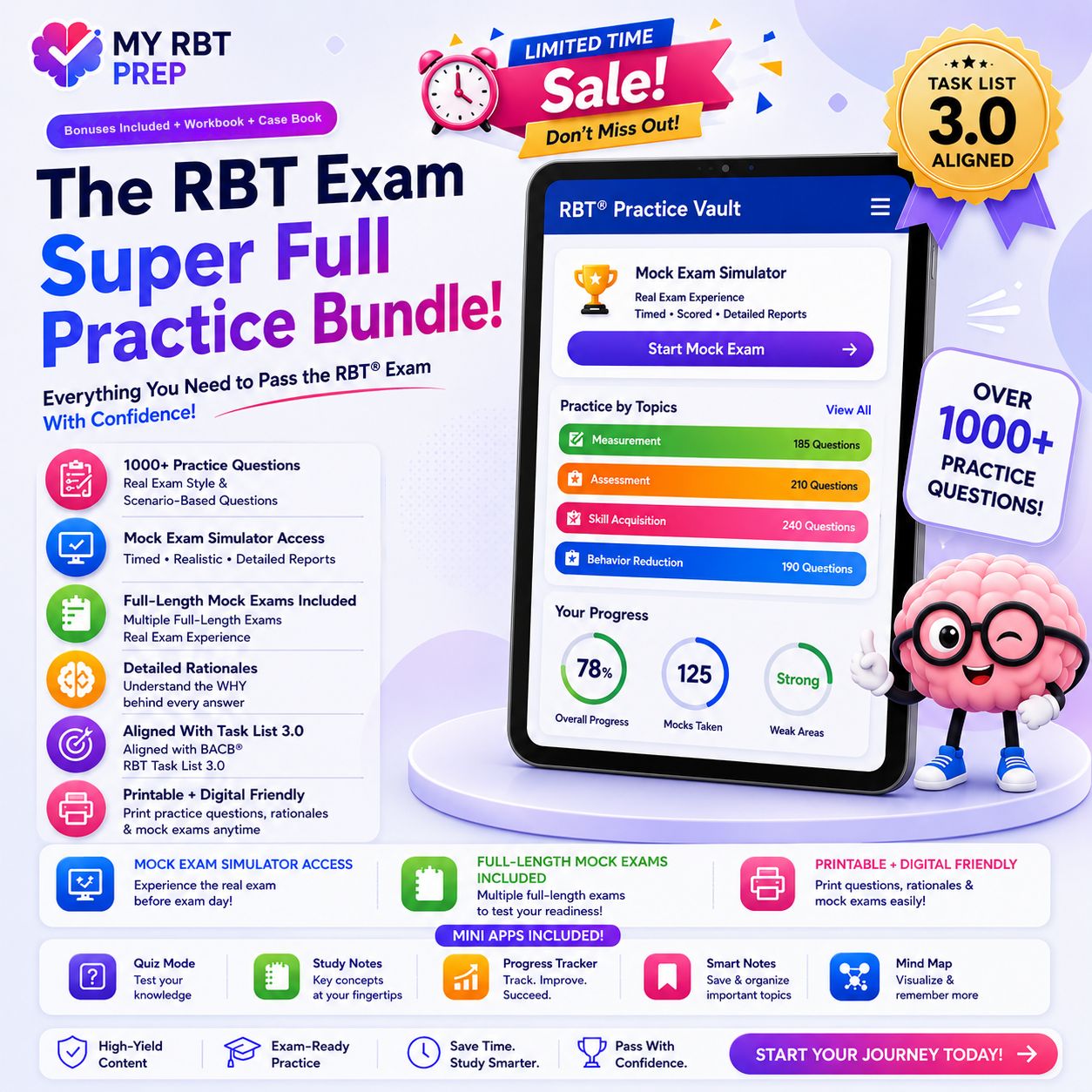
Pass Your RBT® Exam on the First Attempt
Practice with 1,000+ realistic scenario questions, multiple full-length timed mock exams, and detailed rationales formatted exactly like the real Pearson VUE test.
This page includes free RBT practice exams ranging from 5 questions to a complete 85-question timed RBT mock exam, 15 sample RBT exam questions with step-by-step rationales, the full official domain and task code breakdown, domain-specific RBT practice quizzes, and a proven study strategy for passing the RBT certification exam on the first attempt. Start the free RBT practice test above or select a full-length exam from the list below.
The Registered Behavior Technician (RBT) credential is a paraprofessional certification administered by the Behavior Analyst Certification Board (BACB). It verifies that an individual is qualified to directly implement Applied Behavior Analysis (ABA) services under the close, ongoing supervision of a Board Certified Behavior Analyst (BCBA) or Board Certified Assistant Behavior Analyst (BCaBA).
[hurrytimer id=”2295″]

RBT Exam Practice
Welcome to Your Practice Exam
Select the number of questions you'd like to attempt:
Quiz Complete!
Short free quizzes only scratch the surface. Passing the actual 85-question Pearson test requires building your pacing and stamina with full practice.
- Only 6 sample questions
- No timed exam simulator
- No detailed rationales
- Cannot test full pacing
- Multiple Full Mocks (85Q)
- 1,000+ realistic scenario questions
- Step-by-step rationales
- Full app access + printable PDFs
You've completed 5 questions. You have 1 final sample question before the free preview ends.
- 🎯Multiple Full-Length Timed Mocks — exactly like the real Pearson VUE exam
- 📋1,000+ Practice Questions — covering all 2026 BACB Task List 3.0 tasks
- 🧠Detailed Rationales — learn why right answers work and avoid traps
- 📱Exam Simulator App Access — practice anytime on your phone or laptop
You've completed your 6 free sample questions. The real test is 85 questions long with tricky scenarios. Get full practice now so nothing surprises you on test day.
- Multiple Full-Length Timed Mocks — practice with real 85-question exams timed like Pearson VUE
- 1,000+ Scenario Questions — master real clinical situations across all 6 BACB domains
- Crystal-Clear Explanations — understand exactly why each answer is right and how to avoid trick choices
- Full Simulator App + Printable PDFs — practice on your phone in bed or print worksheets
- Complete Exam Prep Materials — build your pacing, endurance, and exam readiness on your schedule
Most candidates who fail admit they only practiced short free quizzes. Give yourself the best chance to pass on your very first try.
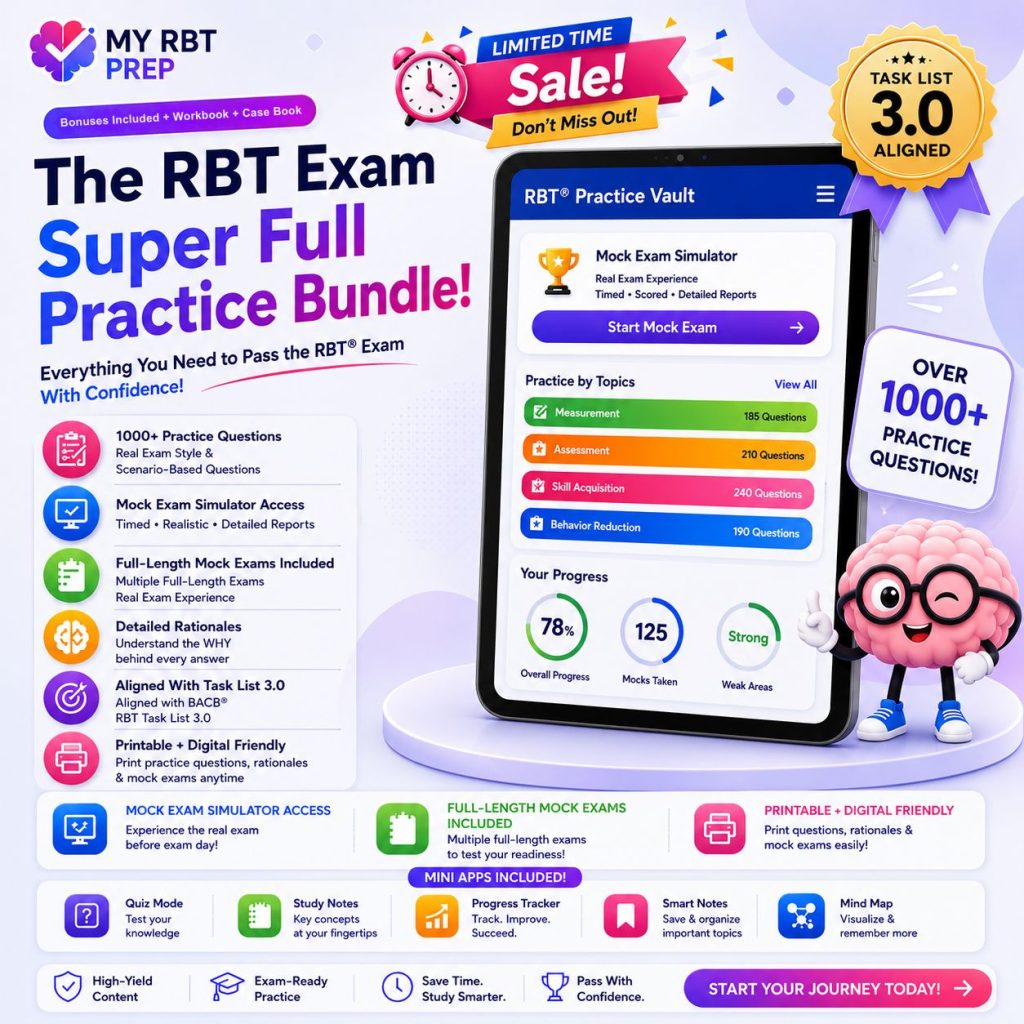

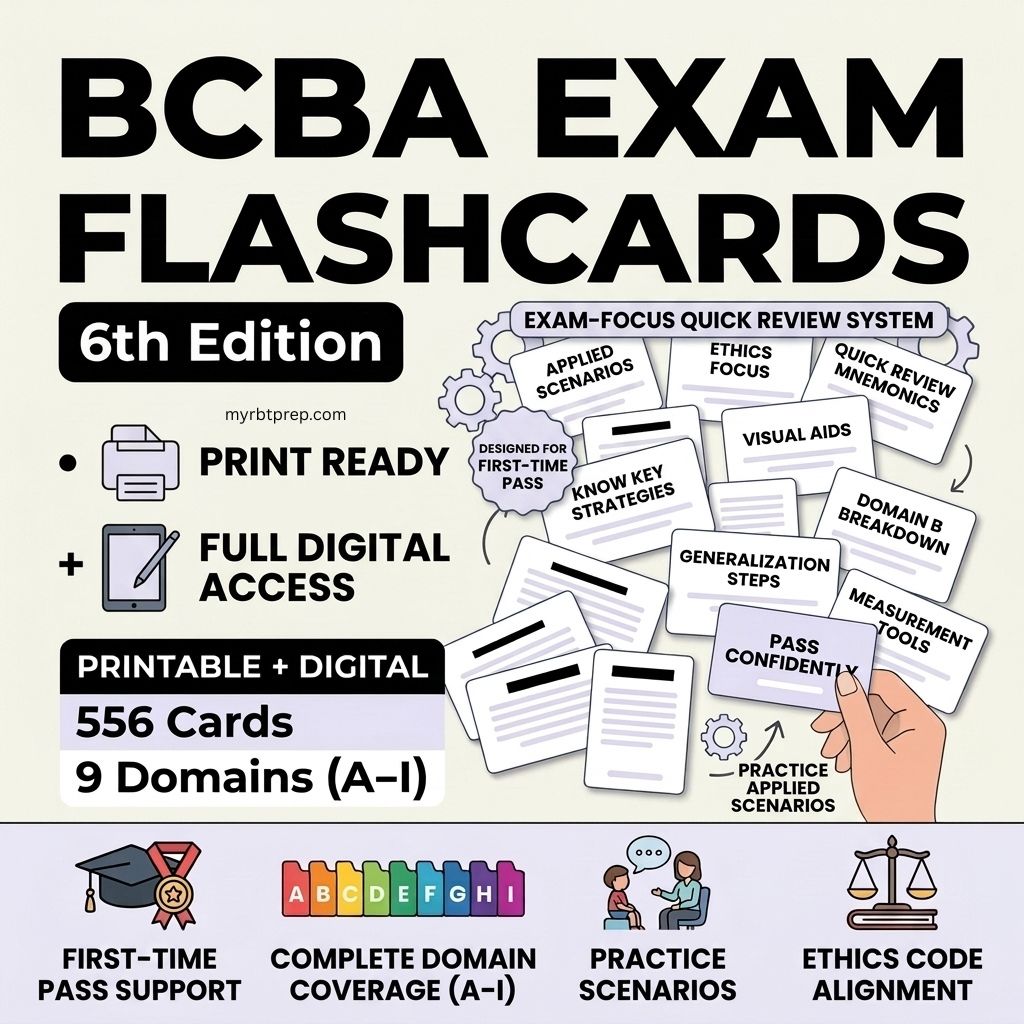
RBT® Exam Flashcards & Study App (3rd Edition)
Master essential ABA terminology and clinical discrimination across all 6 BACB task list areas with 500+ printable and digital flashcards, real exam cues, and full mobile app access.
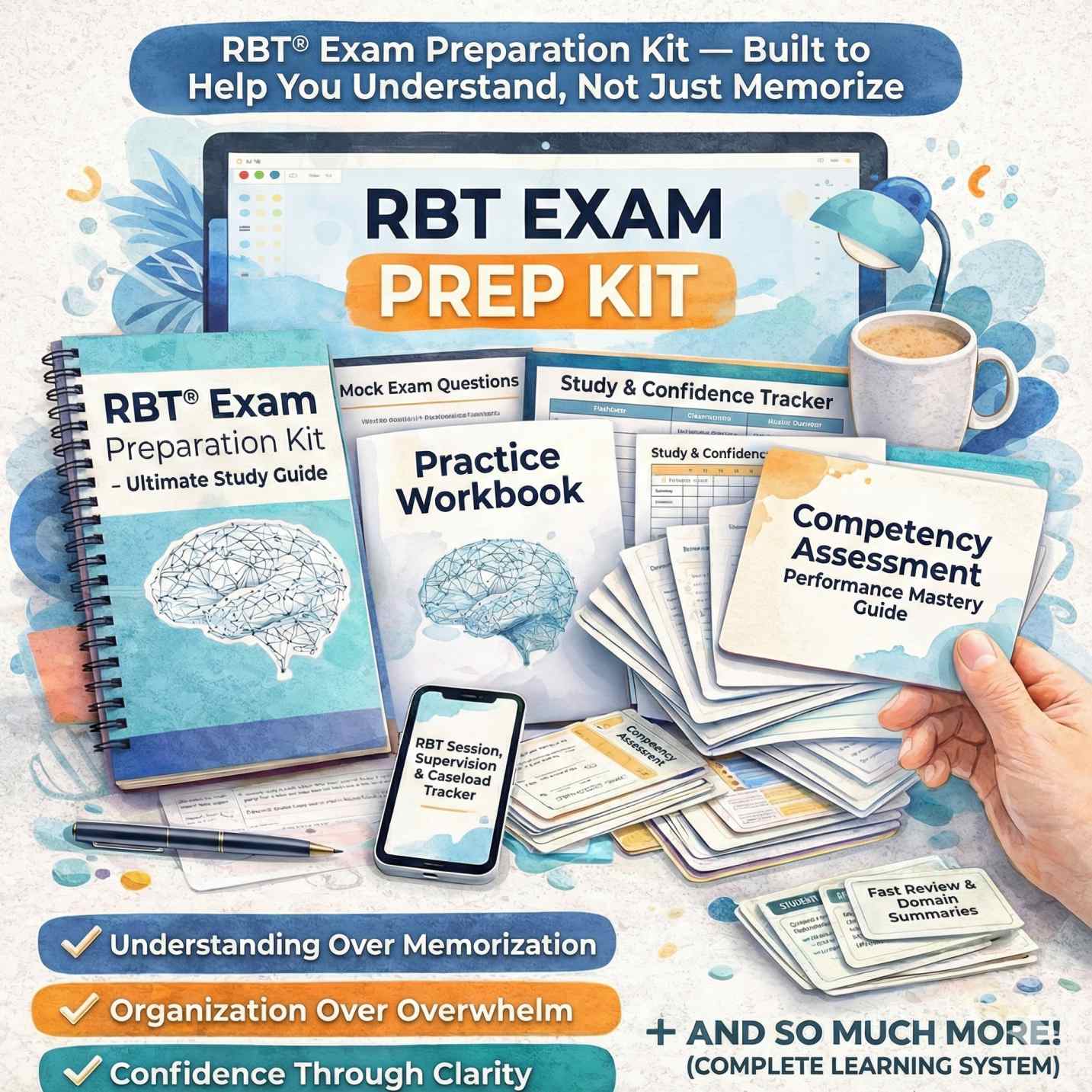


RBTs work across clinics, schools, homes, and community settings — primarily supporting individuals with autism spectrum disorder (ASD), developmental disabilities, and related behavioral needs. As demand for qualified ABA practitioners continues to grow, the RBT has become the most recognized entry-level credential in behavioral health.
What candidates must know for 2026: The BACB officially transitioned the RBT exam to the RBT Test Content Outline 3rd Edition, effective 2026. This update revised domain names, restructured task codes, rebalanced question distribution, and introduced new content — including a dedicated task on cultural humility. Candidates studying from materials based on the 2nd Edition will encounter different domain names and potentially misleading question weights. This page is built directly from the BACB’s official 3rd Edition source document.
Free vs Premium Comparison Table
This converts insanely well in exam niches.
| Feature | Free Practice | Full Prep Package |
|---|---|---|
| Full-length exams | ❌ | ✅ Multiple full exams covering all 6 domains |
| Timed real-exam simulation | ❌ | ✅ 90-minute realistic test mode + multiple modes |
| Score report | ❌ | ✅ Detailed performance analytics + weak areas |
| Detailed explanations | ❌ | ✅ Full step-by-step rationales |
| Pass-ready preparation | ❌ | ✅ Complete exam-level preparation |
💡 Most candidates who rely only on free questions struggle with timing and scenario complexity.
This is your complete, free preparation hub for the RBT certification exam. You will find free full-length RBT practice tests, 15 scenario-based sample questions with detailed explanations, the complete official 3rd Edition domain breakdown, and proven study strategies all on one page.
Start the Free Full RBT Practice Test Now
Table of Contents
- What Is the RBT Certification Exam?
- RBT Exam Overview: Format, Questions & Scoring
- Official RBT Test Content Outline (3rd Edition) — Full Domain Breakdown
- Free Full-Length RBT Practice Tests
- Sample RBT Practice Questions With Answers
- RBT Domains Explained — What to Study in Each
- How to Pass the RBT Exam: Study Strategy
- RBT Competency Assessment Overview
- Targeted Practice: Unit-Based Quizzes
- Study Guides by Domain
- Additional Study Tools
- Frequently Asked Questions
- Conclusion
What Is the RBT Certification Exam?

The exam rewards applied understanding. Scenario-based questions the dominant format — ask you to recognize how and when to use ABA procedures in real clinical situations, not merely recall definitions. That is why realistic practice using mock scenarios is the highest-leverage preparation strategy available.

RBT Exam Overview: Format, Questions & Scoring
| Exam Component | Details |
|---|---|
| Administering Body | Behavior Analyst Certification Board (BACB) |
| Testing Vendor | Pearson VUE — computer-based, in-person testing centers |
| Scored Questions | 75 (these count toward your final result) |
| Unscored Pilot Questions | 10 (randomly distributed; indistinguishable from scored items) |
| Total Questions on Screen | 85 |
| Time Limit | 90 minutes (~63 seconds per question) |
| Question Format | Multiple choice — four answer options per question |
| Passing Score | Scaled score of 200 (scale: 0–250) |
| Score Release | Preliminary pass/fail on screen; official result within days |
| Retake Limit | Up to 8 attempts within a 2-year eligibility window |
| Content Outline | RBT Test Content Outline 3rd Edition (effective 2026) |
| Total Domains / Tasks | 6 domains · 43 tasks |
⚡ On the 10 Pilot Questions: Pilot items are embedded randomly throughout the exam with no label. Because they are indistinguishable from scored questions, approach all 85 with equal effort. Attempting to identify and skip pilot questions is a losing strategy.
Official RBT Test Content Outline (3rd Edition) — Full Domain Breakdown 2026 Updated
The following information is drawn directly from the BACB’s RBT Test Content Outline 3rd Edition (updated September 2024). This document is the official blueprint that the BACB uses to construct your exam. Understanding the exact domain names, task codes, and question weights is the most important information for focused preparation.
⚠️ Many Study Materials Are Out of Date. Websites, flashcard decks, and YouTube channels still using terms like “Measurement,” “Skill Acquisition,” or “Professional Conduct & Scope of Practice” are referencing the 2nd Edition task list. These names no longer reflect the exam you will take in 2026. The correct 3rd Edition domain names are shown in the table below. Always verify that any resource you use reflects the current terminology.
Domain Name Changes: 2nd Edition vs. 3rd Edition
| Domain | ❌ Old (2nd Edition) | ✅ Current (3rd Edition — 2026) |
|---|---|---|
| A | Measurement | Data Collection and Graphing |
| B | Assessment | Behavior Assessment |
| C | Skill Acquisition | Behavior Acquisition |
| D | Behavior Reduction | Behavior Reduction (name unchanged) |
| E | Documentation & Reporting | Documentation and Reporting (name unchanged) |
| F | Professional Conduct & Scope of Practice | Ethics |
Official Question Distribution — 75 Scored Questions
| Domain | Content Area (3rd Edition Name) | # of Questions | % of Exam |
|---|---|---|---|
| A | Data Collection and Graphing | 13 | 17% |
| B | Behavior Assessment | 8 | 11% |
| C | Behavior Acquisition | 19 | 25% |
| D | Behavior Reduction | 14 | 19% |
| E | Documentation and Reporting | 10 | 13% |
| F | Ethics | 11 | 15% |
| Total | 75 | 100% |
Domain Weight — Where Your Points Come From
Complete Task List — All 43 Tasks
The BACB exam draws questions from these 43 specific tasks. Use this as your master checklist during preparation — every unchecked task is a potential point lost on exam day.
Domain A: Data Collection and Graphing — 13 Questions (17%)
- A.1 Implement continuous measurement procedures (e.g., frequency, duration, latency, interresponse time)
- A.2 Implement discontinuous measurement procedures (e.g., partial & whole interval, momentary time sampling)
- A.3 Implement permanent product recording procedures
- A.4 Enter data and update graphs
- A.5 Describe behavior and environment in observable and measurable terms
- A.6 Calculate and summarize data in different ways (e.g., rate, mean duration, percentage)
- A.7 Identify trends in graphed data
- A.8 Describe the risks associated with unreliable data collection and poor procedural fidelity
Domain B: Behavior Assessment — 8 Questions (11%)
- B.1 Conduct preference assessments (e.g., multiple stimulus, paired stimulus, free operant)
- B.2 Participate in assessments of relevant skill strengths and deficits (e.g., curriculum-based, developmental, social skills)
- B.3 Participate in components of functional assessment procedures (e.g., descriptive assessment, functional analysis)
Domain C: Behavior Acquisition — 19 Questions (25%) ⭐ Largest Domain
- C.1 Implement positive and negative reinforcement procedures (e.g., immediately, contingently, according to schedules of reinforcement) along a continuum of dimensions (e.g., magnitude, intensity, variety)
- C.2 Implement procedures to establish and use conditioned reinforcers
- C.3 Implement discrete-trial teaching procedures
- C.4 Implement naturalistic teaching procedures (e.g., incidental teaching, natural environment training)
- C.5 Implement task analyzed chaining procedures (e.g., forward, backward, total task)
- C.6 Implement discrimination training
- C.7 Implement procedures using stimulus and response prompts that include appropriate fading procedures (e.g., errorless, least-to-most, stimulus fading, time delay)
- C.8 Implement generalization procedures (e.g., conduct intervention procedures across settings, people, and stimuli)
- C.9 Distinguish between maintenance and acquisition procedures
- C.10 Implement shaping procedures
- C.11 Implement token economies
Domain D: Behavior Reduction — 14 Questions (19%)
- D.1 Identify common functions of behavior
- D.2 Implement antecedent interventions (e.g., NCR, high-probability request sequences, demand fading)
- D.3 Implement differential reinforcement procedures (e.g., DRO, DRA, DRI, DRL, FCT)
- D.4 Implement extinction procedures
- D.5 Implement positive and negative punishment procedures (e.g., time-out)
- D.6 Describe secondary effects of extinction (e.g., extinction burst, response variation, resurgence, emotional responding) and punishment (e.g., emotional responses, escape and avoidance)
- D.7 Implement crisis/emergency procedures
Domain E: Documentation and Reporting — 10 Questions (13%)
- E.1 Communicate concerns and suggestions from the intervention team (e.g., caregivers, teachers, service providers) with a supervisor in a timely manner
- E.2 Seek and prioritize clinical direction from a supervisor in a timely manner (e.g., training needs, data irregularities, following chain of command)
- E.3 Report/document variables that might affect client progress in a timely manner (e.g., illness, medication, schedule changes)
- E.4 Communicate objectively what occurred during the session in accordance with applicable legal, regulatory, and workplace requirements
Domain F: Ethics — 11 Questions (15%)
- F.1 Identify and apply core principles underlying the BACB’s ethics code for RBT certificants (e.g., benefit others; treat others with compassion, dignity, and respect; behave with integrity)
- F.2 Provide behavioral technician services only after demonstrating competence
- F.3 Provide services only under ongoing supervision from supervisors who meet BACB requirements
- F.4 Identify effective supervision practices (e.g., receive training that includes instructions, modeling, rehearsal, and feedback; observation of RBT service delivery)
- F.5 Identify and comply with requirements for collecting, using, storing, protecting, and disclosing confidential information
- F.6 Identify and comply with requirements for making public statements about professional activities (e.g., social media activity; misrepresentation of professional credentials, behavior analysis, and service outcomes)
- F.7 Identify types of and risks associated with multiple relationships, and how to mitigate those risks when they are unavoidable
- F.8 Adhere to the gift giving and receiving guidelines provided by the BACB’s ethics code for RBT certificants
- F.9 Identify and apply interpersonal and professional skills (e.g., accepting feedback, listening actively, seeking input, collaborating) when representing oneself as an RBT
- F.10 Engage in ongoing cultural humility and responsiveness (e.g., identify personal biases) in service delivery and professional relationships (new in 3rd Edition)
📌 Use This as Your Study Checklist: Print or save this task list and check off each task as you feel confident in it. Any unchecked task in the two weeks before your exam becomes a priority. Use the RBT practice tools to test yourself against specific task codes.
Free Full-Length RBT Practice Tests 3rd Edition Aligned
Simulating the actual exam experience — same question count, time limit, and format — is the most effective preparation strategy. All practice exams below are aligned with the 3rd Edition domain structure and use scenario-based questions that reflect the reasoning demands of the BACB exam.
How to use these exams effectively:
- Simulate real conditions: Set a 90-minute timer and work without interruptions or reference materials.
- Review every explanation: Read the answer explanation for every question — including ones you got right. Understanding why each wrong answer is wrong is as valuable as knowing the correct answer.
- Track domain-level scores: Identify which of the six domains cost you the most points, then use targeted quizzes and study guides to close those gaps.
- Space out retakes: Wait 3–5 days between attempts to allow genuine retention rather than short-term recall.
🎯 Free Full-Length RBT Practice Exams — All 3rd Edition Aligned
No account required. Start any exam below and begin identifying your knowledge gaps today.
- RBT Practice Exam 1 — Balanced domain coverage; ideal starting point and baseline assessment
- RBT Practice Exam 2 — Elevated scenario complexity; strong Behavior Reduction emphasis
- RBT Practice Exam 3 — Heavy Ethics and Documentation focus (Domains E & F)
- RBT Practice Exam 4 — Advanced Behavior Acquisition scenarios (Domain C spotlight)
- RBT Practice Exam 5 — Full-length final prep; closest to BACB exam difficulty level
- 75-Question Free RBT Practice Exam — Mirrors the exact scored question count of the real exam
- 85-Question Free RBT Practice Exam — Full simulation including all 85 questions (75 scored + 10 pilot count)
- RBT Mock Exam — Full Practice Questions — Mixed difficulty with detailed rationale explanations
- Scenario-Based RBT Exam Quiz — Applied reasoning format; ideal for Domains C and D
- Pearson VUE-Style RBT Practice Questions — Formatted to match the Pearson testing interface
Sample RBT Practice Questions With Answers & Explanations
The 15 questions below are original, scenario-based items that reflect the format and difficulty of the actual RBT exam. Each question is tagged to its 3rd Edition domain and task code. Work through each question before reading the explanation.
Domain A · A.1 · Data Collection and Graphing
1. An RBT measures the time elapsed from when a self-stimulatory hand-flapping behavior begins until it completely stops. Which type of continuous measurement procedure is being used?
- Frequency recording
- Duration recording
- Momentary time sampling
- Latency recording
Correct Answer: B — Duration recording
Duration recording captures how long a behavior lasts from its onset to its offset. It is the appropriate measurement procedure for continuous behaviors without clear discrete boundaries — such as prolonged stereotypy, on-task behavior, or tantrum duration. Frequency counts individual occurrences; latency measures the delay between a stimulus and the start of a behavior; momentary time sampling checks only at specific time points, not across the behavior’s full duration.
Domain A · A.2 · Data Collection and Graphing
2. An RBT divides a 30-minute observation into 10-second intervals. She records a behavior as present only if it occurs throughout the entire interval. Which method is this, and how does it bias data relative to true occurrence?
- Partial interval recording — tends to overestimate
- Momentary time sampling — produces accurate estimates
- Whole interval recording — tends to underestimate
- Whole interval recording — tends to overestimate
Correct Answer: C — Whole interval; tends to underestimate
Whole interval recording requires the behavior to be present for the full interval to be counted. A behavior occurring for 9 of 10 seconds would be scored as absent, systematically underestimating true occurrence. This conservative bias makes it best suited for behaviors targeted for increase (like on-task behavior). Partial interval recording — where a single occurrence at any point scores the interval as present — has the opposite bias, tending to overestimate.
Domain A · A.8 · Data Collection and Graphing
3. An RBT has been recording session data from memory at the end of the day rather than in real time. What is the primary clinical risk of this practice?
- It creates scheduling complications for the supervising BCBA
- It produces unreliable data that could lead to poor clinical decisions
- It is acceptable as long as the data reflects general session trends
- It slightly improves interobserver agreement (IOA) scores
Correct Answer: B — Unreliable data risks poor clinical decisions
Task A.8 requires candidates to understand the consequences of unreliable data collection. Memory-based recording introduces recall bias and inaccuracy. All clinical decisions — program advancement, BIP modification, trend identification — depend on the integrity of recorded data. Unreliable data can conceal problems, obscure genuine progress, and result in harmful clinical decisions. Real-time data collection is a core professional responsibility of every RBT.
Domain B · B.1 · Behavior Assessment
4. An RBT lays out all available items simultaneously. When the learner selects and approaches an item, that item is removed from the array and is not returned in subsequent presentations. This procedure describes:
- Paired stimulus (PS) preference assessment
- Free operant preference assessment
- Multiple stimulus with replacement (MSW)
- Multiple stimulus without replacement (MSWO)
Correct Answer: D — MSWO
MSWO presents all stimuli at once; chosen items are removed and not returned, creating a progressively smaller array that generates a preference hierarchy. Multiple stimulus with replacement (MSW) returns chosen items; paired stimulus presents two items at a time; free operant allows free access to items in a natural setting and records approach/interaction time. Knowing the mechanics of each preference assessment type is directly tested under B.1.
Domain C · C.3 · Behavior Acquisition
5. In a discrete trial teaching (DTT) session, the RBT delivers an instruction (SD), the learner responds correctly, and the RBT immediately delivers a preferred item. There is then a brief programmed pause before the next instruction. What is the term for this pause?
- Intertrial interval (ITI)
- Interresponse time (IRT)
- Latency period
- Response cost interval
Correct Answer: A — Intertrial interval (ITI)
The intertrial interval (ITI) is the programmed pause between the end of one trial’s consequence delivery and the presentation of the next SD. It allows the learner to process the reinforcer and transition to a state of readiness for the next trial. ITI length can be adjusted based on learner needs. This is distinct from interresponse time (IRT), which is a data measurement concept describing the time between the end of one response and the start of the next.
Domain C · C.5 · Behavior Acquisition
6. An RBT completes all steps of a 10-step toothbrushing task except the final step, which the learner performs independently. Once mastered, steps 9 and 10 are taught together, then 8–10, and so on. Which chaining method is being used?
- Forward chaining
- Total task presentation
- Backward chaining
- Graduated guidance
Correct Answer: C — Backward chaining
Backward chaining teaches the final step first, then progressively adds earlier steps as each is mastered. Because the learner completes the chain to its natural conclusion from the very first session, they experience immediate contact with the terminal reinforcer — which is a significant advantage. Forward chaining begins with the first step. Total task presentation has the learner attempt every step each session, with prompts provided throughout as needed.
Domain C · C.7 · Behavior Acquisition
7. An RBT is teaching picture identification. Initially, she places the target picture significantly closer to the learner than the distractor cards. Over sessions, she gradually moves the target to a standard position. This technique is called:
- Least-to-most prompting
- Stimulus fading using a positional prompt
- Progressive time delay
- Physical guidance fading
Correct Answer: B — Stimulus fading using a positional prompt
A positional prompt manipulates the physical placement of the target stimulus — placing it closer or more prominently than distractors — to increase the probability of correct responding. Fading gradually removes this support by returning the stimulus to a standard, non-prompted position. This is a form of stimulus fading, which modifies antecedent stimulus properties rather than directly prompting the learner’s response (as gestural, model, or physical prompts do).
Domain C · C.11 · Behavior Acquisition
8. A learner earns star stickers for completing work tasks and exchanges them for 5 minutes of preferred activity when 5 stars are accumulated. This is an example of which procedure?
- Differential reinforcement of alternative behavior (DRA)
- A token economy using conditioned reinforcers
- A fixed ratio reinforcement schedule
- Negative reinforcement contingency
Correct Answer: B — Token economy
A token economy delivers conditioned reinforcers (tokens — here, stickers) contingent on target behaviors. Tokens acquire reinforcing value through their association with backup reinforcers (preferred activity time). They allow reinforcement to be delivered immediately while delaying backup reinforcer access, which is practical in clinical settings. Token economies are listed explicitly in Task C.11 and are a frequent exam topic in Behavior Acquisition scenarios.
Domain D · D.1 · Behavior Reduction
9. ABC data shows that a learner’s throwing behavior occurs most often when difficult demands are presented and results in the task being removed. The most likely function of this behavior is:
- Access to tangibles
- Automatic/sensory reinforcement
- Escape from demands (negative reinforcement)
- Attention from adults (positive reinforcement)
Correct Answer: C — Escape from demands
The four common functions of behavior are attention, tangibles, escape/avoidance, and automatic reinforcement. Here, the antecedent is a difficult demand and the consequence is task removal — a negative reinforcer (removal of an aversive stimulus). The pattern of the behavior increasing when followed by task removal is the hallmark of an escape function. Identifying function (D.1) is the foundation for selecting appropriate, function-matched behavior intervention procedures.
Domain D · D.6 · Behavior Reduction
10. After beginning an extinction procedure for tantrum behavior, an RBT observes that tantrums increase in frequency and intensity before they begin to decrease. This phenomenon is called:
- Resurgence
- Behavioral contrast
- An extinction burst
- Response generalization
Correct Answer: C — Extinction burst
An extinction burst is a temporary increase in the frequency, duration, or intensity of a behavior immediately following the withdrawal of reinforcement. It is a predictable and well-documented secondary effect of extinction (D.6). RBTs must anticipate extinction bursts and continue implementing the procedure consistently — reinforcing the escalated behavior during an extinction burst would intermittently reinforce it and make it significantly more resistant to future extinction attempts.
Domain D · D.2 · Behavior Reduction
11. Before presenting a difficult academic task, the RBT delivers several easy, previously mastered tasks in rapid succession that the learner consistently completes. This is best described as:
- Noncontingent reinforcement (NCR)
- Demand fading
- High-probability (high-p) request sequence
- Differential reinforcement of other behavior (DRO)
Correct Answer: C — High-p request sequence
The high-probability (high-p) request sequence involves presenting several requests with a strong history of compliance (high-p tasks) immediately prior to a low-probability task (one the learner is likely to refuse or escape). This builds behavioral momentum — a state of increased compliance — that carries over to the more challenging demand. It is an antecedent-based intervention because it modifies conditions before the target behavior occurs, rather than responding after the fact.
Domain E · E.3 · Documentation and Reporting
12. Upon arriving for a session, a caregiver tells the RBT that the learner did not sleep well and started a new medication this morning. The most appropriate response is to:
- Continue as planned; medical concerns are the BCBA’s responsibility, not the RBT’s
- Cancel the session since the learner is not in optimal condition
- Document the information and report it to the supervising BCBA before or during the session
- Independently modify the session protocol to account for the learner’s state
Correct Answer: C — Document and report to the supervisor
Task E.3 requires RBTs to report and document variables that might affect client progress in a timely manner — including illness, medication changes, and sleep disruptions. Both sleep deprivation and a new medication can meaningfully alter a learner’s behavior, attention, and response to procedures. This information must reach the supervising BCBA promptly so they can determine whether session modifications are appropriate. The RBT does not independently modify clinical protocols (option D) — that decision belongs to the supervisor.
Domain E · E.4 · Documentation and Reporting
13. Which of the following session note entries best meets the standard of objective, measurable documentation?
- “The client was very aggressive and in a bad mood today.”
- “The client hit the RBT three times on the arm with an open hand and screamed for approximately 2 minutes.”
- “The client showed significant behavior issues that warrant supervisor review.”
- “The client appeared frustrated and acted out several times during the session.”
Correct Answer: B
Task E.4 requires RBTs to communicate objectively what occurred during a session. Option B is the only entry using observable, measurable language — specifying topography (hit on the arm, open hand), frequency (three times), and duration (approximately 2 minutes) without interpretation or subjective judgment. Options A, C, and D use evaluative language (“aggressive,” “bad mood,” “frustrated,” “acted out”) that cannot be operationally verified and does not meet professional documentation standards.
Domain F · F.8 · Ethics
14. At the end of the school year, a learner’s parent offers the RBT a $50 gift card as a thank-you. According to the BACB’s RBT Ethics Code, the RBT should:
- Accept the gift since it was offered voluntarily and not solicited
- Decline and consult with the supervising BCBA on how to handle the situation appropriately
- Accept only if the value is under $25
- Accept but keep it private to avoid creating an awkward situation with the family
Correct Answer: B — Decline and consult the supervisor
The BACB RBT Ethics Code (F.8) provides specific guidelines on gifts. Accepting gifts — even unsolicited ones — can compromise professional objectivity, create a sense of obligation, and introduce multiple relationship risks (F.7). The correct action is to decline respectfully and consult with the supervisor, who can address the family in a way that maintains the therapeutic relationship while adhering to ethics standards. There is no dollar threshold in the code that makes accepting appropriate — this is a common exam misconception.
Domain F · F.10 · Ethics — New 3rd Edition Task
15. An RBT is working with a family whose cultural background involves different norms around communication and physical boundaries than the RBT’s own upbringing. The RBT notices discomfort but recognizes the difference is cultural. According to the 3rd Edition RBT Task List, the most appropriate response is to:
- Maintain her personal comfort standards and ask the family to adapt to professional norms
- Ignore the discomfort entirely and comply with whatever the family requests
- Reflect on her own cultural assumptions, acknowledge potential biases, and work with the supervisor to navigate the situation in a culturally responsive way
- Request reassignment to avoid the cultural conflict
Correct Answer: C — Engage in cultural humility and consult the supervisor
Task F.10 is a new addition unique to the 3rd Edition, requiring RBTs to engage in ongoing cultural humility and responsiveness. This means actively identifying personal cultural biases, remaining open to learning from clients and families, and adapting professional conduct appropriately — while consulting supervisors when navigating complex situations. Cultural humility is not about one party conforming to the other; it is about reflective, responsive practice that serves the client’s best interests within a professional and ethical framework.
RBT Domains Explained — What to Study in Each
Here is a clinical and exam-focused breakdown of each domain — what it covers, what the exam tests, and which study resources will help most.
Domain A Data Collection and Graphing 13 questions · 17%
The 3rd Edition renamed this domain from “Measurement” to reflect the full scope of the RBT’s data responsibilities: not just recording behavior, but graphing, calculating summaries, identifying trends, and understanding what happens when data quality is compromised. You can expect questions on continuous measurement methods (frequency, duration, latency, interresponse time), discontinuous methods (partial interval, whole interval, momentary time sampling), permanent product recording, graph updating, calculating rate and percentage, identifying data trends, and the clinical risks of unreliable data collection and poor procedural fidelity.
Study with the Data Collection & Graphing Study Guide, Unit A Study Guide, and the Data Collection & Graphing Quiz.
Domain B Behavior Assessment 8 questions · 11%
Domain B is the smallest domain by question count but requires specific, accurate knowledge of assessment procedures. The three task codes cover: preference assessment methods (free operant, paired stimulus, MSWO/MSW), participating in skills assessments (curriculum-based, developmental, social skills), and assisting with functional behavior assessments (descriptive assessments and functional analyses). The key principle throughout: RBTs participate in and implement assessments; they do not design, interpret, or make clinical decisions based on assessment results independently.
Study with the Behavior Assessment Study Guide, Unit B Study Guide, and the Behavior Assessment Quiz.
Domain C Behavior Acquisition 19 questions · 25% ⭐ Largest Domain
With 19 questions and 11 task codes, Behavior Acquisition is the highest-weighted domain on the exam. The 3rd Edition renamed it from “Skill Acquisition” to reflect the broader scope of behavioral teaching procedures. You must know: positive and negative reinforcement across dimensions and schedules; conditioned reinforcer procedures; discrete trial teaching (DTT); naturalistic teaching (incidental teaching, NET); forward, backward, and total task chaining; discrimination training; stimulus and response prompting with appropriate fading (errorless, least-to-most, time delay, stimulus fading); generalization programming; the distinction between maintenance and acquisition procedures; shaping; and token economies. Questions in this domain are almost exclusively scenario-based — requiring you to identify the correct procedure or spot an implementation error in context.
Study with the Behavior Acquisition Study Guide, Unit C Study Guide, and the Behavior Acquisition Quiz.
Domain D Behavior Reduction 14 questions · 19%
Domain D tests your ability to implement behavior reduction procedures with accuracy and to recognize the principles behind them. The seven task codes cover: identifying the four common functions of behavior; antecedent-based interventions (NCR, high-p request sequences, demand fading); differential reinforcement procedures (DRO, DRA, DRI, DRL, FCT); extinction procedures; positive and negative punishment; the secondary effects of extinction (extinction burst, resurgence, response variation, emotional responding) and punishment; and crisis/emergency procedures. A consistent thread: RBTs implement BIPs exactly as written. They do not select, modify, or override procedures — but they must understand the procedures well enough to apply them with fidelity.
Study with the Behavior Reduction Study Guide, Unit D Study Guide, and the Behavior Reduction Quiz.
Domain E Documentation and Reporting 10 questions · 13%
Four task codes govern this domain, all oriented around timely, accurate professional communication. E.1 covers communicating team concerns to the supervisor; E.2 covers seeking and prioritizing clinical direction (following the chain of command); E.3 covers documenting variables that might affect client progress; and E.4 covers writing objective session notes that comply with legal and workplace requirements. Questions here often present a scenario and ask whether the RBT communicated appropriately, to whom, and how. Objective language is a recurring theme — RBTs must describe behavior in measurable, observable terms free of interpretation or subjective judgment.
Study with the Documentation & Reporting Study Guide, Unit E Study Guide, and the Documentation & Reporting Quiz.
Domain F Ethics 11 questions · 15%
Renamed from “Professional Conduct & Scope of Practice” in the 3rd Edition, Domain F now covers 10 task codes and represents 15% of the exam. Topics include: core BACB ethics principles (benefit others; treat others with compassion, dignity, and respect; behave with integrity); providing services only after demonstrating competence; BACB supervision requirements; effective supervision practices; confidentiality requirements; public statements and social media conduct; multiple relationships and how to mitigate risks; gift-giving guidelines; professional interpersonal skills; and the new Task F.10 on cultural humility and responsiveness. F.10 is unique to the 3rd Edition and tests whether candidates can recognize the need for self-reflection and cultural responsiveness in clinical practice.
Study with the Ethics Study Guide, Unit F Study Guide, and the Ethics Quiz — 2026.
How to Pass the RBT Exam: Study Strategy & Tips
Effective exam preparation is about quality and strategy, not just hours. Here is a practical, domain-weighted approach built around how the 3rd Edition exam is actually structured.
Step 1: Take a Baseline Exam Before You Study
Before opening any study guide, take a full-length baseline practice exam. Your raw domain scores reveal exactly where your gaps are, so your study plan targets the domains that will move your score the most — not just the areas you feel most curious about.
Step 2: Follow a Domain-Weighted Study Schedule
| Week | Focus Domains | Activities |
|---|---|---|
| Week 1 | Domain A (17%) + Domain B (11%) | Read Unit A and B study guides · Complete domain quizzes · Build flashcard decks for measurement terminology |
| Week 2 | Domain C (25%) — Behavior Acquisition | Read Unit C study guide · DTT, chaining, prompting deep-dive · Complete Behavior Acquisition Quiz · Take Practice Exam 2 |
| Week 3 | Domain D (19%) + Domain E (13%) | Read Unit D and E guides · Focus on extinction secondary effects and objective documentation · Take Practice Exam 3 |
| Week 4 | Domain F (15%) + Full Review | Read Ethics guide and BACB RBT Ethics Code · Complete Ethics Quiz · Take 2 full 85-question timed exams · Review all explanations |
Step 3: Active Recall Over Passive Review
Re-reading notes is one of the least effective study methods. Instead, use flashcards and the domain quizzes for active self-testing. For every question you review — right or wrong — ask: Why is this correct? Why is each wrong answer specifically wrong? That level of analysis is what the exam rewards.
Step 4: Practice Timed Simulations
The 85-question timed simulation should feel familiar before exam day, not novel. Regular timed practice builds the pacing instincts that allow you to work efficiently through scenario-heavy questions without running out of time.
Common Mistakes That Cost Candidates Points
- Studying from 2nd Edition materials: If your study resource uses “Measurement,” “Skill Acquisition,” or “Professional Conduct & Scope of Practice” as domain names, it is not aligned with the exam you will take. Verify that every resource you use reflects the 3rd Edition structure.
- Underweighting Domain C: Behavior Acquisition is 25% of the exam — one in four scored questions. It has 11 task codes and requires hands-on applied understanding, not just definitions.
- Treating Ethics as common sense: Domain F has 10 distinct task codes and includes nuanced scenario questions about confidentiality, social media, gifts, supervision, multiple relationships, and the new cultural humility requirement. Candidates who skip systematic study of this domain often regret it.
- Confusing reinforcement and punishment: All reinforcement increases behavior; all punishment decreases it. Positive = adding a stimulus; negative = removing one. These four combinations are foundational and recur throughout Domains C and D.
- Skipping answer explanations: The explanation is where learning happens. Read every one, every time — especially when you got the question right.
Test-Day Checklist
- Arrive at the Pearson VUE center at least 15 minutes early with valid photo ID
- Read every question completely before looking at the answer options
- Eliminate clearly wrong answers first, then evaluate what remains
- Flag uncertain questions and return to them after finishing the exam
- Spend no more than 90 seconds on any question during the first pass
- Trust your preparation — first instincts on uncertain questions tend to be more reliable than second-guessing
RBT Competency Assessment: Requirements & Overview
The written exam is one component of RBT certification. Before registering for the Pearson VUE exam, you must pass the RBT Initial Competency Assessment — a structured evaluation conducted by a qualified BCBA, BCaBA, or RBT Assessor that verifies you can implement ABA procedures in practice, not just describe them in writing.
Two-Part Structure
- Role-Play Assessment: The assessor uses scenarios to evaluate your ability to implement clinical procedures — DTT, preference assessments, prompting hierarchies, behavior intervention strategies — in a structured role-play format without an actual client.
- Direct Observation: The assessor observes you delivering services to an actual client, evaluating your implementation fidelity, data collection accuracy, client rapport, and professional conduct in a live session.
What the Assessment Covers
The competency assessment is organized around the same 43 task codes as the written exam. You must demonstrate competency in:
- Implementing and recording multiple types of behavioral measurement accurately
- Conducting preference assessments and recording results correctly
- Implementing DTT and naturalistic teaching procedures with fidelity
- Implementing behavior reduction procedures exactly as specified in the BIP
- Writing clear, objective session documentation
- Demonstrating professional conduct, appropriate communication, and respect for client dignity throughout
💡 Dual Preparation Benefit: The competency assessment and written exam test the same 43 task codes from the same 3rd Edition content outline. Preparing for one directly strengthens your performance on the other. The scenario-based practice quiz is particularly effective for building the applied clinical reasoning both assessments require.
Targeted Practice: Unit-Based Quizzes
After a baseline exam reveals your weak domains, targeted unit quizzes are the fastest way to close specific knowledge gaps. Each quiz below focuses on one content domain aligned with the 3rd Edition task list.
Behavior Acquisition QuizDTT, prompting & fading, chaining, reinforcement, token economies (Domain C — 25% of exam)
Behavior Assessment QuizPreference assessments, functional assessment participation, skills assessments (Domain B)
Data Collection & Graphing QuizContinuous & discontinuous measurement, graphing, trend identification (Domain A)
Behavior Reduction QuizExtinction, DRO/DRA/DRI/DRL/FCT, antecedent interventions, extinction secondary effects (Domain D)
Documentation & Reporting QuizObjective session notes, supervisor communication, documenting variables (Domain E)
Ethics Quiz — 2026 (3rd Edition)BACB Ethics Code, supervision, confidentiality, cultural humility F.10 (Domain F)
Study Guides by Domain
Structured study guides provide comprehensive coverage of every 3rd Edition task code with ABA terminology, clinical examples, and exam-focused explanations. Use these alongside practice questions for maximum retention.
Master RBT Study Guide
The comprehensive RBT Study Guide is the ideal starting point, covering all six domains with definitions, clinical examples, and study strategies.
Domain-Specific Study Guides
| Domain (3rd Edition Name) | Study Guide | Key Topics |
|---|---|---|
| A — Data Collection and Graphing | Data Collection & Graphing Guide | Measurement systems, graphing standards, IOA, trend identification, procedural fidelity |
| B — Behavior Assessment | Behavior Assessment Guide | All preference assessment types, FBA procedures, RBT’s role in assessment |
| C — Behavior Acquisition | Behavior Acquisition Guide | DTT, naturalistic teaching, chaining, prompting hierarchies, generalization, token economies |
| D — Behavior Reduction | Behavior Reduction Guide | Behavior functions, extinction, DRO/DRA/DRI/DRL/FCT, antecedent strategies, extinction effects |
| E — Documentation and Reporting | Documentation & Reporting Guide | Objective session notes, incident documentation, supervisor communication, legal compliance |
| F — Ethics | Ethics Study Guide | BACB Ethics Code, supervision, dual relationships, confidentiality, social media, cultural humility (F.10) |
Unit-by-Unit Study Guide Cluster
For the deepest preparation, the RBT Exam Study Guides hub provides granular task-code-level coverage across all six domains:
- Unit A: Data Collection and Graphing
- Unit B: Behavior Assessment
- Unit C: Behavior Acquisition
- Unit D: Behavior Reduction
- Unit E: Documentation and Reporting
- Unit F: Ethics
Additional Study Tools
Free RBT FlashcardsDigital flashcards for key ABA terms, procedure definitions, and 3rd Edition task codes across all 6 domains. Ideal for active recall and on-the-go review.
RBT Practice Tools HubInteractive quizzes, domain trackers, and scenario builders to make preparation measurable and efficient.
Scenario-Based Exam QuizComplex applied-reasoning questions — the closest available simulation to the actual BACB exam’s cognitive demand level.
Pearson VUE-Style QuestionsQuestions in the Pearson interface format so the testing environment feels familiar on exam day — reduces anxiety through familiarity.
📌 Recommended Study Sequence: Take baseline Practice Exam 1 → Read the weakest domain’s study guide → Complete that domain’s targeted quiz → Review flashcards for vocabulary gaps → Retake full 85-question timed exam to measure improvement. Repeat per domain.
Frequently Asked Questions About the RBT Exam
How many questions are on the 2026 RBT exam?
The 2026 RBT exam contains 85 total questions: 75 scored and 10 unscored pilot questions. The 75 scored questions are distributed across six domains per the 3rd Edition Test Content Outline. The 10 pilot questions do not affect your score but appear throughout the exam and cannot be identified. Treat all 85 questions with equal effort.
What changed between the 2nd and 3rd Editions of the RBT Task List?
The most significant changes include: updated domain names (notably “Measurement” → Data Collection and Graphing; “Skill Acquisition” → Behavior Acquisition; “Professional Conduct” → Ethics); a rebalanced question distribution (Behavior Acquisition now 25%; Behavior Reduction 19%); a reorganization to 43 total tasks; and the addition of Task F.10 — Cultural Humility and Responsiveness, which is entirely new to the 3rd Edition. Materials still using 2nd Edition domain names may also reflect outdated question weights.
What is the passing score for the RBT exam?
The RBT exam uses scaled scoring with a passing score of 200 on a scale of 0–250. Scaling equates results across different exam versions. A raw score of approximately 70–75% correct is generally associated with passing, but this varies by exam form. Focus on deep understanding across all domains rather than calculating exact point targets.
Which domain should I study most?
Domain C — Behavior Acquisition has the most questions (19) and the highest weight (25%). It also has the most task codes (11) and requires applied, procedural knowledge. Allocate proportionally more study time here. Domain D (Behavior Reduction, 19%) and Domain A (Data Collection and Graphing, 17%) are the next most heavily weighted. Domain F (Ethics, 15%) is frequently underestimated — it has 10 task codes including the new cultural humility requirement and should not be treated as an afterthought.
What is Task F.10 and why does it matter?
Task F.10 — “Engage in ongoing cultural humility and responsiveness (e.g., identify personal biases) in service delivery and professional relationships” — is a new task introduced exclusively in the 3rd Edition. It represents a meaningful expansion of the Ethics domain beyond conduct rules into reflective practice. Expect at least one scenario-based question testing whether candidates can recognize the need for cultural self-reflection and responsive professional conduct in complex clinical situations.
How is the RBT exam administered?
The exam is delivered via computer at Pearson VUE testing centers worldwide. It is not currently available as an at-home proctored exam. After receiving authorization from the BACB, candidates schedule through the Pearson VUE portal. Valid government-issued photo ID is required at check-in. You have 90 minutes to answer all 85 questions.
Do I need to complete the competency assessment before the exam?
Yes. The RBT Initial Competency Assessment must be passed before you can register for the Pearson VUE written exam. It is a structured evaluation by a BCBA or BCaBA involving role-play and direct observation. Both the competency assessment and the written exam are required for the RBT credential.
How many times can I retake the exam if I fail?
Candidates may attempt the RBT exam up to 8 times within a 2-year eligibility window. After 8 attempts, a new application is required. Between retakes, use the domain breakdown from your previous result to identify and address specific areas of weakness using the targeted quizzes and study guides on this site.
Do I need a college degree to take the RBT exam?
No. The RBT credential requires: being at least 18 years old, holding a high school diploma or equivalent, completing a 40-hour training aligned with the RBT Task List, passing the Initial Competency Assessment, and passing the BACB written exam. No college degree is required, making the RBT one of the most accessible entry-level credentials in behavioral health.
How long should I study for the RBT exam?
Most candidates prepare effectively in 3–6 weeks of consistent, structured study. Candidates with prior hands-on ABA experience under BCBA supervision may need less time. Candidates new to the field may benefit from 6–8 weeks. The deciding factor is quality and consistency of practice — especially scenario-based questions with careful explanation review — not total hours alone.
Are the practice exams on this site aligned with the 3rd Edition?
Yes. All practice exams and quizzes linked from this page — including the 75-question exam, the 85-question simulation, and all domain quizzes — are built around the 3rd Edition domain names, task codes, and question distribution. They use scenario-based formats that reflect the applied reasoning the BACB exam demands, with full answer explanations for every question.
What is the difference between continuous and discontinuous measurement?
Continuous measurement records every occurrence of a behavior during an observation period — examples include frequency (count), duration (length), latency (delay to begin), and interresponse time (time between responses). Discontinuous measurement samples behavior at intervals or time points rather than tracking every occurrence — examples include partial interval, whole interval, and momentary time sampling. Continuous methods are more accurate; discontinuous methods are more practical in busy settings where continuous observation is not feasible. Both types are tested under Domain A.
Conclusion: Your Path to RBT Certification Starts Here
The RBT certification exam is demanding because the work it certifies is consequential. The clients you will support — and the families who rely on you — deserve practitioners who understand ABA deeply enough to apply it accurately, ethically, and responsively in real clinical situations. The exam tests exactly that.
The 3rd Edition has given you a precise blueprint: 75 scored questions, 43 specific tasks, six clearly weighted domains, and an official content outline that tells you exactly what to study. Everything on this page aligns to that blueprint. There is no ambiguity about what is on the test — only the work of mastering it.
Your recommended action plan:
- Take a baseline exam today → Practice Exam 1 is free and takes 90 minutes. Your domain scores reveal where to begin.
- Study by domain weight. Give Domain C (25%) and D (19%) their proportional share of preparation time. Do not overlook Domain F (15%) — it has 10 task codes including the new cultural humility requirement.
- Use domain study guides from the complete RBT study guide and the unit-specific guides for each of your weak areas.
- Reinforce vocabulary with the free flashcards, especially for measurement methods, differential reinforcement procedures, prompting hierarchies, and ethics task codes.
- Simulate the full exam with the timed 85-question mock exam in the final week. Review every explanation without exception.
Thorough preparation is an act of professional commitment — to yourself and to every client you will serve. Use these resources, trust the process, and walk into that testing center ready.
You have prepared. You are ready. Go pass that exam.
Primary Source: Behavior Analyst Certification Board. (2023). RBT Test Content Outline (3rd ed.). Updated September 2024. https://www.bacb.com/wp-content/rbt-outline-3rdEd/ · This page is an independent educational resource and is not affiliated with, endorsed by, or sponsored by the BACB® or Pearson VUE. All exam structure and domain information is derived from the publicly available BACB source document. Candidates should always verify current certification requirements directly with the BACB at bacb.com.

Everything You Need to Pass Your RBT® Exam
Study with our complete, all-in-one preparation package covering every task on the BACB Task List 3.0:
- 1,000+ Practice Questions & Timed Simulator
- 3rd Edition Task List Study Guide & Workbook
- Active Recall Flashcards System + Mobile App
- 20-Task Competency Assessment Mastery Guide