Working in autism care no longer means long commutes or crowded clinics. Work From Home as an RBT is transforming how therapy is delivered across the United States. Remote roles allow you to support children with autism while enjoying flexibility and balance.
Through secure telehealth platforms, you can provide structured ABA sessions directly into family homes. This model improves access to care, strengthens parent involvement, and supports consistent learning.
As demand for virtual services grows, Work From Home as an RBT has become a realistic and rewarding career path. If you want meaningful work without daily traffic, Work From Home as an RBT offers both professional growth and personal freedom.

Prepare the right way, before your competency assessment.
What Are Remote RBT Jobs & How Do They Work?
Remote positions allow a registered behavior technician remote to deliver ABA therapy remotely through secure video platforms. Sessions take place in the child’s home while you guide learning activities online. Treatment plans remain structured and data-driven.
During sessions, you conduct virtual therapy sessions, guide caregivers, and collect behavior data digitally. Many families prefer ABA therapy at home because children practice skills in real-life settings where behaviors naturally occur.
| Aspect | Details |
| Job Type | Remote RBT / Registered Behavior Technician Remote |
| Service Delivery | Deliver ABA therapy remotely using secure video platforms |
| Session Location | Child’s home (virtual sessions) |
| Role During Sessions | Conduct virtual therapy sessions, guide caregivers, collect behavior data digitally |
| Treatment Plans | Structured and data-driven, customized for each child |
| Benefits for Families | ABA therapy at home allows children to practice skills in real-life environments |
| Caregiver Involvement | Parents participate in sessions and reinforce strategies between appointments |
| Technology Use | Secure telehealth platforms, video conferencing, and digital data collection |
How Remote ABA Therapy Differs From Traditional Delivery

Remote therapy places stronger emphasis on caregiver involvement. You coach parents during telehealth sessions so strategies continue throughout the day. You also work under BCBA supervision online, often with more frequent check-ins than clinic-based models.
Why Work From Home as an RBT Is Growing So Fast
Autism diagnoses continue to rise nationwide, while therapist shortages remain a challenge. Telehealth ABA services help fill that gap by reaching families regardless of location. Insurance providers increasingly support virtual care models.
For professionals, a work from home RBT role offers flexibility and stability. Many technicians report improved well-being and reduce burnout with remote work while staying fully engaged in their careers.
| Aspect | Details |
| Rising Demand | Autism diagnoses are increasing across the U.S., creating higher need for ABA services |
| Therapist Shortages | Limited in-person providers create gaps in care, especially in rural areas |
| Solution | Telehealth ABA services reach families regardless of location |
| Insurance Support | More insurance providers now cover virtual ABA sessions, making remote care feasible |
| Professional Benefits | Work from home RBT roles provide flexibility, stability, and reduced commuting stress |
| Well-Being | Technicians report improved mental health and work-life balance |
| Burnout Reduction | Remote work allows professionals to reduce burnout with remote work while staying engaged |
| Career Engagement | Technicians remain fully involved in therapy delivery while enjoying flexible schedules |
Key Benefits & Challenges of Remote RBT Jobs
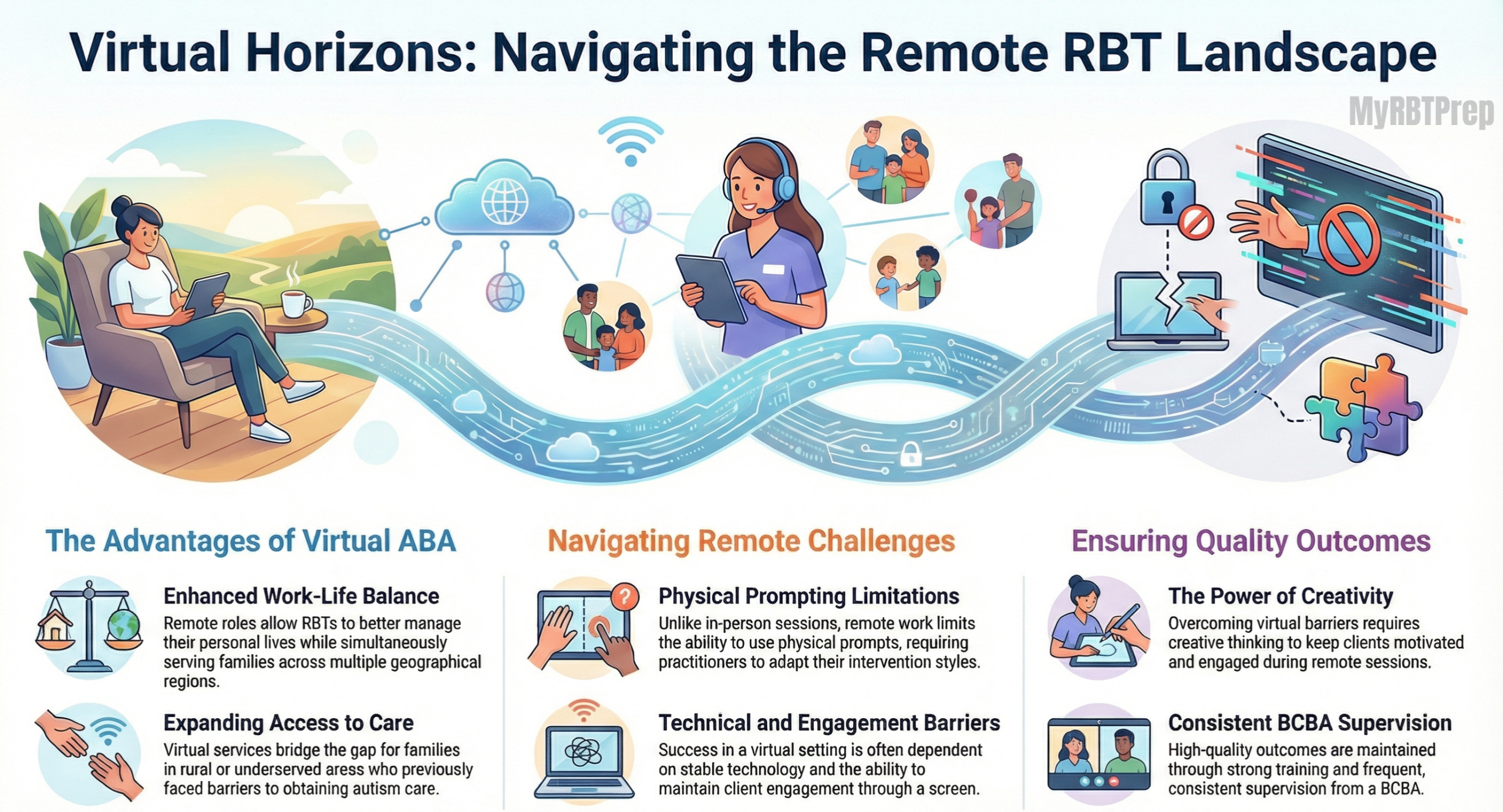
One major benefit is balance. You can balance work life as an RBT while serving families across multiple regions. Remote work also helps expand access to autism care, especially in rural or underserved areas.
Challenges exist as well. Limited physical prompting, technology issues, and engagement through screens require creativity. Strong training and consistent BCBA supervision remote help maintain high-quality outcomes.
Qualifications & Requirements for Remote RBT Positions
The certification path remains the same. You need a high school diploma, completion of a 40-hour RBT training course, a competency assessment, and a passing exam. Ethical practice remains essential.
State regulations vary for telehealth. Some states require additional registration. All providers must maintain HIPAA compliance online and follow telehealth guidelines.
| Requirement | Details |
| Education | High school diploma or equivalent |
| Training | Completion of 40-hour RBT training course |
| Assessment | Pass competency assessment to demonstrate skills |
| Certification | Pass RBT certification exam |
| Ethical Standards | Follow BACB ethical guidelines and professional conduct |
| State Regulations | Some states require additional telehealth registration or licensing |
| Privacy Compliance | Maintain HIPAA compliance online and adhere to telehealth policies |
| Ongoing Supervision | Continuous BCBA supervision remote to ensure proper service delivery |
Technology & Tools Needed for Successful Remote ABA Sessions

Reliable technology supports effective sessions. Secure video platforms protect client privacy. Data software helps track progress. Interactive tools keep children engaged. You must use telehealth platforms for ABA properly.
Most employers provide access to approved systems. You typically supply internet, a private workspace, and basic hardware. Backup options help avoid disruptions during autism telehealth services.
Salary, Pay Structure & Career Growth for Remote RBTs
Pay for remote autism therapy roles often matches in-person positions. Many professionals save money by eliminating commute costs. Some employers offer equipment stipends or flexible scheduling benefits.
Career growth remains strong. Remote experience builds leadership and communication skills. Many technicians advance toward BCBA roles while continuing applied behavior analysis careers.
| Aspect | Details |
| Salary Range | Comparable to in-person RBT roles; typically $18-$35/hour depending on experience and location |
| Cost Savings | Reduced commuting expenses, lower transportation costs, and fewer work-related expenses |
| Additional Benefits | Some employers provide equipment stipends, flexible scheduling, or professional development allowances |
| Career Growth | Remote autism therapy experience enhances leadership, communication, and clinical skills |
| Advancement Opportunities | Technicians often progress toward BCBA certification while continuing applied behavior analysis careers |
| Work-Life Balance | Flexibility supports better balance work life as an RBT and reduces burnout |
| Job Stability | Growing demand for remote RBT jobs ensures strong long-term employment prospects |
Remote RBT Jobs vs In-Person ABA Roles: Outcomes & Research
Studies show comparable outcomes between virtual and in-person ABA when services are delivered correctly. Children benefit from learning in familiar home environments.
Research published through the National Institutes of Health shows strong results for properly implemented telehealth ABA programs. You can explore this research at https://www.ncbi.nlm.nih.gov.
Best States & Companies Offering Legit Remote RBT Jobs
States such as California, Texas, Florida, Georgia, and Massachusetts show high demand. These regions support insurance coverage and telehealth-friendly policies.
Reputable companies never charge fees. They verify credentials and provide training. These signs help identify safe opportunities in remote RBT jobs.
| Category | Details |
| Top States for Remote RBT Jobs | California, Texas, Florida, Georgia, Massachusetts |
| State Advantages | Strong insurance coverage, telehealth-friendly regulations, high demand for ABA services |
| Company Criteria | Reputable companies verify credentials, provide training, and follow telehealth guidelines |
| Red Flags to Avoid | Employers charging upfront fees or not verifying qualifications |
| Opportunity Tips | Focus on providers with a solid reputation, clear job descriptions, and BCBA supervision |
| Job Security | Companies in high-demand states often have consistent caseloads and long-term positions |
| Professional Growth | Many employers offer remote autism therapy career development and advancement opportunities |
How to Find & Apply for Remote RBT Jobs Successfully

Healthcare job boards and LinkedIn remain effective search tools. Employers value experience with virtual ABA therapy and caregiver coaching. Resumes should highlight flexibility and technology comfort.
During interviews, ask about supervision, training, and support systems. Strong programs prepare you to support children with autism remotely with confidence.
How Remote RBT Jobs Improve Access to Autism Care Nationwide
Access to quality autism services has long depended on geography. Families in rural areas often wait months or travel hours for support. Remote RBT jobs are changing that reality in a meaningful way. By allowing therapy to happen virtually, services can reach homes that were once out of range. This shift directly supports children who would otherwise go without early intervention.
When you deliver ABA therapy remotely, sessions take place in the child’s natural environment. That setting helps skills transfer into daily life more smoothly. Parents also become more involved. They observe strategies in real time and apply them between sessions. This consistency strengthens outcomes and builds confidence at home.
Remote care also reduces cancellation rates. Families no longer struggle with transportation, weather, or scheduling conflicts. As a result, children receive more consistent support. That reliability matters deeply in behavior therapy, where repetition and routine drive progress.
From a workforce perspective, remote roles allow providers to serve multiple regions at once. One technician can support families across state lines when regulations allow. This flexibility helps address therapist shortages without sacrificing quality. Over time, this model creates a more balanced system where care follows need rather than location.
| Aspect | Details |
| Geographic Access | Remote RBT jobs allow therapy for families in rural or underserved areas, reducing travel time and wait periods |
| Service Delivery | Sessions occur in the child’s natural environment, supporting real-life skill generalization |
| Parent Involvement | Parents actively observe and implement strategies between sessions, increasing consistency and outcomes |
| Session Reliability | Virtual care reduces cancellations due to transportation, weather, or scheduling conflicts |
| Workforce Efficiency | Technicians can serve multiple regions at once, expanding access while addressing therapist shortages |
| Impact on Children | Children receive more consistent and timely autism telehealth services, enhancing learning and progress |
| Long-Term System Benefit | Remote delivery creates a balanced care system where services follow need rather than location |
| Professional Skills | Technicians gain experience managing virtual sessions, digital data collection, and caregiver coaching |
What a Typical Day Looks Like for a Work From Home RBT
A work from home RBT starts the day differently than a clinic-based technician. Instead of commuting, you prepare your workspace. You review session notes, behavior plans, and goals. Organization sets the tone for smooth sessions.
Sessions usually begin with a quick check-in with the caregiver. You explain the plan for the day and confirm materials are ready. During the session, you guide activities, reinforce behaviors, and track data live. Technology allows immediate feedback and adjustments. Breaks between sessions help maintain energy and focus.
Throughout the day, you communicate with your supervising BCBA. This may include quick messages, data reviews, or scheduled observations. Remote supervision often feels more intentional because it relies on clear communication and shared data. That structure supports clinical quality.
At the end of the day, documentation wraps up quickly since data is already digital. Many RBTs use this extra time for professional development or self-care. Without travel fatigue, you finish the day with more mental space. This rhythm supports long-term sustainability and helps prevent burnout in a demanding field.
How Remote RBT Experience Supports Long-Term Career Advancement

The job of a Remote RBT (Registered Behavior Technician) is not only beneficial in terms of flexibility, but it is also an opportunity to build a career in Applied Behavior Analysis (ABA). By working remotely, you will develop qualities that are highly regarded by employers: improved communication skills, greater ability to solve problems quickly and creatively, and an increased ability to develop creative solutions for providing services to individuals receiving ABA interventions.
One of the biggest benefits of working remotely as an RBT is the range of cases that you will have exposure to. Since most remote work includes telehealth, the opportunity to interact with family members from different regions and backgrounds exposes you to many various clinical situations. A greater depth of clinical experience will assist with your transition into higher level roles, as well as increase your cultural understanding and competence, which is becoming increasingly important in the health care field.
Remote RBT positions fit well with graduate school programs. The flexibility of remote RBT positions makes it easier to attend classes while working towards your BCBA (Board Certified Behavior Analyst) certification. Many technicians find that they can balance their workload and coursework easier without commuting every day. Therefore, the amount of time it takes to attain certification is shortened.
Most professionals also experience improved quality of supervision as they transition to remote work. Technology allows for the provision of immediate, accurate feedback, as well as the opportunity to review recordings of sessions and thoroughly analyze collected data. Over time, remote RBTs have the ability to develop considerable leadership potential.
As telehealth continues to grow, the experience gained through providing remote services will become a major advantage in the job market. Employers are looking for professionals who are able to navigate both the clinical standards with which they need to be compliant, as well as the digital care model used to provide telehealth. Thus, working as a Remote RBT is not only a more convenient way to earn a living, but it is also a thoughtful way to move forward in your career.
| Aspect | Details |
| Skill Development | Working remotely improves communication skills, problem-solving, and creative service delivery strategies |
| Clinical Exposure | Interaction with diverse families across regions increases clinical experience, cultural competence, and adaptability |
| Graduate School Compatibility | Flexibility allows technicians to balance work with coursework for BCBA certification, reducing time to certification |
| Supervision Quality | Technology enables immediate feedback, review of session recordings, and thorough analysis of collected data |
| Leadership Opportunities | Remote work fosters leadership skills and prepares technicians for advanced ABA roles |
| Telehealth Advantage | Experience in autism telehealth services makes professionals attractive to employers in growing digital care models |
| Career Advancement | Remote RBT experience strengthens long-term applied behavior analysis careers and future opportunities |
| Work-Life Balance | Flexibility reduces commuting, supports professional growth, and balance work life as an RBT |
Final Thoughts
The future of ABA is flexible and family-centered. Work from home opportunities allow professionals to grow while supporting families nationwide. Remote care is not a shortcut. It is a thoughtful evolution in how therapy reaches those who need it most.
FAQs
Can I work from home as an RBT?
Yes, you can work from home as an RBT if you are certified and employed by a provider offering telehealth services. You deliver ABA sessions virtually while receiving remote BCBA supervision.
What is the easiest remote job to get?
Remote RBT roles are among the easiest clinical telehealth jobs to access if you already hold certification. Demand is high, training is standardized, and many providers actively hire nationwide.
What is the best RBT training online?
The best online RBT training programs are BACB-approved and offer clear instruction, practice scenarios, and exam preparation. Reputable ABA organizations and universities often provide these courses.
What is the highest paid RBT?
The highest paid RBTs typically work in high-demand states, take complex cases, or specialize in telehealth services. Experienced RBTs can earn higher hourly rates and additional stipends.
Are RBTs in high demand?
Yes, RBTs are in very high demand across the U.S. Rising autism diagnoses, insurance coverage, and telehealth expansion continue to drive strong job growth.